
I Stopped Forcing My Kid to Share His New Toy. The Playground Got Calmer.
A fight over an electric excavator taught me the difference between sharing and giving up what belongs to you.
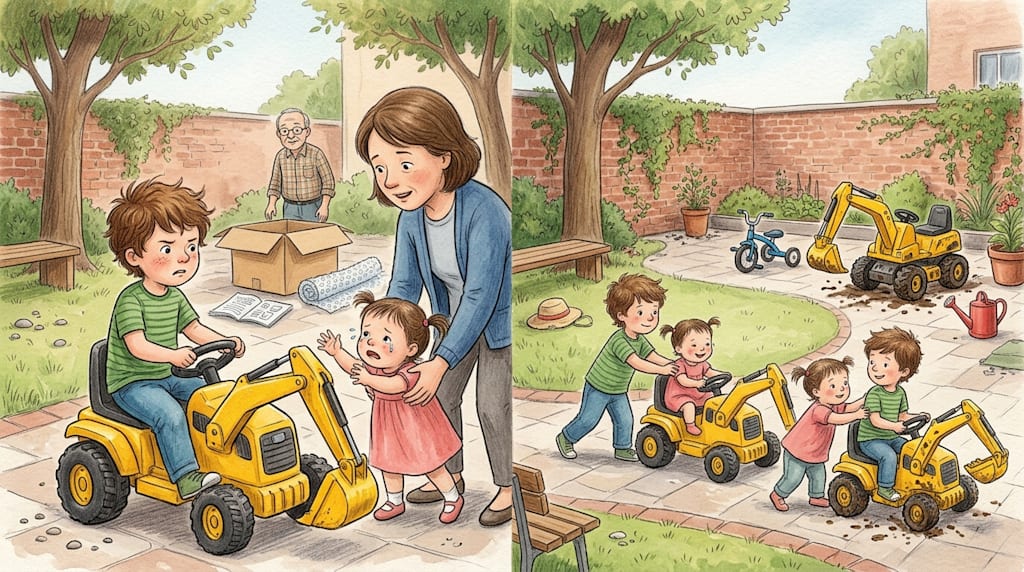
Grandpa’s delivery box wasn’t fully open before three little heads crowded the doorway.
Inside was an electric toy excavator. Hanghang spotted it first and rushed over with one shoe half on. Yiyi and the other child followed, hands on Grandpa’s legs, standing on tiptoe.
When the toy was assembled, Hanghang sat on it and gripped the steering wheel. Yiyi grabbed the front. The other child tried to climb up from the side. Hanghang panicked, one hand guarding the toy, the other raised to hit.
Grandpa’s voice came from behind: “How can you hit your little sister? Let her ride it. You have to share. You can’t be selfish...”
We stopped him before he finished.
Hitting needed to stop. But “You’re the older brother, you have to give in” and “You can’t be selfish” came too early. It was Hanghang’s new toy. The battery wasn’t charged. He hadn’t had a single ride.
Yiyi didn’t get on. No reasoning reached her. She pulled free and rushed to grab it again. I picked her up and carried her away. She kicked, cried, and made enough noise for the whole alley.
I didn’t lose my temper. A child sees a new toy and thinks, “I want to ride it first.” That is normal. They don’t yet understand “This belongs to someone else,” “We take turns,” or “We wait.” Crying isn’t bad behavior. It means they haven’t learned another way to say it.
When her crying slowed, I said: “Baby, this is brother’s new car. Brother rides first. Later you and your sister can take turns. When you get a new toy or a new car, don’t you also not want to share it right away? Brother feels the same. We wait until brother is willing to share. For now, we can ride the wiggle car or the scooter. When brother is ready, we’ll go on the excavator.”
Yiyi sniffled. She stopped pulling toward the excavator. She looked at the wiggle car in the corner and went to sit on it.
Later, Hanghang’s excitement faded. He got off and called to the others: “You sit. I’ll push you.” The three children took turns, two laps each. When the two laps were up, the child on the toy didn’t want to get off. We picked them up one by one. Crying didn’t change the rule. Two laps meant two laps.
By the time the excavator battery died, I had my rule: don’t rush to tell a child to give in. Respect the child first. Respect his reluctance to part with a new toy. Respect his normal wish to play with it first. Respect his right to decide what happens to his own things. If he shares, good. If he isn’t ready, don’t force him. Not wanting to share a new toy right away is not selfishness. It is ordinary human behavior. Adults don’t hand over a new phone the moment they open the box.
Many parents tie sharing to being sensible and not sharing to being selfish. But sharing should rest on willingness. If a child has no say over his belongings and is still expected to be generous, he may learn “My feelings don’t matter” or “The adult’s face matters more than my things.” Over time, he may become a people-pleaser or guard his things even harder.
That doesn’t mean grabbing and hitting get a pass. Respect for ownership does not mean allowing a fight. The new toy belongs to Hanghang. He can ride first. When he raises a hand to hit, stop him: “You can say ‘I’m not done playing,’ but you cannot hit your sister.” Don’t call him selfish. Set a limit on the behavior. With Yiyi: “This is brother’s new car. Brother rides first. You can ask, ‘When you’re done, can I have two laps?’”
Sharing is what happens when the child is willing. Taking turns is a rule everyone follows. Don’t mix them.
I also don’t agree with public criticism from an older family member. The child doesn’t hear “I need to learn to take turns.” He hears “My new toy doesn’t belong to me” and “The moment I’m happy, I get called selfish.” Grandpa needs face. So does the child. I can say privately, “Dad, let Hanghang play for a while. When he’s less excited, then guide him to share. Don’t call him selfish right away.” Stop the public label, not Grandpa’s love.
Then there is the harder test: other people’s children.
We often run into a child who wants every toy he sees. If he doesn’t get it, he waits until adults look away and pushes a smaller child. He never shares his own toys. Yiyi touched his scooter once, and he moved it away even though he was already playing with our Little Flyer toy.
This has happened more than once. Many parents who meet at the playground complain about him. No one calls him selfish to his face. He is a child, and someone else’s child.
My approach: don’t complain about him in public. Don’t attack someone else’s child. Protect my child’s boundary. When Yiyi wants his toy and I see his fierce face, I find something else: “Come on, let’s go see the dog over there.” I take her to play elsewhere. I don’t spend time judging him. Every family draws the line in a different place, and I have my own child to watch. I can comfort my child without attacking someone else’s. If the other child really hurts a smaller child, an adult should stop the behavior, not just pull their own child away.
So when children grab toys and refuse to share, my order is this.
Respect ownership first. Whose toy it is, that child has the first say. This matters most with a new toy. Don’t force a child to give it up so adults can be polite.
Then deal with the feeling. Crying and hurt are normal. Pick the child up. Comfort first. Don’t lecture while the crying is loudest.
Then set the behavior limit. You can refuse to share. You cannot hit or grab. You can say “I’m not done.” You cannot use crying to force someone else to give in.
Then give a rule everyone can follow. “Brother rides first. Later we take turns. Two laps each.” Say it early. Enforce it calmly. Stay with a crying child, but don’t change the rule because of tears.
Then guide sharing instead of forcing it. Ask, “Do you want to let your sister have two laps?” If yes, good. If no, respect it. When the new toy loses its shine, show him that playing together can be fun too.
What I want my children to learn is simple: My things are mine to decide. Other people’s things must be respected. I can share, but I cannot grab. If we agree to take turns, we follow the rule. That lesson takes longer than “give in.” It also holds up better when I am not in the room.
That afternoon, the excavator ran out of battery and sat in the corner. The three children squatted beside it, poking mud off the wheels with twigs. Yiyi looked back at me, pointed at the toy, and said, “Brother’s.”
Then she went back to the mud.
I didn’t say anything. She understood.
About the Creator
Jin
Writer of reamstories
https://reamstories.com/jin
Enjoyed the story? Support the Creator.
Subscribe for free to receive all their stories in your feed. You could also become a paid subscriber, letting them know you appreciate their work.
Comments
There are no comments for this story
Be the first to respond and start the conversation.