
I Grew Up Talking to Air
What my parents' silence taught me about reading the room, and why I'm still unlearning it
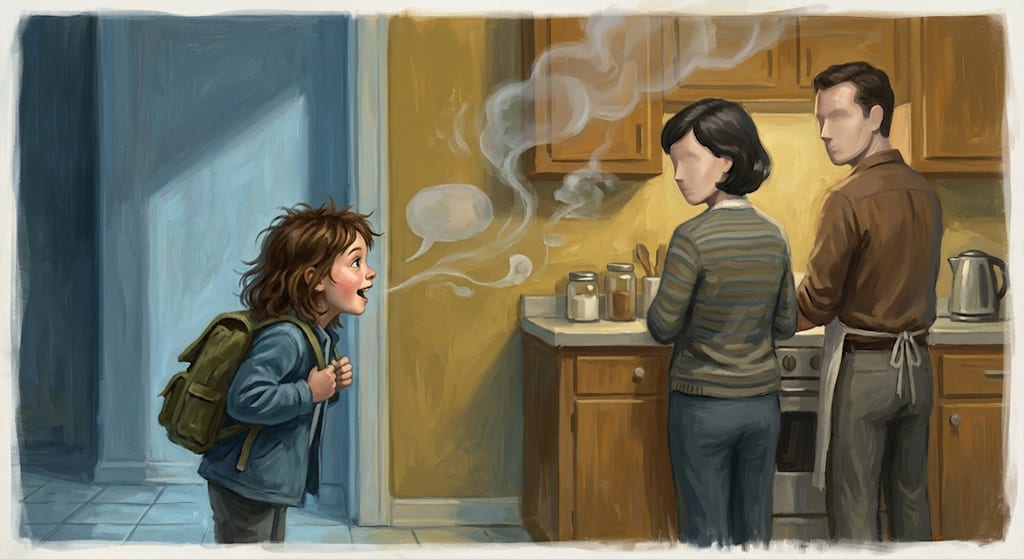
When I was little, nothing hurt more than this. I would be bubbling with excitement about something, school, a book, something I'd seen, and I would tell them, and they would listen, and then there would be no reaction at all.
School life, for example. Something I'd read. A cat stuck up a tree on the way home, and in the end the fire brigade had to bring a ladder and get it down. I'd come home with my schoolbag on my back, my whole day bundled up inside me like a live bird. I'd go to the kitchen door. My mother would be chopping vegetables. I'd start talking. I talked hard, afraid of leaving out a single detail, afraid she wouldn't be able to tell how interesting this was. She finished the potatoes and started on the spring onions. I finished. She didn't look up. She said, "Put your bag away and wash your hands for dinner."
My father was about the same. I'd sit on the sofa and tell him how my deskmate had been caught eating spicy gluten strips in class. He'd stare at the TV and, when the ads came on, give a "mm." That "mm" dropped down like a stone into a well. You wait for the echo. The bottom of the well is dry.
It felt like talking to yourself in an empty room, with not even an echo. You stand there, your mouth still open, not knowing whether you should swallow the rest of what you were going to say. You start examining yourself: Where exactly did I go wrong? Was it my tone? What I said? The timing? Why didn't Mom and Dad react? Was I too boring? Should I not have spoken then? Is there something about me that doesn't deserve to be listened to?
Silence doesn't give you an answer. Silence only gives you a blank wall to walk into.
After I left my parents' home, I learned what normal people's conversation is like. With a topic, you can like it, you can disagree with it, you can also not be interested and say, Let's talk about something else. You can laugh, frown, say "I don't get it, tell me more," or say "I'm really tired today, I don't want to talk about this." I think all of that is normal. Normal isn't "you have to respond enthusiastically to every sentence I say." Normal is "you treat me as a person who is speaking." But when one person is talking and the person across from them has no reaction at all, it feels like you're talking to air. And for a child, that feeling is terrifying. Because air won't tell you what you did wrong; air will only make you feel that you, as a whole, are superfluous.
This is also why, over the years, I kept polishing one skill until I maxed it out: reading the air.
After a few sentences with a stranger, I instinctively know what they like, what they don't want to hear, and what tone and manner I should use to say what I want to say. I know when to stop, when to laugh, when to hand the topic over, when to shrink back. If I'm going to tell someone something, before I open my mouth I've already organized the whole thing: which sentence first, where to pause, which detail to enlarge, which punchline to save for last. How to present it in the most interesting way, so everyone finds it most interesting. Many friends have said the same thing: tell the same story, and I make it funnier than they do.
They don't know what this skill cost me. I was so eager for other people's responses. I was so afraid that what I said would bore them. So whenever I opened my mouth, I had to bring out my best expression and earn their response with great eagerness. I turned an ordinary act of sharing into a carefully prepared performance. I stood onstage, watching every expression, adjusting my tone and rhythm at any moment. As long as someone laughed, nodded, asked "and then?", I felt safe. But if the other person didn't react, I would immediately go back to that empty room, back to the child standing at the kitchen door with her schoolbag.
As an adult, two kinds of people shock me the most.
The first kind babbles on and on, saying a great deal of nonsense, and even when everyone around them has stopped listening, they can still finish what they were saying. I had a roommate in college. Once, in the cafeteria, he told us about his high-school sports meet and the 3,000-meter race, about how he was overtaken by three people on the last lap. The other three of us had already finished eating and started scrolling on our phones. He was still talking. When he finished, he laughed at himself and said, "Anyway, pretty dumb," and went back to his food. No one picked up the thread. He didn't need anyone to.
The second kind gets interrupted, the conversation moves on to something else, and they can still say firmly, "No, listen to me, I haven't finished." I once saw a colleague do this in a meeting. Someone had already steered the topic to the quarterly budget, and he waited for that person to finish, then said, "I wasn't done with what I was saying," and talked for another five minutes.
Both kinds of people make me envious. I think their families must have given them so much security that they can be this self-centered, this willing to share themselves, without caring whether other people want to listen. They seem to assume one thing: I speak because I want to speak; whether you listen is your business, but I won't decide that I shouldn't speak just because you don't listen. They don't read the air first. They just speak. They don't make "whether other people respond" the precondition for "whether I have the right to speak."
I remember one year I went with my best friend to her hometown in Jiangxi. It was the first time I saw how another mother and daughter lived together.
Her mother asked at the dinner table when on earth she was going to find a boyfriend. She said, "None of your business." Her mother slammed down her chopsticks so hard that the rib on my chopsticks fell into the soup. Her mother started yelling: you're thirty and you're not anxious, the kid next door is old enough to run errands for his parents. My friend stood up immediately, banged her bowl on the table, and yelled back. She said, Weren't you thirty when you got married? Now you're rushing me. Her mother said, That's different. No one was managing me back then. She said, Then don't manage me now. They tore open each other's scars, one sentence uglier than the last. I sat there, scared, gnawing on a rib and watching. And I noticed that as they yelled, her mother suddenly said, "I'm afraid that later you'll be alone and no one will take care of you." My friend froze. Her voice dropped. She said, "It's not that I won't look. I just don't want to settle." Her mother said, "Then go look." She said, "I'm not looking. It's annoying." Her mother said, "Fine, don't look. Drink your soup first."
When the fight was over, one went to wash dishes and the other to mop the floor. That night I heard them laughing in the living room, I don't know about what, giggling away.
This is what I envied. Not the yelling. What I envied was the confidence between them: "If I say it, you will catch it." Even if the way you catch it is by slamming chopsticks, yelling back, tearing open old wounds, at least they didn't use silence to turn each other into air. Their emotions collided, loudly, but after the collision the relationship was still there. That is communication with back-and-forth. The silence I knew was worse than disagreement. It said: you are not worth responding to. For a child who hasn't yet built a mature view of life, that is a hard blow.
The psychoanalyst Winnicott proposed a concept called mirroring. How does a child confirm "I exist, I have value"? Through the parents' face. When a child shares something excitedly, whether the parents smile, praise, or even frown and argue, it is a mirror that reacts. The child can see herself in the mirror. She sees that she is here, that her feelings have weight.
My parents' lack of reaction set up a dead mirror, a black hole.
In psychology there is the Still-Face Experiment. A mother sits across from her baby. First she interacts normally: smiling, talking, pointing at things. The baby smiles and babbles back. Then the mother suddenly lets her face go blank, with no expression at all. The baby first keeps smiling, reaches for her mother, makes sounds. The mother still doesn't react. The baby starts squirming and screaming, then collapses into crying. The whole process takes less than three minutes. For a child, "talking to air" is terrifying because it sends a signal into the unconscious: You are transparent. Your feelings are meaningless. You don't even deserve my attention. A child cannot refute this signal. She doesn't yet have the language to say, "No, that's not true." She can only swallow it, and it turns into doubt about herself.
For decades, to escape the fear of "being treated as air," I was forced to learn to read the air. By chance, I became an interesting storyteller. But only I know that I have rarely enjoyed the pleasure of expressing myself. I spent ninety-nine percent of my energy making sure the other person liked my expression. I told stories in order to watch for the reaction. The telling was secondary. I was like an actor constantly watching the audience. Only when the audience laughed could I breathe; when the audience's attention drifted, I felt the whole play had failed.
I have never fully experienced this: even if what I say isn't interesting enough, I still deserve to be taken seriously.
My heart aches for that seven- or eight-year-old child. She comes home excited, schoolbag on her back, but hovers at the door, rehearsing over and over how to chat with her parents so she can get their attention, trade for a little response. She stands at the door, the strap of her schoolbag wrapped twice around her finger. In her mind she smiles first, testing whether the smile looks natural. Then she thinks of the first sentence, the second sentence, and how she should respond if they say "not now." She is so small, and she has already learned to change "I want to say" into "how should I say it." She wants so much to share, but she has learned to observe first. She stands at the door as if before a dead mirror, preparing her expression and her words, bracing for the response.
I want to go back and tell her: "Even if what you say today is a pile of completely illogical nonsense, even if it isn't funny at all, I am still very willing to listen to you."
I am practicing now, slowly. Practicing not rehearsing everything in my head before I speak. Last week I was having dinner with a friend, and I told her something I'd seen on the street. I stumbled. In the middle I forgot what color shirt the person was wearing and got stuck for two seconds. My friend said, "And then?" So I went on. When I finished, she laughed a little and said, "What a weird person." I said, "Yeah." Then we kept eating. On my way home after dinner, I realized: while I was talking, I hadn't checked her face first.
I am practicing separating silence from rejection: he didn't speak, and that doesn't mean I'm not worth it. He drifted off, and that doesn't mean my feelings are meaningless. I am practicing moving closer to people who ask "and then?", who frown, who disagree, who say "I'm not interested in this, but go on." I am also practicing mirroring myself a little: I say these things because I want to be seen, and that is reasonable. When I say nonsense, I am still here. My feelings have weight. I don't have to turn myself into a brilliant performance first before I deserve a face that listens to me seriously.
That child hovering at the door: I am willing to listen to her now. Even if she talks in a mess and tells the same detail three times. I will look at her and tell her: Go on. I'm here.
About the Creator
Jin
Writer of reamstories
https://reamstories.com/jin
Enjoyed the story? Support the Creator.
Subscribe for free to receive all their stories in your feed. You could also become a paid subscriber, letting them know you appreciate their work.
Comments
There are no comments for this story
Be the first to respond and start the conversation.