
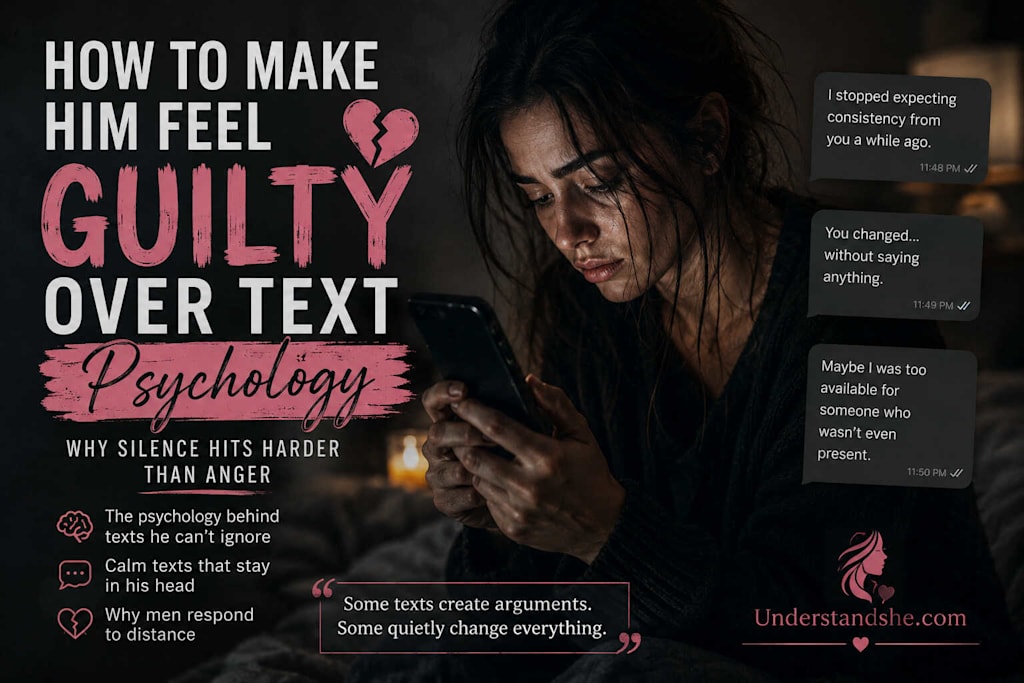
How To Make Him Feel Guilty Over Text Psychology (Why Silence Hits Harder Than Anger)
Most women think emotional intensity creates emotional impact. Usually it does the opposite.

You know that thing where you type out a whole paragraph and then delete it? Not because you’re scared. Because you already know how he’s going to read it. Or not read it. You sit there with your thumb hovering over send, rereading what you wrote, wondering if “I just feel like you don’t care anymore” sounds too heavy, or if it’s too light, or if he’s even going to reply with more than “that’s not true” or some dry variation of “you’re overthinking.”
And then sometimes you send it anyway. The paragraph. The one with all the feelings laid out in chronological order, with receipts from last Tuesday, with the screenshot of when he said he’d call and didn’t. You send it because some part of you still believes that if you just explain it clearly enough if you find the right combination of words he’ll finally feel it. The thing you’ve been feeling for weeks. The slow drift. The quiet replacement of you with everything else.
But he doesn’t. Or he replies three hours later with “I’m sorry you feel that way.” Or he goes offline. Or he sends a thumbs up. And you sit there feeling like you just screamed into a room and someone closed the door.
That’s the part nobody really talks about. It’s not that he doesn’t understand you’re hurt. It’s that your hurt has become predictable. And predictable emotion stops landing after a while.
There’s a weird thing that happens in texting when someone starts pulling away. At first, you notice the small stuff. He used to send voice notes. Now it’s one-word answers. He used to ask questions. Now he reacts to your story with a flame emoji and calls that a conversation. You used to talk until sleep. Now he disappears mid-sentence and reappears twelve hours later like the conversation never had a heartbeat.
So you adapt. You start sending more to get less. You explain more because he’s explaining less. You become the emotional engine of the conversation, dragging it forward with paragraphs, with “can we talk,” with “I feel like something’s off.” You think the intensity will wake him up. That if you just feel big enough, he’ll match it. That if you make him feel guilty through text, he’ll finally understand the weight of what he’s doing.
But here’s what actually happens. He starts skimming. Not because he’s evil. Because human brains check out when emotion becomes repetitive noise. When every notification from you carries the same frequency hurt, accusation, need, explanation he stops hearing the specifics. He just hears pressure. And pressure makes people retreat. Not because they don’t care. Because they don’t know what to do with the volume, so they mute it.
The texts that actually stay in his head are rarely the ones written at 2am with crying emojis and seven screenshots. Those get read once, maybe twice, then buried under the guilt of not knowing how to respond. What stays is the unexpected quiet. The moment when you stop performing your hurt and simply let it exist without asking him to fix it.

That’s the real psychology. Not manipulation. Just emotional contrast. He got used to your noise. Your silence becomes the thing he can’t predict.
Think about the last time someone was genuinely disappointed in you not angry, not loud, just quietly done. Remember how that sat in your stomach? Anger you can argue with. Disappointment you have to sit with. It has no door to exit through. That’s why calm texts after emotional distance hit differently. They don’t give him a fight to win or lose. They give him a mirror.
When you flood him with emotion, he gets to play a role. The defender. The apologizer. The guy who “didn’t mean it like that.” It’s a script. But when you stop sending the script when you send something calm, observational, almost resigned there’s no role for him to step into. He just has to absorb what you said without the drama to distract from it.
Silence does something specific in texting psychology. In person, silence is awkward and immediate. Over text, silence is a vacuum he fills with his own thoughts. When you stop initiating, when you stop double-texting, when you stop reacting to his stories or accepting his random late-night returns, he doesn’t have you to bounce off anymore. He has to face the space you left. And most men don’t start missing your presence because you told them to. They start noticing it when your emotional availability is no longer there to absorb their inconsistency.
That’s the delayed part. The realization that doesn’t come during your paragraph. It comes two weeks later when he texts “you up?” and you don’t reply for three hours. Or you do reply, but it’s dry, final, not angry just gone. That’s when he rereads the old messages. That’s when he sees the shift. Not because you performed it for him, but because you stopped performing altogether.
It’s not about making him feel guilty over text as a strategy. It’s about understanding that guilt is often a byproduct of absence, not accusation. When you’re always there, always explaining, always available, there’s no room for him to feel the lack of you. You have to actually become absent for the absence to register.
There’s a difference between emotional control and emotional suppression. Suppression is pretending you’re fine. Control is deciding what deserves your energy. The women who get stuck in these texting loops aren’t too emotional. They’re too available with their emotion. They keep offering it to someone who’s stopped reaching for it, hoping the offering itself will remind him to want it again.
But emotional texting psychology works more like water. If you keep pouring into a cup that’s tipped over, you’re just making a mess. The cup has to be upright. And sometimes the only way to show someone the cup is tipped is to stop pouring and let them notice the puddle themselves.
Left on read stops hurting as much when you stop checking if he’s online. Dry replies stop feeling like rejection when you stop sending messages that require real replies. Random late-night returns stop feeling like hope when you stop being awake for them. It’s not a game. It’s just the physics of attention. You can’t make someone feel the weight of your absence while you’re still sitting in their inbox, holding the door open.
Here are the kinds of texts that actually land. Not because they’re clever. Because they’re true. And because they don’t ask him to do anything except hear them.
“I stopped expecting consistency from you a while ago.”
There’s no demand in this. No question mark. Nothing for him to explain away. It just states a fact about your internal timeline. It tells him you’ve been adjusting to his absence without announcing it. That’s what makes it heavy. He thought you were still waiting. You’re telling him you stopped.
“You changed without saying anything.”
Simple. Almost too simple. But it names the thing he probably hoped you wouldn’t notice, or at least wouldn’t name out loud. It’s not an attack. It’s an observation from someone who was paying attention while he was changing the rules.
“I think I got tired of explaining the same hurt.”
This one is exhausted in a very specific way. It’s not angry. It’s finished. It tells him that your emotional labor has a limit, and he reached it without knowing because he wasn’t keeping track. That’s a specific kind of guilt. The kind that comes from realizing someone carried something alone until they couldn’t anymore.
“I used to reread our conversations to understand what I said wrong. Now I don’t.”
This is the kind of text that makes him imagine you doing that. Rereading. Searching. Trying to find the moment. It makes your past effort visible without asking for credit. And the “now I don’t” lands like a door closing. Not slammed. Just closed.
“Your replies got shorter and I kept making excuses for it.”
Again, observational. You’re not blaming him for having short replies. You’re admitting what you did with them. You performed the emotional labor of justification so he wouldn’t have to. And now you’re stopping. That’s what he feels. The removal of your excuses for him.
“You only text when you’re bored and I convinced myself that meant something.”
This one hurts because it’s honest about your own participation. You’re not just calling him out. You’re calling out the version of you that accepted crumbs because they looked like bread from far away. It’s self-aware without being self-deprecating. It just names the pattern.
“I don’t need an explanation anymore. I just needed you to be honest when it mattered.”
This is the unfinished one. The text that doesn’t end with “but it’s fine” or “I forgive you.” It just hangs there. It tells him the window closed while he was deciding whether to walk through it. That’s a specific kind of loss. The kind he can’t fix with a late-night paragraph of his own.
These are emotional texts that stay in his head not because they’re dramatic, but because they’re undramatic in a way that feels final. They don’t give him an argument. They give him a truth he has to carry without your help.
Most women think emotional intensity creates emotional impact. Usually it does the opposite. The texts that stay in his head are usually the calmer ones the ones written after the storm, when you’re not trying to win anything, you’re just stating what happened to you. I explained that more deeply here, with more on why romantic text to make him feel guilty for hurting you works better when it comes from emotional accuracy instead of emotional flooding:
It’s not about crafting the perfect sentence to destroy him. It’s about finally saying the true thing without worrying if he’s ready to hear it.
Here is the part that’s hard to accept. Guilt does not always create change. Some men feel guilty privately and still do nothing. They sit with it, they reread your messages, they feel the weight of your calm disappointment, and they still don’t reach out with anything real. They just carry it like a bruise they don’t touch.
Some return because they miss access, not because they feel remorse. They come back when your silence starts to feel like a locked door, and they want to see if you’ll open it again. Not because they want to fix what broke. Because they want to stop feeling excluded from your attention. That’s not healing. That’s ego.
Some only notice your pain after your emotional availability disappears completely. When you’re still explaining, they’re still defending. When you’re gone, they finally see the shape of what they lost. But by then, you might not want it back. And that’s the delayed realization that hurts both sides you wanted him to see it when it mattered, and he only saw it when it was over.
And some people understand your pain too late. They reread your calm text three months later and finally get it. But three months later, you’ve already stopped rereading their replies. The timing is the tragedy. Not the text. Not the intent. Just the lag between your hurt and his recognition of it.
That’s why this isn’t about how to make him feel guilty over text as a tool for getting him back. It’s about understanding that your emotional energy is finite, and at some point, the text becomes a record of your clarity, not a request for his.
Some conversations do not end after one text. Sometimes you keep reopening the same chat for weeks trying to understand what changed. You scroll up to when he used to sound different. You compare timestamps. You look for the exact message where the temperature dropped. It becomes a kind of forensic grief, trying to solve a case where the only suspect is someone’s fading interest.
If you’ve been living in that loop analyzing dry replies, decoding ghosting behavior, wondering why he only texts at night, trying to find the calm texts that actually land instead of the ones that get ignored there’s a reason it all starts to feel like the same exhausting pattern. The psychology behind it repeats.
The late-night texting patterns, the sudden distance, the way calm disappointment cuts deeper than anger it’s all connected. I put together something that walks through the real emotional texting psychology behind all of it, including the calm texts that emotionally stay with men and why men respond to silence only after emotional noise stops. You can find it here:
It’s not about getting him back. It’s about finally understanding what you’ve been participating in, so you can write the text that frees you instead of the one that waits for him.
You will probably still type and delete. You will still check his online status without meaning to. You will still have nights where you want to send the paragraph that explains everything, where you believe that if you just say it right, he’ll finally feel what you felt.
But the truth is, some people feel guilty and still do nothing. Some conversations quietly die not because nobody cared, but because only one person was keeping them alive. Some texts are written for closure, not replies. You send them because you need to say the true thing out loud, not because you need him to validate it.
The text that makes him realize he hurt you isn’t the one that hurts the most. It’s the one that sounds like you stopped trying to make him understand. It’s the one that reads like someone who finally saw the situation clearly and decided to stop performing their own neglect.
And sometimes, the most powerful thing you can send is nothing at all. Not as a strategy. Just as the honest result of having nothing left to explain to someone who stopped asking.
About the Creator
Understandshe
I write about healing, self-growth, and the messy but beautiful journey of becoming. Honest lessons, real stories, and gentle insights you’ll also find on UnderstandShe.
Enjoyed the story? Support the Creator.
Subscribe for free to receive all their stories in your feed.
Comments
There are no comments for this story
Be the first to respond and start the conversation.