
Every Day a Choice: How Pumping Breast Milk Empowered Breanna Seibel to Transform Grief into Strength
Written by: Marci Hughes Published: December 18, 2024


As Told by Breanna Seibel, RN, Lactation Expert
After facing infertility and the heartbreaking loss of her son, Breanna Seibel turned to breastfeeding as a way to nurture her daughter and reclaim a sense of control amidst chaos. With practical advice on pumping, maintaining milk supply, and the significance of milk bank donations, she emphasizes the power of breastfeeding in supporting vulnerable infants.
Now a nursing professional, Breanna is dedicated to sharing her lactation knowledge and empowering other parents through her 200,000 and growing TikTok channel.
Breanna and her husband married in 2017, eager to start a family. However, their path soon led them through a series of infertility treatments — Letrozole, Clomid, and IUI — until they received the life changing news that Breanna was pregnant with twins. Everything seemed perfect, with all health indicators pointing toward a smooth pregnancy.
But around 20 weeks, Breanna began experiencing unexplainable back pain. Initially dismissed as typical pregnancy discomfort, her pain grew worse, culminating in an early and traumatic labor experience at just 23 weeks. Delivered at 24 weeks, her twins, Teddy and Viviana, entered the world at a critical stage.
While both began their fight in the NICU, Breanna’s family faced the unimaginable loss of their son Teddy, a tragedy that unfolded unexpectedly. Through it all, Breanna found strength in small, tender acts of motherhood — like pumping breast milk — and focused on Viviana’s fight for survival, against the odds. Now, after completing her nursing degree amidst this journey, she reflects on her time in the NICU, the lactation community she has cultivated, and her life as an ER nurse at the very hospital where her journey unfolded.
Breanna Seibel’s journey to motherhood is a powerful testament to resilience and strength. In our latest All Things Conceivable podcast episode, she shares her deeply emotional path to parenthood and how her pumping journey for her daughter became a source of healing after the heartbreaking loss of her son, Teddy.
🎧 Listen to Breanna’s full podcast episode!
NF: During such an incredibly difficult time, you not only finished nursing school, you began your breastfeeding journey to nurture Viviana — with every drop holding so much meaning. How did that journey shape you?
BS: I took my final nursing exam just a couple days after my son died. I thankfully passed. The only thing other than homework that I could do was pump breastmilk. It was the only thing that I had control over. Because of the stress, the trauma, because they were born so early, and I was a first time mom, I couldn’t produce a lot of milk. I remember when I was in the postpartum room, I’d get one drop and we’d put it on a Q-tip. My husband would sprint down to the NICU so that they could do their oral care with it.
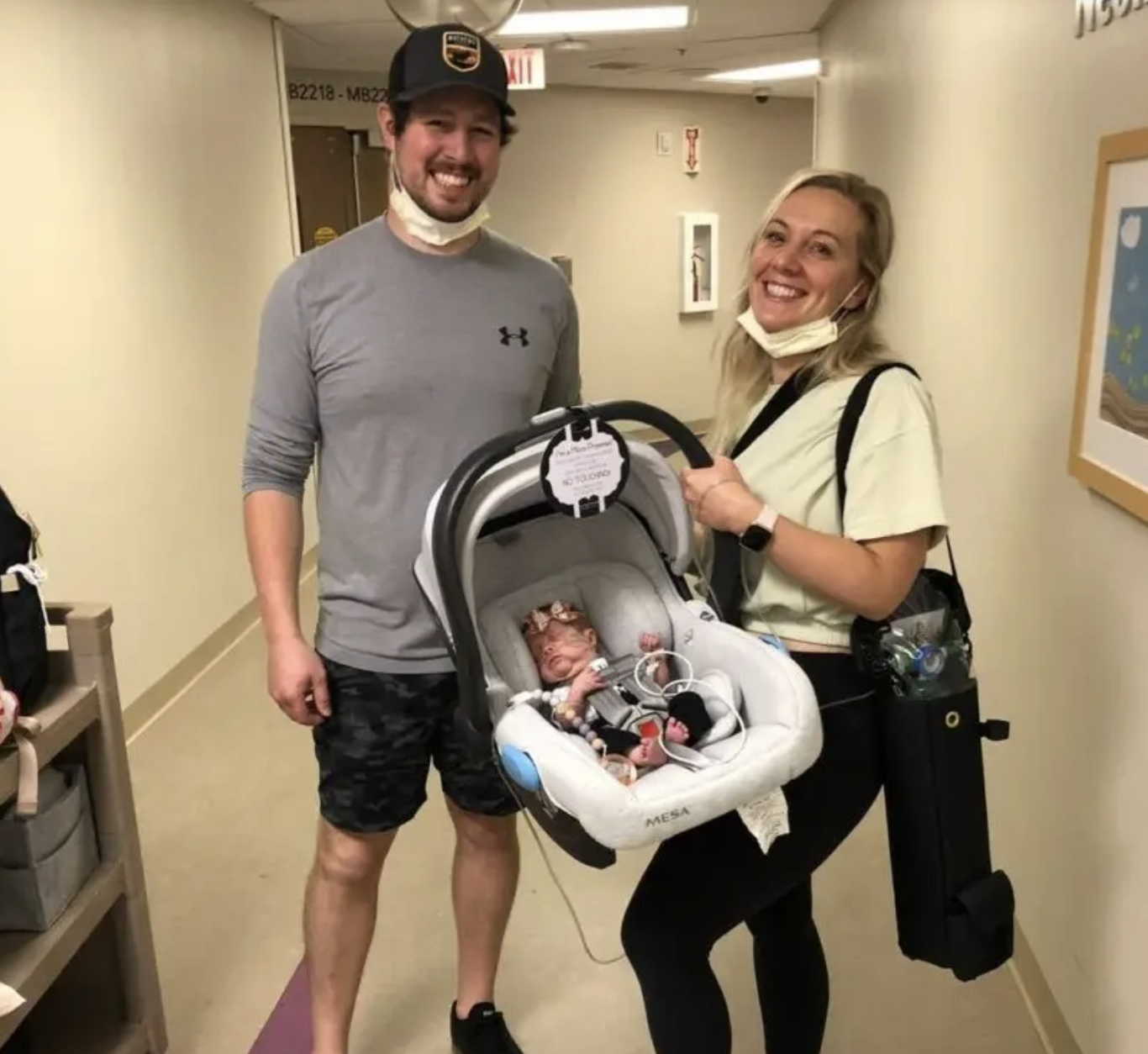
It felt like the only thing that we could do as parents. Viviana got to be on this product called Prolacta, which is made from breast milk donations. With that and the help of Teddy from above, she started gaining weight. She was able to get her heart fixed. She was one of the smallest babies that they had ever done the surgery on.
We finally made it home. She came home below the first percentile. After working at home, she popped up to the 50th percentile. She is now a normal 2-year-old. We were told she might not ever walk, talk, eat, or breathe on her own because of her brain bleeds, but she does all of those things and we are so incredibly blessed.
We had a lot of healing to do. I graduated from nursing school. I now work in the ER at the hospital that I delivered at, where I lost my son, where we stayed for 101 days, and where I finished nursing school.
NF: For all the parents who might be listening who are navigating this kind of unimaginable grief and loss, what would you like to share with them about moving through the pain?
BS: I kept thinking I would never want my child (in heaven or living) thinking that I didn’t pursue my dreams because of them. I would never want them to think that because they were born early, they ruined my life or the grief overtook their mom. I would never want them to think that way or feel that way.
You have a choice every single day. When you get up, you can choose to do what you can and control what you can control and put your trust in faith over fear. Or, you can choose to let the negative things in life and grief overtake you. It is a choice every single day, and it’s still a choice that we make every single day. It’s not always easy. Some days are better than others, but it truly is a choice, and every single person has the ability and has the power to choose to be happy and to choose to find the good in even the worst situations.
NF: How has sharing your deeply personal story on TikTok been helped you?
BS: One way I found healing was by sharing the story of my children, particularly Teddy’s. I want him to be remembered. I began sharing our story online in hopes of keeping his memory alive and helping others. We faced a very difficult journey in the NICU, and I thought that if I could share it to provide hope or advice, it would be beneficial. At the very least, sharing our story was incredibly healing for me, allowing me to relive our experiences and connect with other parents who have faced similar challenges, even if their stories differ. The hurt is the same.
NF: Your story is incredibly powerful, and we are so grateful for your courage in sharing it. Since pumping became a vital source of healing for you, I want to explore your lactation journey in more depth. In a situation where every drop of breast milk can make an incredible difference for your daughter in the NICU, how did you go about increasing your milk supply?
BS: I was as green as they come when it came to breastfeeding and pumping. I knew absolutely nothing. I didn’t even have a pump since I was only 24 weeks along and hadn’t researched any of it yet. Thankfully, there were lactation consultants in the NICU who helped me out. I also sought out online resources, constantly watching other people’s videos to see what was working for them.
The key for me right from the beginning was sticking to a tight pumping schedule. I was incredibly determined to provide something for my babies, knowing the benefits of even a single drop of breast milk. It contains antibodies, stem cells, and all these amazing properties — each drop has millions of cells. I was so determined to give them anything, even on a Q-tip. However, when I first started pumping, it was incredibly painful because I didn’t have a pump that fit me. Luckily, the lactation consultants assisted me with that, allowing me to maintain a comfortable pumping schedule and eventually produce enough to donate over 4,000 ounces.
NF: Why is milk bank donation so important to you?
BS: The product Prolacta that Vivi was on, which helped her gain weight for her heart procedure, would not have existed without milk bank donors. My daughter wouldn’t have survived without those previous donations. I also remember being in my postpartum room, overwhelmed with traumatic information — I think I blacked out half of it. So much was happening, and I was incredibly worried that I wouldn’t be able to produce any breast milk, knowing that’s what my babies needed. One of the nurses reassured me, saying, “Don’t worry. We have a milk bank here. If you don’t make enough, there are moms who have donated.”
That was such a relief, even though I was only producing a couple of drops at the time. Just knowing that support was available lifted a huge weight off my shoulders. Any relief you can provide a parent, especially a new mom, is invaluable when you’re in the trenches. For instance, I chose to donate back to Prolacta because of our connection with them and my belief in their amazing product. But any donation, even if it doesn’t go to a milk bank and goes directly to a mom, is something money can’t buy — a gift that keeps on giving to that baby.
NF: What do you wish lactating moms knew about breastfeeding or pumping before they started their journey?
BS: I wish breastfeeding was discussed more before giving birth so we wouldn’t have to face such a big learning curve. A key point to know is that it’s okay if you don’t achieve the outcome you originally wanted. It’s okay. There’s a way to get there, and you shouldn’t compare yourself to others because everyone’s hormones, bodies, stress levels, pumps, and available time to pump are different.
If your goal is to pump, breastfeed, or feed your baby, there is a way to reach that goal. It’s likely not you; it’s probably a lack of tools, resources, the right flange size, or not being hydrated enough — so many factors. It’s not you; it’s everything else. That might sound a bit crazy, but if you keep going, there is a way to get there.
NF: What would you say are the most common mistakes new moms make when it comes to pumping?
BS: If you have a pump that doesn’t fit, don’t use it. I did, and I ended up with shredded skin and blisters — it was so painful. Healing from that takes forever. Make sure to measure your flange size, as it can change throughout your pumping journey. When you first give birth, it’s likely going to be different than it is three months later. There are little inserts you can use with your pumps, so I recommend buying a few different sizes and measuring to ensure you have the right flange size. In the beginning, your body isn’t used to it, and using the wrong size will make it that much harder and more painful. It’s not always the picture-perfect moment you see on TV; while it can be beautiful, it can also be really painful — and that’s normal. So definitely learn from me: do not use a flange size that’s too big, because the healing is not worth it.
Another thing I wish moms knew is that breastfeeding or pumping after giving birth helps the uterus contract back to its original size and can prevent postpartum hemorrhage.
NF: What is the most common breastfeeding question you get asked?
BS: Regarding breastfeeding, what pump did I use? I also get questions on how to increase and maintain milk supply. I was in a massive oversupply, and that wasn’t the case in the beginning.
NF: Is there anything else that might lend itself to boosting milk supply?
BS: When it comes to pumps, a big thing for me was convenience. I don’t like being attached to a wall, so I knew I needed a good wearable pump. I know some women use pumps with battery packs in backpacks, but for me, if I couldn’t just throw it in my shirt and do other things, I wouldn’t stick with it. Having a reliable set of wearable pumps that worked with my body helped me stay on schedule.
Another key to increasing my milk supply was maintaining a pumping schedule. I pumped every three hours around the clock and didn’t drop any night pumps until several months after they were born. By then, I had a well-established supply and enough in the freezer to donate, which I wanted to do to honor my son. I knew dropping a night pump would slightly reduce my supply, which it did, but I needed the sleep.
When I got my period back, my supply dipped again, which is normal, though no one had told me that. To counter this, I started power pumping in the mornings — 15 minutes on, 10 minutes off, 15 minutes on, 10 minutes off. It’s much easier with a wearable pump. I had a little one to care for, but I could throw in a load of laundry, do the dishes, or even give her a bottle during that time.
NF: What is power pumping?
BS: Power pumping is a pumping technique that mimics cluster feeding and is crucial for increasing supply. Since breast milk production works on a supply and demand feedback system, the more you pump, the more milk you’ll produce.
BS: I’ve experimented with several breast pumps, including the hospital model and the popular Medela pump that many swear by. While some are devoted fans of Medela, I found it too harsh for my needs. Then I discovered the Willow 3.0, a wearable, spill-proof pump. However, as someone who produces a lot of milk, the bags were too small, forcing me to pause and change them frequently. That’s when I switched to the Willow Go. Although it’s not spill-proof, it features small openings at the top and holds seven-ounce containers. I quickly became a loyal fan of the Willow Go and plan to use it again.
I’ve also tried some excellent, budget-friendly pumps from Amazon that cost around $100. There’s one I picked up from Costco for about $150 that includes various flange sizes, has a heating feature, and comes with a charging case. I’m definitely going to give that one a shot; I believe it’s called UFI or something similar. You can find it on my TikTok if you’re interested. It’s very affordable, so I’m excited to try those as well. But for now, I’m a big fan of the Willow Go, especially because of those seven-ounce containers.
NF: What would you tell someone who is interested in donating their breast milk?
BS: Sign up for the Milk Donation Challenge. Because milk banks have different requirements, sign up early to ensure you’re meeting those requirements. Also, start stashing it up in your freezer and keep a good schedule going. Even if you donate just a tiny bit, that’s more than enough.
NF: As a nurse and a busy mom and content creator, how do you combat compassion fatigue?
BS: I’m an ER nurse in an inner city emergency room, where we see around 200 patients a day. Nursing has one of the highest burnout rates; it’s a very difficult job. One thing I keep in mind, especially after being inpatient for over a hundred days, is that we see people during the worst times of their lives. It’s not okay for them to harass or abuse us, yet I face these issues almost every day. Many people are unaware of this reality.
While it’s not acceptable, we must remember that we’re caring for people at their lowest points, which is both an honor and a privilege. Keeping that in mind helps a bit, but we also need to prioritize self-care
We need to ensure that we’re taking care of our families, doing things we love when we get home, and really trying our best to leave it all at the door. This is nearly impossible when you see people coding, witness deaths, and perform CPR, then five minutes later walk into the next patient’s room and act like everything’s fine after trying to save a life and not being able to do it.
It’s extremely hard. I would recommend leaving things at the door to really focus on self-care and to do the things that you love to do. Put your family first. Put yourself first and not pick up the extra shift every single time.
Learn more about supporting nurses combat compassion fatigue through the #EmpowerNurseChallenge
NF: What’s been the most rewarding part in sharing your journey with your own audience on TikTok?
BS: One of my favorite things in the entire world is when people send me a message saying, “I saw your story, and it resonated with me; it helped me. Thank you for not making me feel so alone.” That feels like a big, warm, fuzzy blanket hug to me, and it feels like I’m making a difference.
NF: Finally, I hear you have some very exciting family news you have recently shared!
BS: Yes! My husband and I are pregnant. We are expecting a boy in April!
More Resources
If you are experiencing perinatal loss, know you are not alone. Tune into this podcast with mental health professional Kristy Miller for guidance on navigating grief and finding support.
ConceiveAbilities Egg Donor and Surrogacy Agency is committed to empowering surrogates and moms with unparalleled support throughout every step of their journey.
Through the groundbreaking All-In Surrogate Care and Compensation Package, ConceiveAbilities provides vital resources, including comprehensive fourth-trimester and lactation support, to ensure surrogates are cared for during postpartum recovery.
This dedication reflects our profound gratitude and respect for surrogates and moms, honoring their extraordinary role in helping families grow.
About the Creator
ConceiveAbilities Egg Donor and Surrogacy Agency
ConceiveAbilities is a leading egg donor and surrogacy agency that has helped build families for over 30 years. Learn more about becoming a surrogate, egg donation, the surrogacy process and modern family building.
Enjoyed the story? Support the Creator.
Subscribe for free to receive all their stories in your feed.
Comments
There are no comments for this story
Be the first to respond and start the conversation.