
Chapter 2 — In Childhood, I Had Nowhere to Breathe
At six, I began sleeping in the kitchen where my family cooked every day—and I stayed there for years.
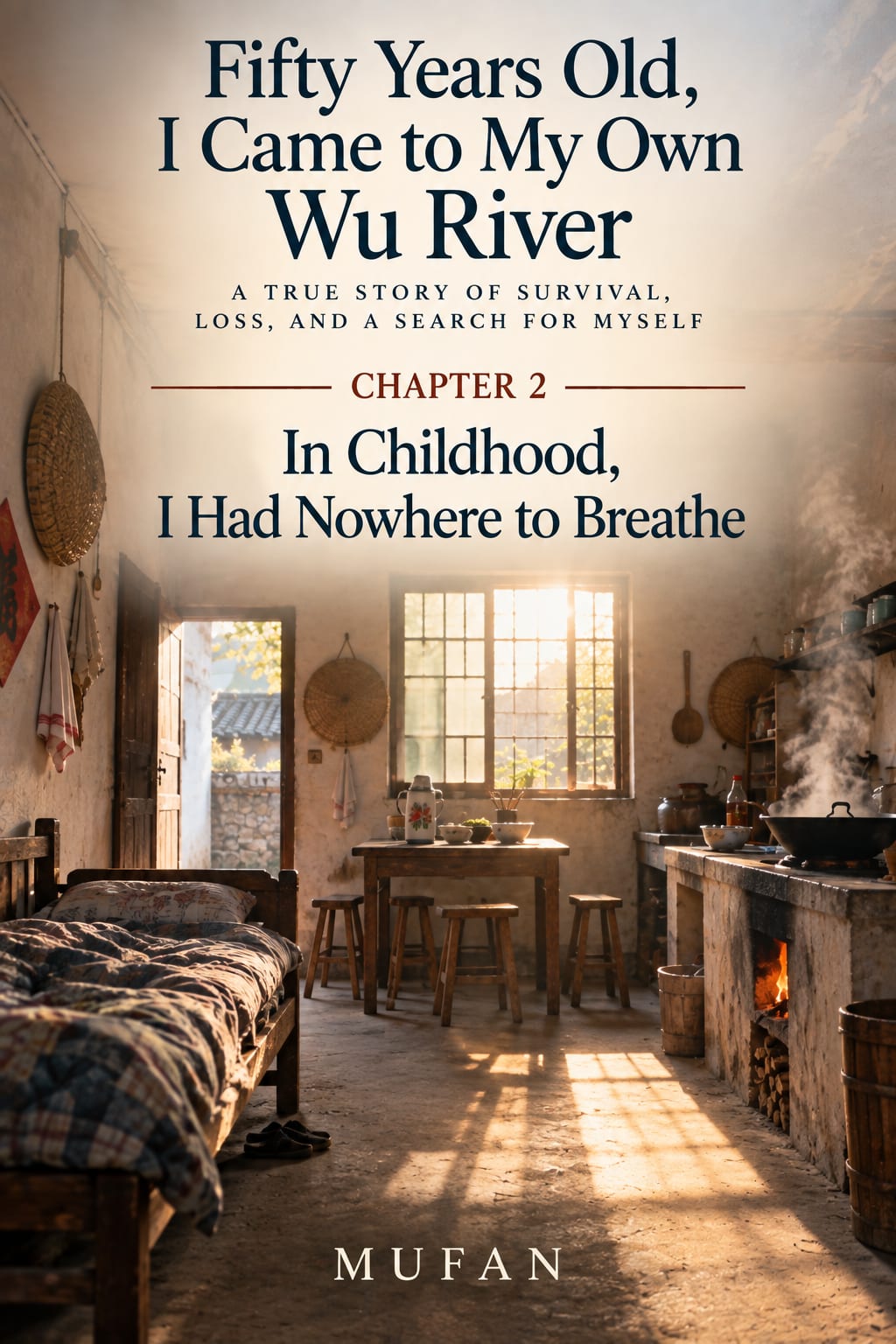
We were poor then.
At first, our family had only one room to live in. We did not even have a proper kitchen.
All four of us slept in that one room.
But from as far back as I can remember, I do not remember ever sharing a bed with my parents.
My father, my mother, and my younger brother slept in one bed.
I slept in another.
This was not like some families today, where parents have a child sleep alone from an early age to teach independence.
At least, that was not how it was in our family.
In the life we lived then, sleeping with your parents meant closeness.
My brother had that closeness.
I did not.
When I was about six, our family added a kitchen.
I moved into the kitchen to sleep.
It was not an old kitchen that was no longer being used. It was not a room converted into a bedroom.
It was the kitchen where we cooked every day.
The stove was at one end, just inside the door.
I slept at the other end.
Every morning, after my parents got up, they came in to cook.
As soon as the noise started, I woke up.
Whenever they began making breakfast was more or less when I stopped being able to sleep.
My brother did not have to.
He was still asleep in my parents’ room.
After they finished cooking, they went back to wake him.
He got up and came out to eat.
At that age, I did not know how to analyze any of this.
I only knew that he could sleep beside our parents.
I slept in the kitchen.
I stayed there for many years.
When I was about fifteen or sixteen, our family built a new kitchen and an additional room. Cooking moved into the new kitchen, and the new room was given to my brother.
I did not move into it.
I stayed in the old kitchen.
The end where the stove had been became a place to store grain and household odds and ends.
I still slept at the other end.
I had moved into that kitchen when I was about six. Even after it stopped being a kitchen, I kept living there, all the way until I got married.
My father rarely took care of matters concerning me.
He also rarely spoke to me in everyday life.
If I did something that displeased him, he could be very harsh with me.
Other than times like those, there was very little conversation between us.
Sometimes I would be standing right there when he said directly to my mother:
“I’m not dealing with his matters.”
I heard him say things like that more than once.
What he meant was that anything concerning me was for my mother to handle.
But my mother did not say much to me either. Over time, I realized that most of what she said to me was about something she wanted me to do.
At around eight, I began helping her prepare and wash vegetables.
By nine or ten, I was doing more and more.
Washing vegetables. Cutting them. Then I learned to cook from my mother, and little by little I learned to stir-fry as well.
This was not something I did once in a while.
As I remember it, there was something for me to do almost every day.
My mother did not talk to me much in ordinary life. What she said to me most often was probably about work she wanted me to do: wash the vegetables, cut them, or do some other chore.
I did not particularly enjoy doing these things.
I simply thought that if I did more, my mother could do less. I hoped that if I did things well, she might treat me a little better.
When my parents went to work in the fields, I went with them.
My brother usually did not.
Most of the time, he was out playing with friends or at home watching television.
As I remember it, he did almost no housework and rarely worked alongside my parents.
Years later, when he was around twenty-one or twenty-two, I once saw him cook noodles for himself.
The water in the pot was still cold when he put the noodles in.
He did not even know that you normally waited for the water to boil first.
We grew up in the same house.
By eight or nine, I was washing and cutting vegetables, and later I could cook full meals.
At twenty-one or twenty-two, my brother still did not know when to put noodles into a pot.
Once, I was working in the fields with my parents when I saw my brother coming toward us with a friend.
At first, I was happy.
I thought he had come to work too.
He had not.
He had come to ask our parents for money.
They gave it to him.
Once he had the money, he was ready to leave with his friend.
I had not expected that.
I was out there working with our parents, while he had come all the way to the fields only to get money so he could go out and have fun.
I was upset.
I thought what he was doing was wrong, so I said a few words to him.
He immediately got angry.
He snapped at me.
My parents got angry too.
But they did not yell at him.
They cursed at me.
They said:
“His business is none of yours. Who are you to tell him what to do?”
I only thought of myself as his older brother.
If my younger brother was doing something wrong, I thought I should say something.
But in that house, even that became my fault.
My brother took the money our parents had given him and left with his friend.
I stayed in the fields and kept working with them.
It was not an isolated incident.
My brother regularly asked our parents for money.
He used it to buy food with friends or play video games.
Our family did not have much, but when he asked, our parents still tried to give him what they could.
Sometimes he secretly took their money.
When I found out, I thought that as his older brother I should say something.
But whenever I did, my parents often became angry with me first.
Again:
“His business is none of yours. Who are you to tell him what to do?”
As I remember it, I never saw them scold him that way for secretly taking their money.
What I saw was this:
I tried to correct my brother, and I was often the one who ended up being scolded.
Food was the same.
If my mother cooked something my brother did not like and he said he wanted something else, she would make something else for him.
As a child, I do not remember ever asking my parents for money so I could go out and buy snacks or anything else.
So I never really went into a shop and bought something for myself.
Sometimes I went to a shop with other children.
They went inside and bought things.
I went in with them.
But I never bought anything.
It was the same at home.
Whatever my mother cooked, I ate.
I never said, as my brother did, “I don’t like this. Make me something else.”
I thought anything was fine.
I could eat whatever was there.
My circumstances taught me very early to avoid asking for things.
From around age nine, my brother loved instant noodles, so my parents kept them in the house.
Whenever he wanted some, all he had to do was tell my mother, and she would take out a small pot and cook them for him.
She would crack in an egg first, add the noodles, then some vegetables. My brother liked richer food, so at the end she would add a little oil.
My mother made instant noodles for him like that for years.
I never had a single bowl.
It is true that I did not like noodles much as a child.
But that was not really the point.
In all those years, my mother never once asked me:
“Do you want some?”
She never said:
“I’ll make you a bowl too.”
It was not that I said no.
No one asked me in the first place.
I did not like noodles or very dry foods. I preferred food with more broth. My brother was the opposite. He liked noodles and rice and did not like porridge.
So sometimes we had porridge for breakfast, but lunch and dinner were usually noodles, with rice only occasionally.
When my mother made millet porridge in the morning, the millet settled toward the bottom and the liquid at the top was thinner. When I served myself, I liked to take more of the liquid from the top and less of the millet from the bottom.
Once my father saw me doing that and scolded me, saying I was deliberately taking the “rice oil” from the top.
At the time, I had no idea what “rice oil” even meant.
I did not know there was such a term.
I was not deliberately taking something better.
I simply liked more liquid in my porridge. I also had recurring sores around my mouth, and people told me they were caused by “internal heat” and that I should drink more water and thin soups.
So I felt deeply wronged.
I remember thinking that if my brother had done the same thing, he would not have been scolded for it. Did other parents treat their children this way?
After that, I never again dared to scoop the liquid from the top of the porridge.
Before I was ten, I was extremely thin.
At around ten, my appetite grew. I ate a lot and gradually put on weight.
But most of what I ate was staple food: steamed buns and noodles.
Steamed buns until I was full.
Noodles until I was full.
As I remember it, we had tofu every few days, eggs every few days, and meat perhaps once a month.
Looking back, although I began to gain weight after ten, I never felt it was the weight of a strong, well-nourished body.
As an adult, I came to think of it as a kind of unhealthy puffiness.
That is only my later interpretation of my body then. I never had a nutritional assessment as a child.
My brother was not as heavy as I was, but he looked healthier to me.
My parents regularly gave him milk and eggs. He also got more protein-rich food than I did.
When I was about thirty-nine, my complexion had been looking yellowish and dull for a long time.
Because of that, I went to the Shanghai Municipal Hospital of Traditional Chinese Medicine and saw a well-known traditional Chinese medicine specialist whose surname was Xia.
After taking my pulse, I asked whether my health could still be improved through treatment and conditioning.
He said it would now be difficult to change things fundamentally.
He believed that I had been poorly nourished as a child.
Then he used an analogy I have never forgotten:
“You started out as a Santana. No matter how much I tune you up, I can’t turn you into a Mercedes.”
I was unhappy when I heard that. But I also felt there was truth in it.
I felt sad.
I did not know what to say.
Little by little, these things taught me something:
I could not change my parents.
So I became more and more demanding of myself.
Say less.
Endure a little more.
Do a little more.
At around eight, I gradually began washing my own clothes.
Earlier, when I was about five or six and had just started kindergarten, I did not yet know how to wash them myself.
I wore cloth shoes then, with cloth soles. I wore them to kindergarten every day, and hardly anyone washed them for me. After a while, the shoes smelled terrible, and so did my socks.
Sometimes I woke up in the morning and my socks had gone stiff, but I put them back on and went to kindergarten anyway.
I still remember how my feet felt inside them. When the shoes and socks had gone too long without washing, everything felt sticky and stale, as though my feet were trapped inside them.
I remember asking my mother to wash my shoes.
She said:
“Who washes shoes all the time?”
The shoes still did not get washed.
When I got a little older and understood that dirty, smelly socks needed washing, I had to wash them myself.
If I did not, I simply had to keep wearing socks that already smelled.
Eventually I developed a routine.
Every night I washed my socks and put them beside the kitchen stove to dry. By morning they were dry enough to wear to school.
I washed my shoes about once a week. I usually had only the pair on my feet, and I needed them for school every day, so I could wash them only on a Saturday or Sunday when I did not have to go out.
Once I learned to wash them myself, I began to understand the difference. Clean socks and shoes felt fresh. My feet felt lighter.
Clothes were the same. When I was too young to wash them, I could only wait. Once I learned, I washed more and more of my own clothes.
Later I washed my own underwear too. I would wash it at night, put it beside the stove, and wear it again the next day.
My brother did not have to do this.
My mother washed his clothes.
She washed his socks every day.
Sometimes my father even washed his shoes.
So on some evenings, two pairs of socks for the next day sat beside the kitchen stove.
My brother’s had been washed by my mother.
Mine had been washed by me.
The next morning, he put on the socks our mother had washed for him.
I put on the ones I had washed the night before.
I rarely had new clothes.
Apart from school uniforms and the occasional clothes my parents bought me, an older cousin would give me some of his used clothes from time to time.
Some clearly did not fit. If the pants were too long, I rolled the legs up again and again. I even wore one of my cousin’s adult suits to school once, and my classmates laughed at me.
The problem was not only that some clothes were too large.
I had very little underwear, so the same pieces were washed and worn for a long time. Over time, the fabric became stiff. Even when it had hardened, I had nothing else to replace it with, so I kept wearing it. The stiff fabric rubbed against my skin and hurt.
As I grew, underwear that had once fit also became too small. It cut tightly into my waist and left deep marks. The skin underneath became hot and itchy. I scratched it, sometimes until the skin broke.
Pants caused similar problems.
I might wear the same pair for years. My body grew, but the waistband did not. I would force them on and spend the day with the waistband cutting into me.
So having few clothes was not only about wearing things that were old or looked bad.
Sometimes it meant discomfort pressed against my body all day.
I always felt that my older cousin was good to me.
The clothes were used, but to me, at the time, they still felt like care.
We remained close as we grew older.
In my own feelings, I was even closer to him than I was to my younger brother.
As I remember it, my brother’s clothes were usually clean and fit him well.
As we grew older, even the way we looked to other people became different.
My brother always looked fair-skinned and clean.
Neat. Well cared for.
I was different.
I looked rougher, and older than my actual age.
I cannot say that this difference in appearance was necessarily caused by the different care we received.
What I can say is that when the two of us stood together, we looked very different.
We grew up in the same house, yet even something as small as who washed our socks or scrubbed our shoes was different.
And still, I kept doing more.
I did what I could.
Then, little by little, I began doing things I was not really strong enough to do.
When I was about eleven or twelve, our tap water was often shut off.
Sometimes it stayed off for days.
Without running water, we had to carry it home.
I was not good at carrying water yet.
Two full buckets hung from the ends of a shoulder pole, with the pole pressing down across my shoulder.
As soon as I started walking, the buckets swung.
One went one way, the other the opposite way.
The more the water sloshed, the more the pole moved, and I could barely keep my balance.
But I still carried it.
My thinking was simple:
If I carried one load, my parents would have one less load to carry.
One day, I was walking down the street with two buckets of water.
A woman from the neighborhood stood on one side of the street.
My mother stood on the other.
The neighbor saw the buckets swinging wildly and began teasing and laughing at me.
She said I looked like a woman who had never done physical work.
I remember feeling deeply embarrassed.
I wanted to answer her, but I did not know what to say.
Because the truth was, I was not good at it.
Then I saw my mother laughing too.
She joined the neighbor.
I did not know what else to say.
I just kept walking between them with the two buckets still swinging from side to side.
Around fourth grade, the school gave us physical examinations.
After the blood test, a teacher told me I had iron-deficiency anemia.
She also told me I needed more iron.
I went home and told my parents. They were both there.
My father showed no reaction.
My mother looked at me and said nothing.
That was the end of it.
No one took me for further testing, and no one told me how I was supposed to get more iron.
Around fourth or fifth grade, I also began getting repeated leg cramps at night.
They were especially bad in winter.
They hurt.
I did not know why my legs cramped, so I told my parents about it more than once.
What I wanted was for them to tell me:
What is happening?
What am I supposed to do?
They did not tell me why it was happening or what I should do about it.
I do not know whether they knew.
Later, I heard somewhere that leg cramps might be related to calcium and that sunlight might help.
So when the sun was out, I sat outside in it.
Sometimes for nearly an hour.
I did not know how long I was supposed to stay there.
No one told me.
As a child, I also had sores that kept coming back around the corners of my mouth, my lips, and my chin.
They hurt, and they looked bad.
This went on for years.
At the time, I did not know it was something I should see a doctor about.
People who saw them often said:
“You’ve got too much internal heat.”
“You’re running hot.”
They told me to drink more water and eat thinner porridge.
So I tried to drink more water and eat more liquid, soupy foods, hoping the sores would improve.
I already preferred foods with more broth, and because people kept telling me this, I chose thinner porridge whenever I could.
As I got older, I began to think maybe I should see a doctor.
When I was about eleven or twelve, I told my mother I wanted to go to the village clinic.
By then, I already knew she would not go with me.
She gave me money.
I went alone.
The doctor made me a yellow ointment.
I remember him grinding tablets into powder and mixing them with something else to make a yellow paste.
After that, whenever the sores came back, I put the ointment on myself.
Other children sometimes laughed when they saw it, saying I looked as though I had eaten something and forgotten to wipe my mouth.
When my brother was sick, my parents took him to see a doctor.
I remember once, when he had a cold as a child, my father carried him on his back while my mother walked beside them, and together they took him to the village clinic.
My father often carried him even when he was not sick.
Sometimes there were local opera performances in the village at night, and our whole family went to watch. On the way home, if my brother got sleepy, my father carried him on his back.
As far as I can remember, my father never carried me.
Not once.
Even when my brother was older, there was a time when he was sick and my father still carried him. By then he was no longer a small child, and I could see that carrying him was hard for my father. He carried him anyway.
When my brother was around eleven or twelve, there was a period when he often said he felt dizzy.
My parents first took him to the village clinic.
When nothing definite was found, they took him to a hospital several times.
As I remember it, nothing serious was ultimately found.
At that same age, I was also dizzy for long periods.
My dizziness lasted much longer. Years later, I learned that it was connected to the chronic blockage and inflammation in my nose.
But at the time, no one took me to a hospital to have it examined.
It is not true that my mother never took me for medical care.
I can remember two times when I had a cold and fever and she took me to the village clinic for injections.
Those are the two times I can remember now.
Other than that, I cannot remember my parents taking me to the clinic, and I cannot remember them ever taking me to a hospital.
When I was about fifteen and had already begun earning some money, I developed a severe cough one winter.
I was still sleeping in the old kitchen.
Every morning my parents came into the kitchen to cook. The sound of them cooking woke me, and once I was awake, I began coughing and coughing. Sometimes I coughed up a lot of phlegm.
My parents were right there in the kitchen.
I lay there coughing and waiting.
I thought: I’m coughing this badly. Surely they’ll ask me what’s wrong.
They said nothing.
The next morning, it was the same.
The morning after that, the same again.
Eventually I even began thinking that maybe if I coughed harder, they would ask.
They never did.
I finally went to the village clinic by myself.
After several days without improvement, I went alone to the county hospital.
Someone at the hospital asked who had come with me.
I said no one.
They seemed surprised that a boy of about fifteen had come to the hospital alone.
The doctor diagnosed bronchitis and prescribed medicine that had to be injected.
I carried the medicine back to the village and then went to the village clinic each day with that day’s dose for the injection.
The trip to the county hospital, bringing the medicine home, and arranging the daily injections—I handled all of it myself.
I kept doing things for my parents.
Carrying water was only one of them.
After the wheat harvest, sacks of grain had to be carried from the entrance into the house.
I remember how heavy those sacks were. One weighed around a hundred jin—roughly a hundred and ten pounds—and some may have been heavier.
At first, my father and mother carried them.
As I got older, at around twelve, I started carrying them too.
Once I began, my mother stopped carrying the sacks into the house herself.
Instead, she stood beside me and helped get a sack onto my shoulder.
With one hand I grabbed the top of the sack and pulled upward. With the other I gripped a lower corner. My mother held the bottom too, helping lift the wheat until the sack settled onto my shoulder.
Once it was there, I carried it into the house myself.
My father carried one sack.
I carried one.
My mother stayed there to help lift the next one onto my shoulder.
For someone my age and size, those sacks were already very heavy.
But I kept carrying them.
My thinking was simple:
Every sack I carried was one less for my parents.
I also remember that when I was doing work for the family, my mother’s tone toward me was usually a little warmer than it was otherwise.
Sometimes she smiled. Sometimes she asked me a question or two.
She did not praise me for being capable. She did not compliment me.
But I could feel that while I was working, the way she spoke to me was different.
When the work was over, things between us went back to normal.
My father did not change that way.
Whether I was working or not, as I remember it, he rarely spoke to me. Most of the time he either ignored me or, when something displeased him, was harsh with me.
The next time there was heavy work to do, I still went.
Every year before the Lunar New Year, there was a great deal of food to prepare.
One year my mother told me that the vegetables and meat needed to be washed and asked, “Why don’t you do it this year?”
I did not really want to. I had never done all of it before.
But I still said, “Okay.”
That morning, I sat down in the courtyard and began washing vegetables and meat.
There was a small stool beside the outdoor tap. I sat on it with a large basin in front of me and a smaller basin beside it. Around me were plastic bags filled with meat and vegetables that still had to be cleaned.
There were lotus roots. I had to scrape away the skin little by little and wash them clean.
There was celery, carrots, and a local Henan vegetable called yintiao—thin, white roots dug from the earth, still covered in soil.
There was beef, pork, and ribbonfish.
The ribbonfish was especially difficult to clean.
There was no hot water.
There were no gloves.
To make it easier to work, I took off my coat and wore only a sweater. Again and again, my bare hands went into the cold water.
It was about seven or eight degrees below freezing.
I did not just want to finish.
I wanted everything to be very clean.
After about an hour, my hands began to stiffen.
Then they slowly went numb. I could feel them less and less.
I kept washing.
By nearly two hours, my whole body was beginning to stiffen from the cold.
At one point my mother came out of the house.
She walked over to the large basin and stood diagonally across from me.
“Are you cold?” she asked.
“I’m okay. I’m okay,” I said.
She stood there for less than a minute, then went back inside.
I stayed beside the tap and kept washing.
More than three hours passed before I finally finished everything.
When I went back inside, I held my hands near the fire.
Even after about twenty minutes, I could barely feel the warmth.
It took a long time that afternoon for my body to feel normal again.
After that, whenever the Lunar New Year approached and the same kinds of food had to be prepared, my mother waited for me to wash them.
It was like that with other things too.
Once I learned how to do something, little by little it became something I was expected to keep doing.
My nose had been another constant problem since childhood.
I always had a lot of mucus. When my nose was badly blocked, I often felt dizzy too.
At its worst, my nostrils were so clogged that I could not breathe normally through my nose.
But throughout childhood and well into my teens, I had no idea that this was something I should see a doctor about.
I thought maybe this was simply the way I was.
We did not keep tissues in the house for blowing my nose.
At first, I tried using toilet paper.
I used it a few times, but the paper was so poor that it shed white powder and bits of paper whenever I wiped my nose. Sometimes the powder got into my mouth, which felt awful.
After a few times, I stopped using it.
There was one open trash can in the courtyard.
It was the only trash can in the house. Everything went into it, including leftover food and other household waste.
So for a while, I simply blew my nose directly into that trash can.
It seemed perfectly reasonable to me. If all kinds of dirty household waste could go into it, I could not understand why mucus could not.
When my mother discovered what I was doing, she scolded me. She said it was disgusting and told me not to do it again.
So I found another place.
I went outside the front gate, farther from the house, and cleared my nose beside a wall.
My mother discovered that too.
Again she scolded me and told me not to do it.
I had to find another solution.
Eventually I began tearing pages from old books or magazines.
The paper was hard and not meant for blowing a nose. It was difficult to clean myself properly with it. Sometimes mucus got on my hands, and then I washed them.
For a long time, that was what I did: tear paper from an old book or magazine, use it, then throw it into the trash can in the courtyard.
Once, while we were working in the fields, my older cousin was beside me.
He saw how much mucus I had and asked:
“Doesn’t it bother you, having that much mucus all the time?”
I did not answer the question directly.
Then he told me that when I had mucus, I should use paper to get it out instead of letting it block my nostrils.
My parents were nearby at the time. I cannot say now whether they heard what my cousin said.
I have remembered his question all these years.
Because as far as I can remember, neither my father nor my mother ever asked me:
“Doesn’t it bother you?”
Later, I began earning my own money.
Once I had money of my own, I started buying boxes of tissues.
I put them in the living room and dining area.
They could be used to blow a nose or wipe your mouth after eating.
I did not buy them only for myself.
I simply left them there.
Anyone in the family could use them.
It was not until I was about twenty that I finally went to a hospital specifically because of my nose.
By then, I was earning my own money.
I went to the hospital in town.
The doctor punctured and flushed both sides of my sinuses.
I remember a large amount of yellow pus coming out.
The doctor told me:
“This isn’t mucus. It’s pus from the infection inside.”
He prescribed medication.
After the treatment, for the first time I understood that my nose could actually feel comfortable.
My whole body felt lighter.
I had not known that kind of relief for years.
For the next several months, I felt much better. Even life itself seemed easier and happier.
I had suffered with it for so many years.
If only I could have been treated sooner.
When I was fourteen, just before the Lunar New Year, I was still in school.
There were only about two days left before the holiday when my father needed to repay four thousand yuan from a small business transaction. The man he owed lived in a village near Yanling, in Xuchang, Henan.
With the New Year so close, my father did not want to make the trip himself. He told me to take the money.
I said I would.
It was the same as with other things. I wanted them to be satisfied with me. When they asked me to do something, I said yes.
I had never traveled that far alone before.
My father gave me an address and told me roughly how to get there. I first had to take a bus from home to the county seat, transfer from there, travel through Zhengzhou, and then continue to Yanling. Once I reached Yanling, I still had to find a local vehicle—something like a small tractor with a covered passenger bed—to get to the village. There was no clear transfer information for much of the route. I had to keep asking people along the way.
The four thousand yuan was inside a red bag.
I put other things on top of the money to hide it and set out with the bag.
I was anxious the entire way.
It was my first time traveling so far alone, with one transfer after another. I was afraid of getting on the wrong bus or not finding the village.
At the time, theft on long-distance buses was common enough that I had heard many stories about it. I had also heard about robberies on the road.
The four thousand yuan stayed with me the whole way.
I was afraid someone would steal it.
I was afraid someone might rob me.
And because it was only two days before the New Year, there were fewer and fewer vehicles on the road.
The man lived in a small village, and the last part of the trip could only be figured out after I arrived in the area, asked around, and found another ride.
I kept wondering:
What if there are no more vehicles?
What if I cannot get to the village?
So I traveled with that red bag, changing vehicles and asking directions again and again.
I left in the morning and spent almost the entire day on the road.
By the time I finally found the village and reached the man’s house, it was late afternoon, almost dark.
I gave him the four thousand yuan.
That night, I slept in a room in his house.
The next morning, I retraced the route alone.
By the time I got home, the New Year was almost upon us.
After I returned, my father asked what time I had reached the man’s house.
He also asked what the man had said when I arrived.
He seemed to ask a little about the journey too. I remember something about where I had caught a bus.
I do not remember him asking whether I had been afraid traveling so far alone.
I do not remember him asking whether I was tired.
I do not remember him asking whether anything dangerous had happened on the way.
My mother did not ask me about the trip.
I was fourteen years old.
It was the first time I had ever traveled so far by myself.
When I was younger, it was not that I never argued with my parents.
When we had conflicts, sometimes I argued back.
Sometimes I cried right there in front of them.
Then I would go back to the place where I slept and keep crying.
As I got older, I argued with them less and less.
Not because those things stopped hurting.
I simply came to feel that arguing changed nothing.
I could not change my parents.
I could not change that family.
And I could not leave it.
I felt completely helpless.
But the anger and pain did not disappear.
Eventually I began slapping myself across the face.
I did not slap myself lightly.
Each time, I hit myself with all my strength, hard enough to turn my head to the side.
My face would be bright red afterward.
Strangely, at the time, it did not feel especially painful.
Once, my father was there.
I remember him seeing what I was doing and then turning away and leaving.
My mother saw me hit myself too.
She did not stop me.
She showed little reaction.
Later, after one conflict with my mother, I was furious and overwhelmed by that same helplessness.
I picked up an old wooden stool beside me. It was already loose and unsteady.
I struck my head with it.
One of the wooden braces on the stool broke.
My head hurt badly and I felt dizzy.
There was no blood, but later a large lump rose on my head.
My mother was standing nearby.
I remember that she looked surprised.
She did not stop me.
She did not ask whether my head hurt.
That was not the last time.
The broken wooden stool was eventually thrown away.
There was another small stool in the house, this one with metal legs and a very hard seat.
At least twice later, I struck my head with that stool.
One time, the pain was especially severe.
I became so dizzy that I felt I was on the verge of collapsing.
I did not fall.
I did not completely lose consciousness.
There was no blood.
My mother was there.
That time, her reaction was different.
I remember that she looked somewhat distressed.
From the way she reacted, I even thought she might have believed I had split my head open.
I had not.
But my head hurt terribly, and I was extremely dizzy.
I did not do these things because I believed I was bad.
I did not believe I deserved to be punished.
I could not change my parents.
I could not change that family.
And I could not leave it.
I felt helpless.
I did not know where else to put all that anger and pain.
Eventually, some of the anger I had once directed toward them began turning toward myself.
Sometimes, after a conflict, I cried.
As I got older, I no longer needed an argument to start crying.
At night, alone in my room, I would think about everything happening in our family.
I would ask myself:
Why do they treat me this way?
Why are my brother and I so different when we live in the same family?
Life in that house felt unbearably hard.
I felt trapped and suffocated.
I cried like that for years.
Sometimes I even thought:
Living like this, I might as well be dead.
That thought came to me more than once.
At the time, all I knew was that living this way felt too painful, too oppressive.
About the Creator
Enjoyed the story? Support the Creator.
Subscribe for free to receive all their stories in your feed.
Comments
There are no comments for this story
Be the first to respond and start the conversation.