
A Dad Who Didn’t Know What to Expect at a MIAM - Until He Attended One
A practical guide to MIAMs: what they are, how to prepare, and how family mediation can support your next steps.

I Thought It Was Going to Be the Worst Morning of My Life
I remember sitting in my car outside the office building for about ten minutes before I went in. Just sitting there, engine off, watching other people walk past with their coffees and their normal days, thinking: how did I end up here?
It was a Tuesday in February. Cold, grey, the kind of morning that feels like the sky hasn't quite woken up yet. My daughter had asked me the previous night why I was wearing my "smart jumper" on a weekday, and I'd said I had a meeting. She'd gone back to watching her programme, completely unbothered. Kids are like that sometimes. They don't know they've just broken your heart a little bit.
The meeting was what's called a Mediation Information and Assessment Meeting. I'd been sent a letter telling me I needed to attend one before I could apply to court about arrangements for the children. I'd looked up a guide to attending a MIAM in the UK the night before, but reading about something and actually sitting outside the building are very different things. My solicitor had explained it to me briefly, but I hadn't really taken it in. I was still in that phase of the separation where everything felt like it was happening to someone else, and I was just observing from a slight distance.
Sarah and I had been separated for four months by that point. We'd been together for eleven years. The split had been, in her words, "mutual," though I'm not sure I'd have chosen that word. We had two children, Mia who was eight and Joel who was five. We both loved them fiercely and completely. That wasn't the problem. The problem was that we couldn't seem to agree on anything else.
I'd convinced myself that the MIAM was going to be some kind of formal assessment, like an interview where someone would decide whether I was a fit parent or a reasonable person. I had no idea what it actually involved. I'd done a bit of searching online but mostly found things that made it sound either very simple or very frightening, and I couldn't work out which was closer to the truth.
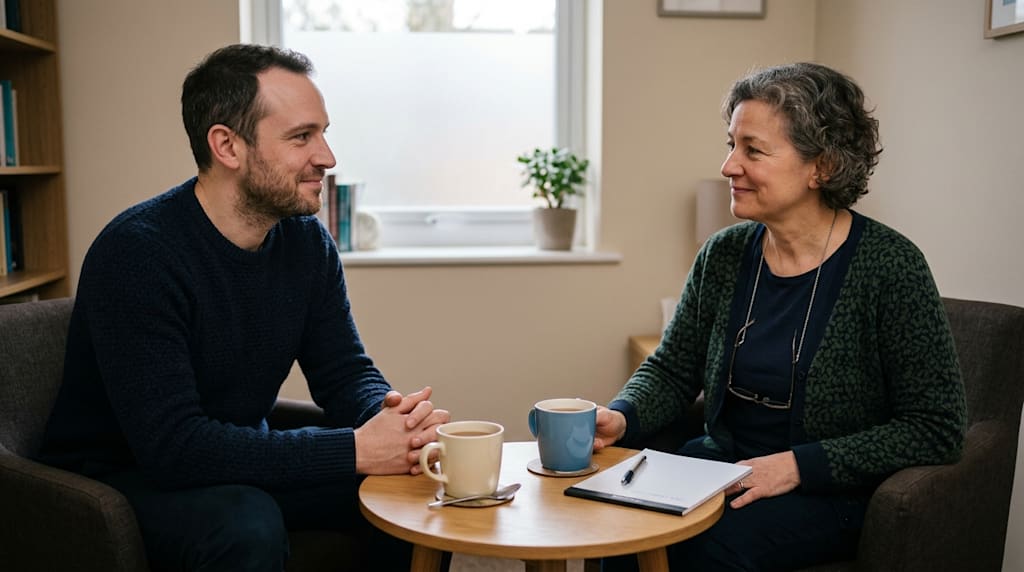
The mediator who met me was a woman probably in her mid-fifties. She had one of those voices that's calm without being patronising, which I appreciated more than I expected to. She offered me tea and I said yes even though I didn't really want any, just because it gave me something to do with my hands.
She explained pretty quickly that this wasn't a court hearing and she wasn't there to judge me. The whole point of the meeting, she said, was simply to give me information about mediation as an option, and to think together about whether it might work in my situation. I didn't have to agree to anything. I just had to show up and listen.
That was the first moment I felt my shoulders drop.
She talked me through how mediation actually works. That it's not about being in the same room as someone and screaming at each other until one of you gives in. It's structured. It's guided. The mediator doesn't take sides or tell you what to do. They help both people say what they need to say and, ideally, find some ground they can both live with. She was honest that it doesn't work for every situation, and she asked me a few questions about how things had been between Sarah and me at home, whether there'd been any safety concerns, whether I felt able to speak freely. I told her the truth. Things had been difficult, but not in that way.
I asked her what would happen if Sarah refused to come. She said that was fine, that attending the MIAM separately is entirely normal. The meeting isn't about sitting across from your ex. It's about understanding whether mediation is even a possibility before heading down the court route, which involves things like a C100 completion service and formal applications I wasn't ready to think about yet. I hadn't understood that distinction before. I'd assumed we'd both be there, in the same room, that first morning.
We talked about the children for a bit. Not in any official way, just in a human way. She asked about their ages, about the current arrangements. I told her that at the moment Mia and Joel were staying with me every other weekend and I was picking them up from school on Wednesdays, but that I wanted more time with them. That I missed them in a way that felt physical, like a constant low-level ache in my chest that I'd started to think I'd just have to live with.
She listened properly. Not in the way that people sometimes listen, where you can tell they're just waiting for you to finish. She actually listened.
By the time I left, the meeting had lasted just under an hour. I sat back in the car for a few minutes again, but it felt different this time. Not dread. Something more like possibility, which I hadn't felt in months.
Sarah did agree to try mediation. It took a few weeks and a couple of difficult conversations, but she agreed. Our first joint session was strange and awkward in the way that all first sessions probably are, two people who used to share a bed, now sitting in armchairs on opposite sides of a room, trying to find words that don't land like accusations.
But we got somewhere. Not all at once, and not without some sessions that left me driving home in silence, gripping the steering wheel too hard. There was one afternoon where Sarah said something that stung me more than I let on, and another where I said something I wish I hadn't. The mediator held the space between us without flinching, which I found remarkable.
What we came out with, eventually, was a parenting plan. Mia and Joel would spend alternate weeks with each of us, with flexibility built in around school holidays and birthdays and the kind of things that life throws at you. It wasn't a formal consent order, though I did look into what it means to enforce a consent order in the UK at one point, just to understand our options. It wasn't perfect. I still wanted more. But it was fair, and we'd made it together, which mattered more than I'd expected it to.
Joel turned six in April. He had his birthday party at one of those soft play places, the ones that are brilliantly chaotic and smelling faintly of socks. Sarah and I were both there. We didn't talk much beyond the practicalities, but we managed it. Mia made him a card with a drawing of the two of them as superheroes, and when he opened it he just said, "That's me," in this completely delighted way that made both Sarah and me laugh at exactly the same time.
Those moments exist alongside the hard ones. That's what I've learned. The separation isn't over, not really. It just becomes a different thing you're managing rather than a crisis you're in. The morning I sat in that car park in February, I couldn't have imagined getting here. If I'm honest, the best thing I did was just show up. If you're in the same position, you can book a MIAM and take it one step at a time, the same as I did.
I still wear the smart jumper sometimes. Mia has stopped noticing. That feels like progress.
This story is based on real mediation experiences, with details changed to protect confidentiality.
About the Creator
Jess Knauf
Jess Knauf is the Director of Client Strategy at Mediate UK and Co-founder of Family Law Service. She shares real stories from clients to help separating couples across the UK.
Jess is author of The Divorce Guide in England & Wales 2016.
Enjoyed the story? Support the Creator.
Subscribe for free to receive all their stories in your feed.
Comments
There are no comments for this story
Be the first to respond and start the conversation.