
A Couple Who Couldn’t Agree on Ongoing Financial Support
We thought everything was settled in our divorce, until the conversation turned to ongoing support.

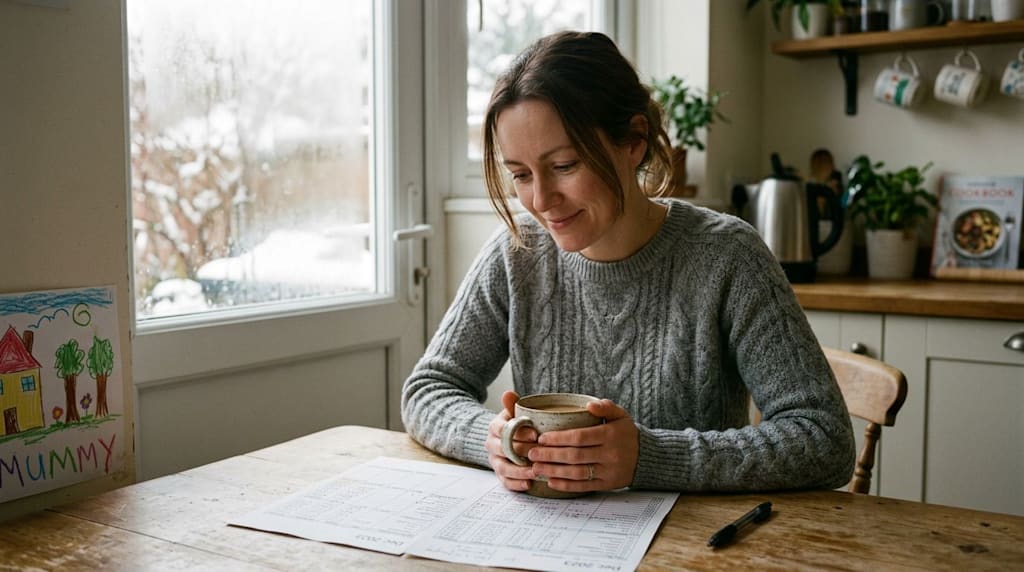
There was a spreadsheet. That's what I remember most from those first few weeks after Gary moved out. He'd emailed it to me, sixteen rows, colour-coded, with a column for what he thought was fair and a column left blank for my response. As if eleven years of marriage could be reduced to a shared Google doc.
I printed it out and put it on the kitchen table. Then I sat and looked at it for a long time, with a cold cup of tea going tepid beside me, while the kids were at school.
The numbers weren't even the problem. Well, they were, but not in the way you might think. We'd never been rich, but we'd been comfortable enough, two salaries, a modest house in Staffordshire, the usual school trips and birthday parties and one holiday a year to somewhere with a pool. When Gary left, the money didn't halve. It got complicated. I'd been working part-time since Ellie was born, four years earlier, and while I'd always planned to go back full-time eventually, that hadn't happened yet. Gary earned considerably more than me. We both knew that. What we couldn't agree on was what it meant now that we were separating.
His spreadsheet suggested a figure for monthly support that would, if I'm honest, have left me scrambling by week three of every month. He'd accounted for the mortgage, the council tax, the basics. He hadn't accounted for the fact that I was the one doing the school runs, the GP appointments, the birthday party supplies, the haircuts, the new school shoes every time one of them had a growth spurt, which in the case of our son, Callum, seemed to be happening every eight weeks.
I tried talking to Gary directly. Twice by phone, once in person over coffee that neither of us drank. Each time, we'd start calmly enough, and then something would shift, some word, some tone, and within ten minutes we were rehashing things that had nothing to do with spousal maintenance and everything to do with who hadn't pulled their weight during the marriage. Those conversations left me exhausted and no further forward.
A friend suggested I try mediation before getting solicitors involved. Her sister had used family mediation services in London after her own divorce, and while it hadn't been easy, it had been better than the alternative. I was sceptical. I imagined something very formal, two people either side of a long table while a stranger tried to referee. But I was also tired of the spreadsheet sitting on my kitchen table like an accusation.
The mediator was a woman, calm without being cold. The first session was just me, which I hadn't expected. She explained that this was normal, that she needed to understand both our situations separately before bringing us together. She asked me to describe what my days looked like now, what the children needed, what I was earning and what I might realistically earn in the short to medium term. It didn't feel like an interrogation. It felt more like someone was finally bothering to ask.
Gary had his own individual session. I don't know what he said, obviously, but when we came together for the first joint session, something had shifted slightly. Not dramatically. He was still Gary, still prone to stating things as facts when they were really opinions. But the mediator had a way of redirecting things when they started to curdle. She'd say something like, "I can hear this feels important to both of you, let's come back to the underlying concern here." It sounds simple. It was surprisingly effective.
What came out over several weeks was that Gary's spreadsheet number had come from a place of fear, his own financial fear, which I hadn't fully appreciated because I'd been so consumed by mine. He was looking at his outgoings after moving into a rented flat, paying a mortgage contribution to me, and trying to keep some kind of financial footing. He wasn't being deliberately cruel with that figure. He was panicking. I could understand that, even if understanding it didn't make the number any more workable.
We went through everything properly. Childcare costs, which Gary had substantially underestimated. My part-time salary and what it actually covered. The realistic cost of running a household with two children under eleven, one of whom has a nut allergy that means every school trip involves a phone call and a special packed lunch and a low-level hum of anxiety that doesn't show up in any spreadsheet.
There was one session, the third or fourth, where Gary said something that stayed with me. He said he didn't want Callum and Ellie growing up thinking their dad had left them short. He said it quietly, looking at the table rather than at me or the mediator, and I believed him completely. That was the first moment I thought we might actually get somewhere.
We didn't resolve everything in mediation. The financial arrangement we agreed took a few more weeks to finalise properly through solicitors, because we both wanted the paperwork done right and legally binding. But mediation gave us a basis, a set of numbers we'd both actually arrived at rather than one of us imposing on the other. The mediator had been clear throughout that she wasn't there to advise us on what was legally fair, only to help us communicate. She did point us both towards getting independent legal advice before we signed anything, which I did.
The figure we ended up with was higher than Gary's original spreadsheet and lower than what I'd initially hoped for, which felt about right, genuinely rather than resignedly. It was something I could make work. I went back full-time eight months later anyway, when Ellie started reception, and things got easier again.
I took that spreadsheet off the kitchen table eventually. Put it in the recycling. It felt like something worth marking.
I won't pretend the process was easy or that Gary and I came out of it as friends. We're not friends. We're co-parents, which is different, and most of the time that works well enough. I found it helped, in those early months, to talk to other people going through the same thing, there's a divorce circle group online where people share their experiences, and just knowing others had got through it made a difference. We communicate about the children by text and manage handovers without drama, which I know isn't something everyone can say.
What mediation gave us wasn't a resolution so much as a way of having the conversation properly, maybe for the first time. It gave us a space where I could say, without it becoming an argument, that I was frightened about money, and Gary could say, without it turning into a row, that he was frightened about it too. That sounds like a small thing. At the time, it felt enormous.
The children are fine, by the way. Callum is ten now and obsessed with Lego and football in equal measure. Ellie draws horses on every available surface, including, once, the back of a gas bill. They know their parents live in different houses. They don't know about the spreadsheet. They don't need to.
This story is based on real divorce experiences, with details changed to protect confidentiality.
About the Creator
Family Law Service
Family Law Service is a UK-based online family law support provider helping people across England and Wales with divorce, child and financial matters, offering clear, practical guidance without the high cost of traditional solicitors.
Enjoyed the story? Support the Creator.
Subscribe for free to receive all their stories in your feed.
Comments
There are no comments for this story
Be the first to respond and start the conversation.