
5 Year Old Doesn't Know Letters or Numbers? What Finally Helped Me Understand Why
I spent weeks trying to understand why my son could sing the ABC song but couldn't recognize simple letters or numbers. Here's what finally made everything make more sense.

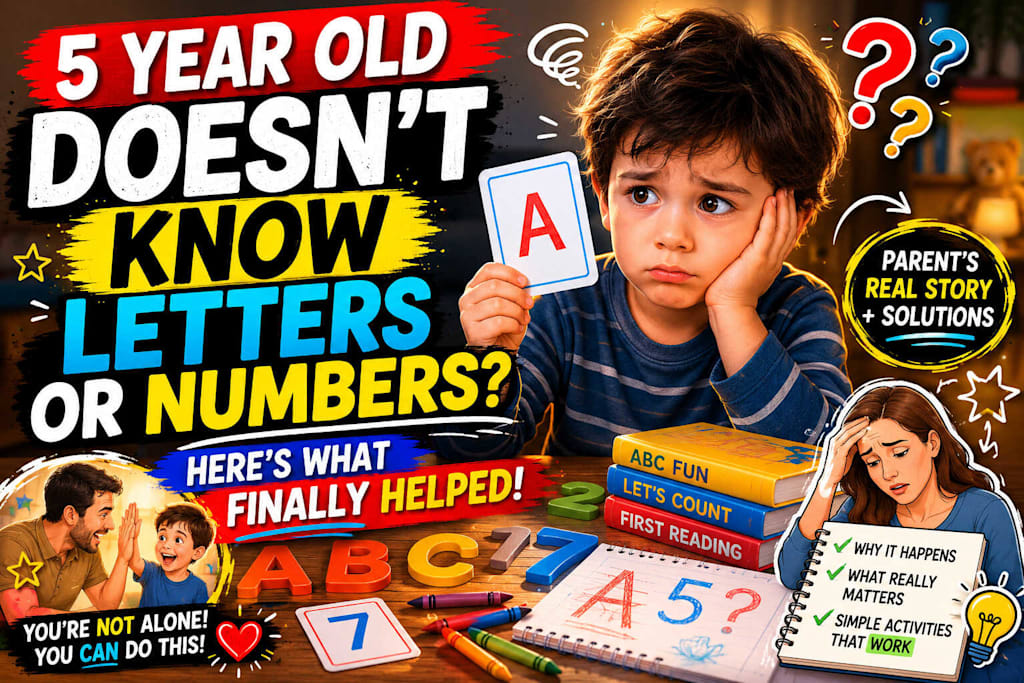
Tuesday morning. I'm sitting at the kitchen table with my son. He's got a bowl of Cheerios, I'm scrolling through my phone, and I see this Reddit thread where some parent says their kid knew the entire alphabet by age three. I look over at my son. He's five. Kindergarten starts in four months. I point at the cereal box and ask him what letter that is.
He stares at the big yellow 'C'. Nothing. Just this blank look. Then he smiles and says, "Cheerios!" Like he nailed it.
I try another one. I grab a magnet off the fridge, one of those wooden ones, big red 'A'. He knows the ABC song. Sings it in the car. But looking at that single letter? He guesses 'B'. Then 'C'. Then he shrugs and goes back to his cereal.
I felt this weird tightness in my chest. Not panic. More like... I should've noticed this earlier. He's funny. He's social. He builds these elaborate block towers. But letters? Numbers? It's like they don't stick. He can count to twenty out loud. Ask him to point to the number 7 on a page? Half the time he can't find it. The other half he points to 3 and says "seven" with total confidence.
I spent the next two weeks doing what every parent does. I went deep into Google at 11 PM. I read everything. I talked to a preschool teacher I know. I read studies. I read parent forums until my eyes hurt. And here's what actually helped me understand what was going on.
Is It Normal If A 5 Year Old Doesn't Know Letters Or Numbers?
Short answer: yes, more than people admit.
The internet makes it look like every five-year-old is reading chapter books and doing basic math. That's not reality. A lot of five-year-olds enter kindergarten without solid letter recognition. Some don't know all their numbers. Some know them one week and draw a blank the next. This happens. It doesn't mean something is wrong.
What I learned is there's a huge gap between "knowing" something and being able to use it. My son could sing the ABC song. That's auditory memory. It's a sequence. It's basically a song he memorized. But recognizing the letter 'K' when it's sitting alone on a flashcard? That's visual processing. That's a totally different skill. Same with numbers. Counting to twenty is verbal. Pointing to the written number 14 and knowing what it means? That's visual-symbolic recognition.
Some kids develop that visual piece later. Especially boys, from what I read. Especially kids who spend more time moving around, building things, playing outside. Their brains are busy with spatial stuff, motor stuff. The symbolic stuff comes when it comes.
What I Learned About Early Learning Milestones
I used to think there was this checklist. By five, they should know this. By six, that. Turns out the range is massive.
Some kids recognize all letters by four. Some don't get there until six or even early seven. Studies on early literacy show that kindergarten readiness isn't about knowing everything beforehand. It's about having a foundation. Can the child listen to a story? Do they understand that print carries meaning? Can they hold a pencil? Those things matter more than memorizing every letter.
I found a study from the National Early Literacy Panel that basically said letter naming is a strong predictor of later reading success, but it's not the only one. Phonological awareness matters a lot. That's hearing sounds in words. Rhyming. Breaking words apart. My son is actually decent at that. He'll make up nonsense rhymes in the car. "Dad, truck rhymes with... stuck!" That skill matters for reading too.
So the picture is more complicated than "knows letters = ready, doesn't know letters = behind."

Why Some Children Need More Time
Here's what nobody tells you: memory works differently for different kids at this age.
Some kids have strong visual memory early. They see a letter once, they remember it. Other kids need way more repetition. My son is in that second group. I noticed he could recognize the letter 'S' because it's in his name. He saw it every day on his backpack, on his bedroom door. But 'Q'? He'd seen it on flashcards maybe ten times. Still nothing.
There's also something called working memory. That's holding information in your head while you use it. A five-year-old's working memory is still developing. Some researchers say it doesn't really mature until seven or eight. So a kid might look at a letter, know it for a second, and then the memory just... drops. It's not that they aren't trying. Their brain literally hasn't built that storage system yet.
Then there's attention. My son can focus for an hour on Lego. But flashcards? Two minutes and he's looking at the ceiling, asking about dinosaurs, fidgeting with his shirt. Forced sit-down learning at five is rough for a lot of kids. Their brains aren't wired for it yet.
- Another factor: letter confusion is incredibly common. B and D. P and Q. M and W. Kids mix these up for years. It's not dyslexia. It's normal visual development. The brain is still learning to differentiate similar shapes.
Common Mistakes Parents Make Without Realizing It
I made a bunch of these. I'm not proud of it.
First mistake: drilling. I bought these alphabet flashcards and we'd sit at the table and I'd flip through them like we were training for a spelling bee. He hated it. I hated it. He'd get one wrong and I'd feel this pressure to correct him immediately, which made him shut down. Drilling doesn't work for a lot of five-year-olds. It creates anxiety. It makes them associate letters with stress.
Second mistake: comparing. I'd see videos of other kids reading and think, what am I doing wrong? Nothing. That kid is that kid. My kid is my kid. Comparing doesn't help anyone. It just makes you panic and push harder, which backfires.
Third mistake: thinking knowing the ABC song means knowing letters. I already covered this, but it's worth repeating because it's such a trap. Parents hear the song and think, great, we're good. Nope. Completely different skill.
Fourth mistake: only doing letters in isolation. I'd show him 'T' on a card. But in real life, letters are in words, in different fonts, uppercase, lowercase, messy handwriting. A kid who knows 'T' in one font might not recognize it in another. I wasn't giving him enough variety.
Fifth mistake: ignoring numbers because "he can count." Counting verbally and number recognition are separate tracks. I assumed because he could rattle off numbers, he understood them. He didn't. Not visually. Not conceptually.
Simple Activities That Build Letter And Number Recognition
After I stopped the flashcard torture, I tried things that actually worked. None of this is revolutionary. It's just... calmer. More woven into normal life.
Letters in the wild. We'd go to the grocery store and I'd ask him to find an 'A' on a can. Or a 'P' on a sign. Letters in real context stuck better than letters on cards. He'd find one and get excited. No pressure.
His name everywhere. I wrote his name on paper, on the sidewalk with chalk, on a whiteboard. He learned those letters first because they meant something. 'S' for Sam. 'A.' 'M.' Then I pointed out that 'M' is also in 'Mom.' Connections started forming.
Number scavenger hunts. I'd hide number magnets around the living room. Find the 5. Find the 8. Make it a game. He'd run around. No sitting still required.
Drawing numbers in sand, shaving cream, rice. Sensory stuff. He'd trace a number with his finger while saying it out loud. Multi-sensory input helps memory stick. Way better than staring at a worksheet.
Reading the same books over and over. Repetition without it feeling like repetition. He'd memorize the story, then start tracking the words with his finger. Eventually he'd recognize that 'the' always looks like that. 'And' always looks like that.
Board games with numbers. Chutes and Ladders. Dice games. He'd count the dots, move the piece, start connecting the dot pattern to the number symbol.
None of this took more than ten or fifteen minutes a day. The key was stopping before he got frustrated. Keeping it light. Not making it a thing.
When I Started Looking For A More Structured Approach
After about a month of the casual approach, I saw some improvement. He knew maybe twelve letters solidly. Numbers were slower. But I started wondering if I was missing something. Maybe there was a better sequence. Maybe I was teaching things out of order. Maybe there was a method I didn't know about.
I didn't want to hire a tutor for a five-year-old. That felt extreme. But I did want to understand what a structured learning path looked like. What comes first? Letters or sounds? Uppercase or lowercase? Numbers before letters? I had no framework.
So I started researching structured reading programs. Not to buy anything immediately. Just to see what existed. What the curriculums looked like. How they sequenced things.
While sorting through what I found, I ended up organizing my notes here while comparing different reading approaches.
Who Might Benefit From A Structured Reading Program
Reading Head Start was one of the programs I spent time looking at.
The curriculum appeared to focus on step-by-step learning for parents who wanted more structure. It breaks things into short sessions, which made sense for a kid like mine who can't sit still for long. It also seemed to emphasize phonics early, which research suggests matters a lot for actual reading, not just letter naming.
I didn't sign up right away. I wanted to sit with the information. But I did find some resources useful for understanding how the curriculum is organized and what it includes.
Later, while trying to understand how other parents evaluate similar programs, I came across another write-up that answered a few questions I still had.
I'm still mostly doing the casual, everyday stuff. But having looked at a structured option makes me feel less like I'm flying blind. It's there if I need it. That's enough for now.
Final Thoughts
Here's what I wish someone had told me that morning at the kitchen table.
Your kid not knowing letters at five is not a crisis. It's not a sign of future failure. It's not evidence that you messed up. It's one data point in a much bigger picture. Some kids are early bloomers with symbols. Some aren't. Both groups end up fine.
What matters more than letter recognition at five is whether your kid likes learning. Whether they feel safe trying and getting it wrong. Whether they trust you enough to keep going when it's hard. If you turn letter practice into a battle, you might win the letter battle and lose the learning war.
My son still doesn't know all his letters. We're working on it. Some days he gets five in a row and we celebrate like he won a gold medal. Some days he looks at 'B' and guesses 'eleven.' I don't correct him with that tight voice anymore. I just say, "That's a B, buddy. Eleven is a number. Crazy, right?" And he laughs.
Kindergarten will meet him where he is. Teachers have seen everything. They've had kids who enter reading sentences and kids who enter barely holding a pencil. Their job is to teach. Your job is to love your kid and give them chances to learn without making them feel broken for needing more time.
Children learn at different speeds. The goal is understanding your child's learning pattern instead of comparing them with others. That's it. That's the whole thing.
About the Creator
Understandshe
I write about healing, self-growth, and the messy but beautiful journey of becoming. Honest lessons, real stories, and gentle insights you’ll also find on UnderstandShe.
Enjoyed the story? Support the Creator.
Subscribe for free to receive all their stories in your feed.
Comments
There are no comments for this story
Be the first to respond and start the conversation.