
Why Single-System EHRs Are Failing Complex Patients — And What an Integrative Clinical Decision Platform Actually Fixes
The problem was never that clinicians lacked data. The problem is that when a patient has four diagnoses, three specialists, and two active drug interactions — no one EHR was built to think across all of it at once.

There is a version of the EHR failure story that most people know. The burnout version. The "doctors spend more time clicking than healing" version. That story is real — and it has been told thoroughly enough that it barely registers anymore.
This is not that story.
This is about what happens when a patient is genuinely complex — multiple comorbidities, cross-specialty care, overlapping pharmacological regimens — and the system that was supposed to unify their care instead becomes the infrastructure of fragmentation. This is about the structural failure hiding inside the single-system EHR assumption, and why no amount of UI polish, bolt-on modules, or alert optimization fixes it.
And this is about what actually does.
The complexity problem most EHR criticism ignores
When people criticize EHRs, they tend to focus on the primary care use case: a physician drowning in documentation, a note that takes longer to write than the appointment took to give. Those are real problems. But they're solvable problems — better templates, smarter defaults, ambient AI transcription.
The failure mode for complex patients is a different category of problem entirely.
Clinical scenario
The Multi-Diagnosis Patient
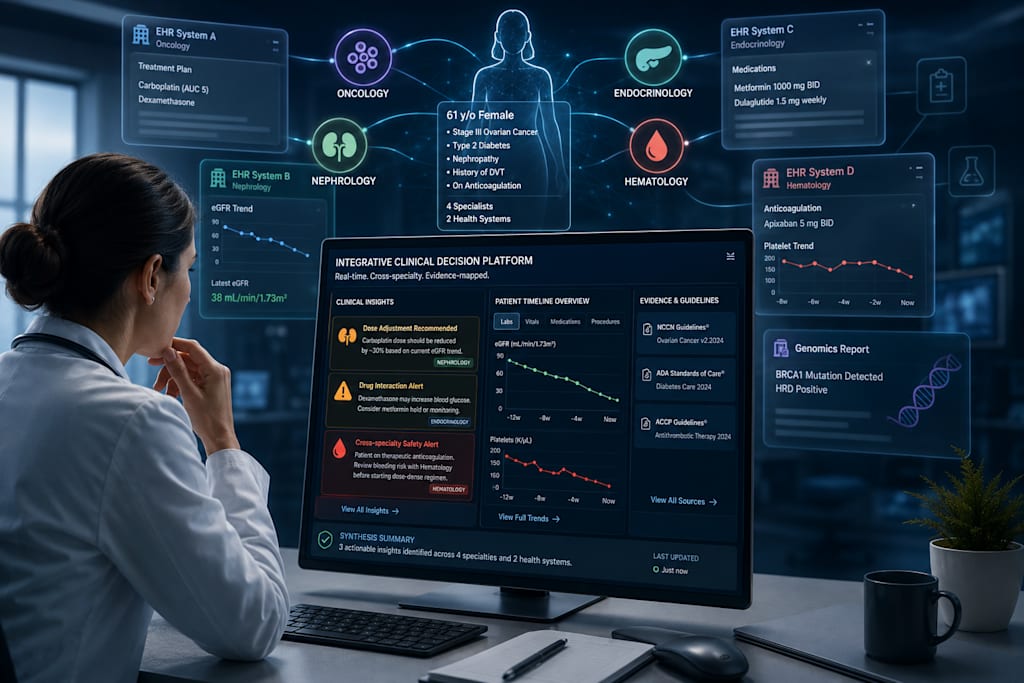
Consider a 61-year-old patient presenting with stage III ovarian cancer, type 2 diabetes with early nephropathy, and a recent history of DVT currently managed on anticoagulation therapy. She is being seen by an oncologist, a nephrologist, an endocrinologist, and a hematologist — each within a different health system, each operating inside a different EHR instance.
Her oncologist is evaluating carboplatin-based chemotherapy. But carboplatin is renally cleared and dose-adjusted by GFR — information that lives in the nephrologist's system. Meanwhile, her anticoagulation protocol creates bleeding risk that intersects with her platelet trajectory, tracked only by hematology. Her diabetes medications interact with dexamethasone she'll need for chemo-induced nausea — a loop that touches endocrinology's notes, pharmacy records, and the oncologist's treatment plan simultaneously.
No single EHR sees the whole picture. And no single-system tool is designed to reason across all of it.
This is not an edge case. It is the default condition of patients who consume the highest share of healthcare resources. Patients with four or more chronic conditions account for nearly 80% of all healthcare spending in the United States. The very patients most likely to be harmed by fragmentation are the ones the system is most fragmented around.
The single-system assumption and why it was always wrong
The design premise of every major EHR — Epic, Cerner, Meditech, Allscripts — is that a single, institution-wide system can serve as the longitudinal record of truth for a patient. This was a reasonable assumption in 1995. It is a structurally false assumption in 2025.
Modern healthcare is not institution-bound. Patients cross systems. Specialists exist in separate networks. Reference labs send results back to portals that don't integrate. Imaging lives in PACS systems with proprietary viewers. Genomics reports sit in PDFs attached to notes, unstructured and unsearchable. Pharmacy records are partly in the EHR and partly in retail pharmacy chains running their own databases.
The EHR was designed to be a container. It became a silo.
"The problem with EHR systems is not that they don't store data — it's that they don't synthesize it. A clinician reviewing a complex patient doesn't need another place to look. They need a system that has already done the looking."
— Adapted from JMIR Medical Informatics, Co-Design of an Integrated Informatics Platform for Ovarian Cancer Care, 2024
What gets lost in this architecture is not data. The data exists. What gets lost is the reasoning layer — the ability to surface a drug interaction between a chemo agent and a diabetes medication, to flag that a GFR decline changes the entire dosing calculus, to alert a prescriber that today's new order conflicts with a protocol note from a specialist the patient saw six weeks ago in a different system.
This is the gap. Not missing records. Missing synthesis.
The five specific failure modes in complex patient care
01 — Cross-specialty data blindness
Each specialist operates with a partial record. The oncologist doesn't see the nephrologist's trending creatinine. The cardiologist doesn't see the rheumatologist's steroid doses. Decisions are made on incomplete inputs — not because data wasn't recorded, but because EHR architecture treats each specialty's data as belonging to that specialty, not to the patient.
02 — Alert fatigue masking genuine danger
Single-system EHRs generate drug interaction alerts at a volume that clinicians routinely override — studies suggest override rates above 90% in some institutions. The tragedy is that the genuinely dangerous interactions — the rare but critical cross-class contraindications that emerge only in complex polypharmacy — are buried under alerts about mild interactions that cause nothing more than mild nausea. The signal is indistinguishable from the noise.
03 — Temporal reasoning failures
A patient's lab value from eight weeks ago means something different than the same value trending over eight weeks. EHRs store timestamps but lack contextual temporal reasoning. They do not flag that a creatinine that was 1.1 six months ago and is now 1.8 puts a planned renally-dosed drug in the danger zone — even if both values sit in the same record.
04 — Genomic data orphaned outside the clinical workflow
Next-generation sequencing results, pharmacogenomic panels, BRCA/HER2 status, tumor mutational burden — the data that increasingly drives precision treatment decisions is almost universally stored as unstructured attachments or free-text notes, entirely outside the structured clinical decision layer. A clinician must physically find and manually read the report rather than having its implications surface automatically at the point of care.
05 — Protocol currency collapse
Clinical guidelines update. NCCN revises its recommended regimens. New trial data changes first-line recommendations. EHRs are passive repositories — they do not know whether the protocol driving today's order set reflects guidelines from 2023 or 2019. Clinicians who aren't subscribed to every relevant specialty's guidelines update cycle are operating from stale evidence without knowing it.
"The EHR doesn't fail complex patients by losing their data. It fails them by refusing to think about it."
What "integrative" actually means — and what it doesn't
The word "integrative" has become overloaded in health technology. Every EHR vendor now claims integration — with labs, with imaging, with pharmacy. But integration in the EHR sense typically means data aggregation: pulling disparate records into a unified display. That's a UI problem solving a logistics challenge.
An integrative clinical decision platform is solving a different problem: it is reasoning across integrated data to surface clinically actionable conclusions. The distinction matters enormously.
Data aggregation vs. clinical reasoning
Aggregation says: here is the patient's creatinine from last week's lab draw. Clinical reasoning says: given this patient's current creatinine, their planned carboplatin dose requires a 30% reduction, and their attending nephrologist has not been notified of the change in trajectory. Aggregation collects. Reasoning acts.
Cross-system data unification
Pulls structured and unstructured data across EHR instances, lab systems, imaging, pharmacy, and genomics into a single patient reasoning layer — not just a display layer.
Evidence-mapped decision support
Surfaces recommendations linked directly to current guideline citations — NCCN, ACC, ADA — not static rule libraries. When guidelines update, the clinical logic updates with them.
Temporal pattern recognition
Monitors lab trends, vital trajectories, and biomarker changes over time — flagging directional risk before a threshold value is breached, not after.
Genomic reasoning integration
Parses pharmacogenomic and tumor genomic data out of unstructured reports, maps it to drug sensitivity and dosing implications, and surfaces it at the prescribing moment — not in an attached PDF.
Prioritized, explainable alerts
Replaces high-volume, low-priority alert floods with ranked, explainable clinical flags — showing not just that an interaction exists, but why it matters for this patient's specific profile and what to do about it.
Multi-specialty care coordination
Creates a shared decision layer visible to all treating specialists — so that the oncologist's new order is immediately contextualized against the nephrologist's latest creatinine and the hematologist's bleeding risk assessment.
Why this matters more now than it ever has
Precision medicine is not a future concept. It is a current clinical reality — at least in intention. Oncology is already operating on molecular profiling. Cardiology is stratifying risk with polygenic scores. Pharmacogenomics is beginning to inform first-line prescribing decisions in psychiatry, pain management, and oncology simultaneously.
But precision medicine requires precision infrastructure. It requires a system that can hold genomic context alongside lab values alongside treatment history alongside current contraindications — and synthesize across all of them in real time. What most institutions have instead is a genomics report as a PDF attachment, a lab value in one system, and a treatment order in another.
The integrative clinical decision platform is not a nice-to-have layer on top of existing infrastructure. For complex patients in a precision medicine world, it is the infrastructure.
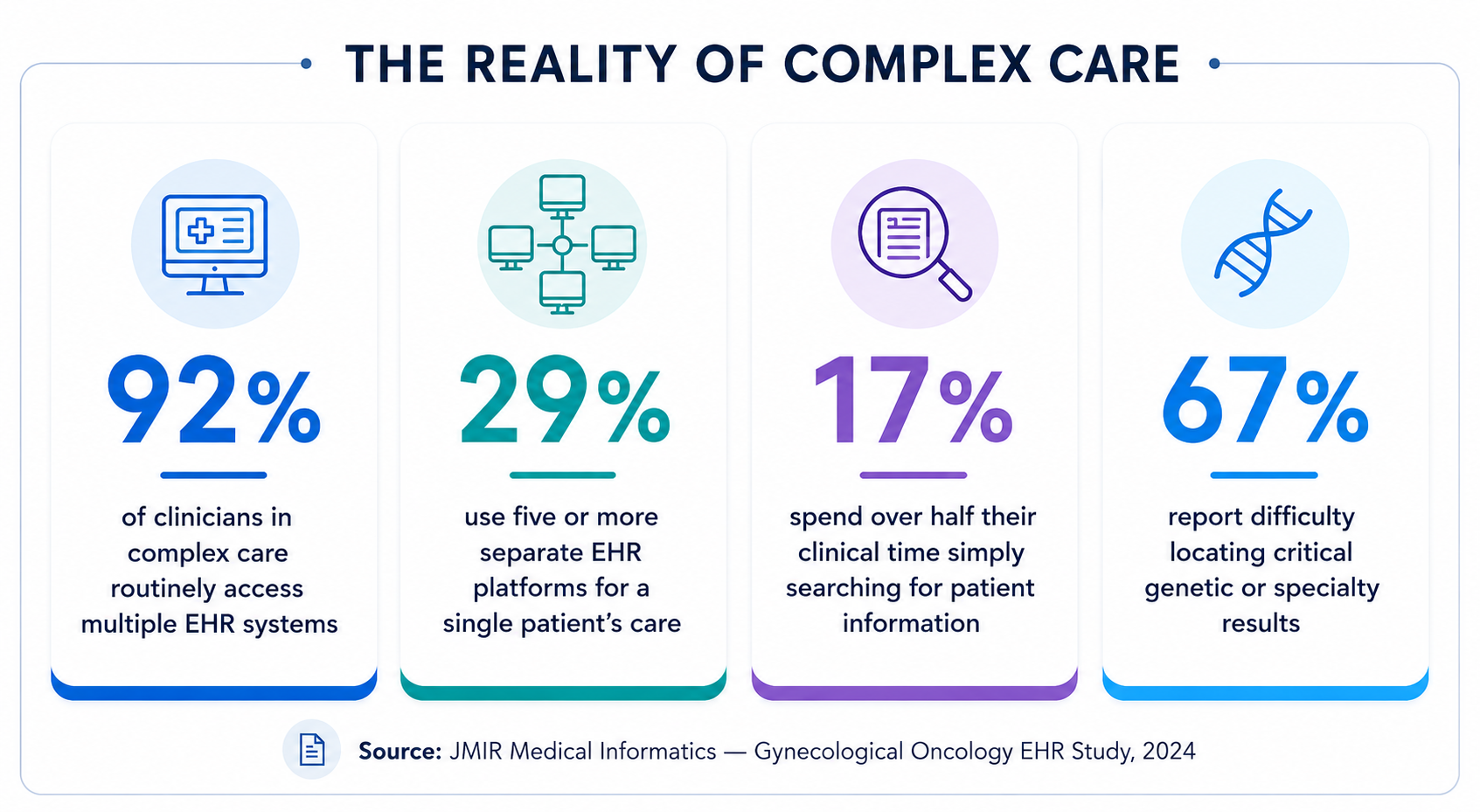
"Current EHR systems are suboptimal for supporting complex clinical decision-making. The data exists. The synthesis does not. Clinicians are effectively doing manual integration — spending cognitive resources on information retrieval instead of clinical reasoning."
— JMIR Medical Informatics, 2024 — Gynecological Oncology Cross-Specialty EHR Study
What this looks like in practice: the resolution of the scenario above
Return to the patient from earlier — 61-year-old, ovarian cancer, nephropathy, DVT, anticoagulation, four treating specialists across two health systems.
Without integrative decision support
The oncologist orders carboplatin at standard dosing. The nephrology note about declining GFR is in a different system and hasn't been reviewed. The drug interaction between dexamethasone and her metformin isn't flagged because pharmacy and endocrinology records don't connect. The hematologist's DVT protocol conflicts silently with a planned dose-dense regimen. Three potential harms. Zero alerts.
With an integrative clinical decision platform
Before the order is finalized, the platform surfaces:
A GFR-based dose adjustment recommendation for carboplatin citing current renal function trend.
A ranked flag on the dexamethasone-metformin interaction with a recommended monitoring protocol.
A cross-specialty alert that the planned regimen should be reviewed against the active anticoagulation status with the treating hematologist.
Each flag includes the evidence source, the specific patient data driving it, and a recommended action. The oncologist has what they need to make a safer decision in the same time it would have taken to open the first note.
Is this an EHR replacement or an EHR layer?
This is the question most clinical administrators ask first, and it deserves a direct answer. An integrative clinical decision platform is not designed to replace EHRs. EHRs serve documentation, billing, scheduling, and regulatory compliance functions that are deeply institution-specific and unlikely to be displaced.
What an integrative platform replaces is the assumption that the EHR is also the right tool for clinical reasoning. It isn't. EHRs are systems of record. Clinical decision platforms are systems of reasoning. These are different functions and they require different architectures.
The most useful mental model:
The EHR is where data lives. The integrative clinical decision platform is where data thinks.
What to look for — and what to avoid
Does it reason or just display?
Aggregating data from multiple EHRs into a unified view is table stakes. The question is whether the platform can generate ranked, explainable, patient-specific clinical recommendations — not just show you the data and leave the synthesis to the clinician.
Is the evidence layer live or static?
A platform that ships with a fixed rule library becomes stale the moment a guideline updates. Look for platforms that map recommendations to current, citable evidence sources that update with the literature.
Can it handle unstructured data — specifically genomics?
If genomic and pharmacogenomic results remain as attachments outside the reasoning layer, the platform cannot support precision medicine decisions. This is non-negotiable for oncology, rare disease, and any specialty where molecular profiling drives treatment selection.
Is explainability built in?
A recommendation without a cited rationale is an alert — and alerts get overridden. Every clinical decision output should show what data drove the recommendation, which guideline it references, and what the recommended action is. Explainability is what separates a useful decision support tool from a liability.
Final thoughts
The dominant assumption in health technology has been that better data access solves the clinical decision problem. Give clinicians more data, faster, in a cleaner interface, and outcomes will improve. This assumption has driven billions of dollars of EHR investment. It is only partly correct.
Better access is necessary. It is not sufficient. Complex patients don't suffer from data scarcity. They suffer from synthesis scarcity — from a system architecture where the burden of connecting genomic data to drug dosing to renal function to cross-specialty protocols falls entirely on the cognitive load of an individual clinician who has, on average, seventeen minutes with the patient.
The integrative clinical decision platform is the infrastructure that closes that gap. Not by replacing the clinician's judgment. By giving that judgment the full picture it needs to be right.
About the Creator
Clarity Tx
ClarityTx empowers clinicians with AI-assisted, evidence-synthesized clinical insights and personalized treatment planning across conventional and integrative therapies helping you build safer, research-backed protocols faster.
Enjoyed the story? Support the Creator.
Subscribe for free to receive all their stories in your feed.
Comments
There are no comments for this story
Be the first to respond and start the conversation.