
Why SEO Thinking Breaks the Moment AI Starts Shaping the Answer
Why SEO Thinking Breaks the Moment AI Starts Shaping the Answer

For years, SEO gave companies a reliable mental model for discovery.
Rank higher. Get clicked. Win more traffic.
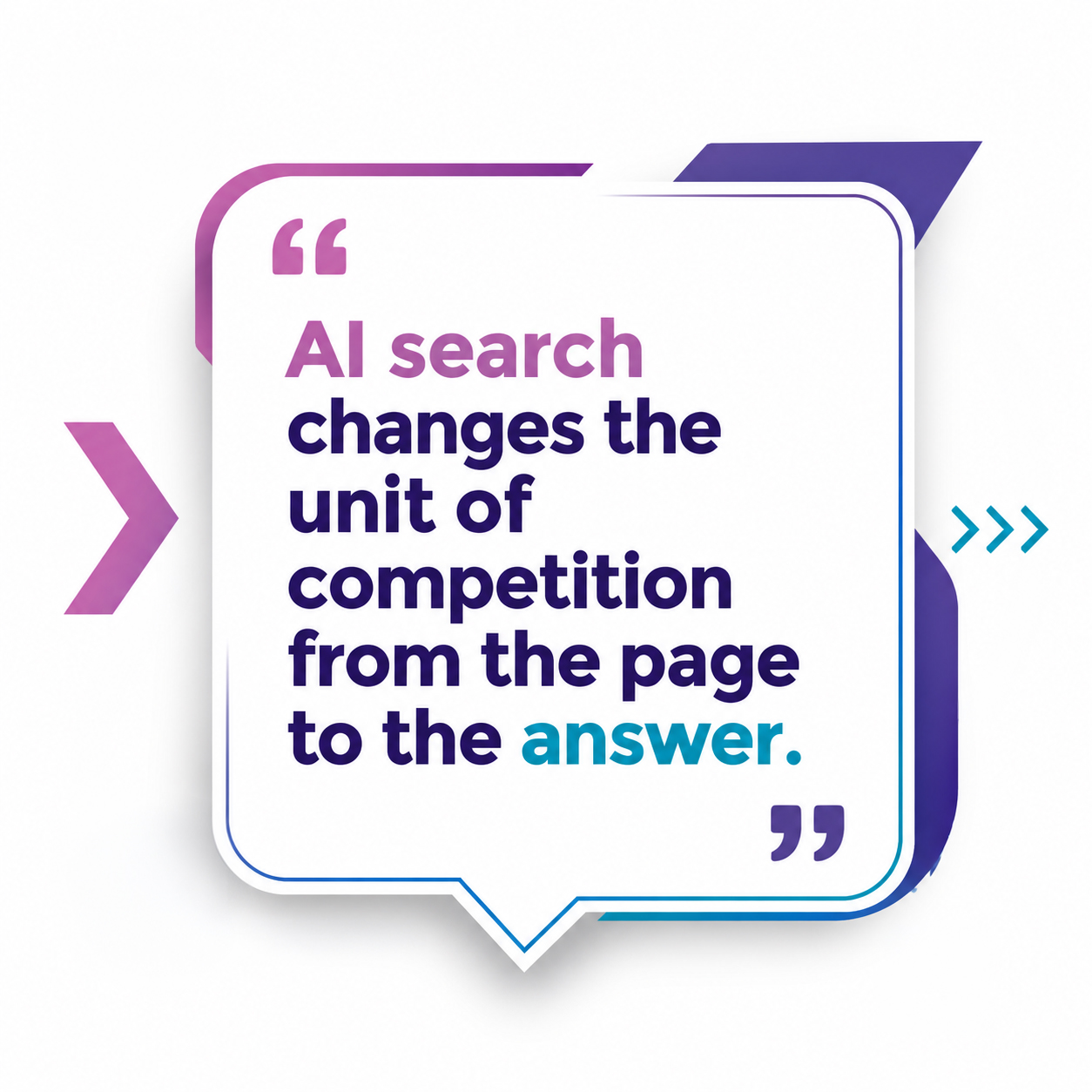
That model still matters, but it no longer explains the whole market. As LLM Authority Index’s article explains, AI search is changing the unit of competition itself. In traditional search, pages competed against other pages.
In AI-driven discovery, the answer becomes the primary surface, and companies compete to be included, framed, and recommended inside that answer. That is why old SEO logic starts breaking so quickly once AI begins shaping buyer decisions.
SEO was built for pages. AI is built for answers
The source article makes the mismatch plain. SEO was designed for a page-based, link-mediated, click-driven environment. AI search increasingly works as a response-based, recommendation-mediated, trust-driven environment.
That is not a small adjustment. It changes how users discover options, how systems structure information, and what it means to “win” visibility.
In classic search, marketers asked which page ranks, which keyword it ranks for, how much traffic it drives, and how to improve that page’s authority or relevance. In AI search, those questions are no longer enough. Once the answer becomes the main product, companies are no longer only competing to rank a page. They are competing to influence a generated response. SEO taught page visibility. AI requires decision visibility.
The user journey is no longer built around browsing
That is where the behavioral shift becomes impossible to ignore.
Traditional search tends to work like this: user searches, search engine retrieves pages, user compares options, user clicks, user evaluates. AI discovery increasingly works like this: user asks, AI interprets intent, AI synthesizes a response, AI recommends or ranks options, user follows the guidance.
The browsing layer shrinks, and once that browsing layer shrinks, many of the assumptions that made SEO so powerful become weaker as explanatory tools. In search, winning attention often meant winning a click. In AI, winning attention increasingly means winning a recommendation.
Links still matter. They just do not explain enough anymore
The source article on Why SEO Thinking Fails in AI Search strongest points is that companies keep asking for the AI equivalent of backlinks.
That question is understandable, but incomplete. In the AI environment, citations and context often matter more than links alone.
LLM Authority Index defines backlinks as hyperlinks that historically served as important ranking signals in search, while citations in AI refer more broadly to the source material an AI system uses, references, or is influenced by. Context then becomes the narrative and framing that repeat across those sources.
That means the authority model changes. Instead of asking only which page linked to you, companies need to understand where they appear across the web, how consistently they are described, how often those descriptions are reinforced, and which source classes seem to shape AI answers in their category.
Watch this video for a quick rundown on the topic.
Ranking and recommendation are no longer the same thing
This is where the error gets expensive.
The article says a company can rank highly in Google search and still be weakly represented in AI answers, because AI systems are not simply reprinting search rankings. They are interpreting the category, reducing the choice set, and generating an answer through their own synthesis process.
That means traditional search rank and AI recommendation frequency are related, but not equivalent. Companies that treat them as interchangeable are likely to misjudge future exposure.
That is also why LLM Authority Index’s article on How to Measure Your Company’s Presence in AI Search matters here.
It argues that traditional analytics can show what happens after the click, but not always what happens before the click, where the recommendation is formed and the decision begins to narrow. It also says mention counts measure presence, not preference.
The deeper failure is page-centric thinking
The source article says the biggest reason SEO thinking fails in AI search is that it stays page-centric in a world that is becoming entity-centric.
SEO asks which page ranks. AI increasingly asks which company, product, service, or entity should be recommended. That changes the whole strategic conversation.
In a page-centric model, the priority is title tags, on-page optimization, internal links, technical SEO, link building, and content refreshes.
In an entity-centric model, the questions become much more commercially direct: Is the company consistently present across relevant prompts? Does the AI understand what the company is best for? Is it framed clearly against competitors? Do the sources influencing AI responses reinforce that positioning? Does the company appear in high-intent recommendation-heavy use cases?
Mentions can look better than they really are
That is exactly where Mentions Are the New Page Two sharpens the argument. That article says many AI SEO reports are still built around the easiest thing to count: mentions. But AI systems do not just list brands.
They summarize, compare, rank, qualify, warn, cite, and exclude. A mention can be technically visible and still be commercially weak. In some cases, it can even be negative visibility dressed up as success.
The real opportunity is happening during the transition
The source article ends on a point that matters more than most companies realize. We are still in a transition period. Many businesses are still using SEO-era assumptions to interpret AI outcomes, still measuring page-level signals while the market is increasingly shaped by response-level decisions. That creates a temporary asymmetry.
Companies that adapt earlier can see competitive shifts sooner, identify weak recommendation coverage faster, understand where search leadership is failing to carry into AI, and act before slower competitors even realize there is a problem.
About the Creator
Taylor Hill
Social media strategist analyzing algorithms, viral loops, and community building through actionable case studies.
Enjoyed the story? Support the Creator.
Subscribe for free to receive all their stories in your feed.
Comments
There are no comments for this story
Be the first to respond and start the conversation.