
Why Realistic Facial Injection Models Are Essential for Training
Mastering Technique and Avoiding Risk Starts with the Right Tools
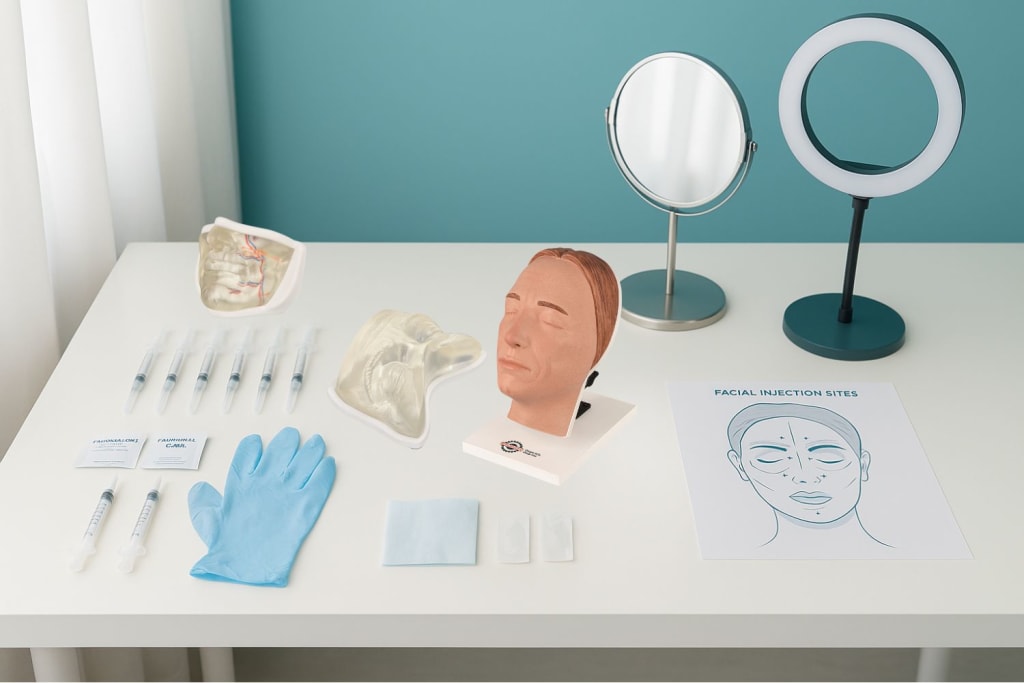
When it comes to facial aesthetic procedures, confidence doesn't come from watching tutorials - it comes from hands-on experience. Whether you're a beginner learning dermal filler basics or an advanced injector refining tear trough or nasolabial fold techniques, training with realistic anatomical models is one of the most important steps in building true expertise.
In this article, we'll explore why facial injection models are more than just practice tools - they're critical instruments for safety, skill-building, and patient trust.
The High-Stakes Nature of Facial Injections
Aesthetic injections are often viewed as routine, but in reality, they involve navigating complex vascular structures and soft tissues - often just millimeters from critical danger zones. A misplaced filler injection can result in bruising, asymmetry, or more seriously, vascular occlusion and tissue necrosis.
New injectors frequently underestimate:
- The subtlety of correct needle depth
- The real resistance felt when inserting a cannula
- The variation in facial anatomy among individuals
- The importance of angle, aspiration, and precise volume control
These can't be fully understood through diagrams or video demonstrations alone. Realistic simulation, in a safe, repeatable environment, is essential.
Why Facial Injection Mannequins Are a Game-Changer
High-quality facial injection mannequins are designed to replicate both the surface topography and the underlying anatomical structures - such as blood vessels, fat compartments, and bone landmarks.
Some advanced models now include transparent skin or vascular mapping, allowing injectors to practice:
- Needle angle adjustments
- Cannula redirection
- Safe filler placement in relation to danger zones
- Evaluating correct depth for each region (temple, cheek, tear trough, chin, etc.)
This is especially valuable for visual learners who benefit from seeing exactly what's happening under the surface. When learners can visualize and feel their technique, retention is much more effective.
Bridging the Gap Between Textbook and Real Skin
In live patient training, mistakes can lead to visible or lasting harm. Yet, in a facial injection mannequin, mistakes become valuable feedback loops. You can repeat a technique dozens of times until it feels second nature - all without risk to a person.
Many institutions, aesthetic academies, and independent trainers are now integrating these models as a core part of their curricula. They're used to teach:
- Filler injections for volume restoration
- Neuromodulator techniques (Botox, Dysport)
- Cannula vs. needle comparisons
- Patient safety and emergency protocols
At MedEduQuest, the facial injection model collection was designed by clinical educators to meet the real-world demands of training. Each model replicates accurate anatomical contours and offers reusable injection zones for hundreds of punctures - with options for various skin tones and visible vessels.
Key Features to Look For in a Facial Injection Training Model
When choosing a model, not all mannequins are created equal. Consider the following:
- Anatomical Accuracy: Does the model include key vasculature and facial fat compartments?
- Skin Quality: Is the material puncture-resistant yet soft enough to mimic real tissue?
- Multi-Zone Practice: Can you practice on multiple regions - tear trough, nasolabial folds, temples, cheeks, and chin?
- Reusability: How many times can it be injected before showing wear?
- Transparency Options: Can you see your needle or filler under the surface?
These features not only support technical skill-building but also instill safer habits, like avoiding high-risk zones and verifying placement before injecting.
From Classroom to Clinic: How Models Elevate Confidence
One of the biggest benefits of using facial injection mannequins is psychological: they build confidence.
New injectors often report feeling hesitant or uncertain during early patient sessions. After practicing on a high-fidelity training model, they gain:
- Muscle memory of correct techniques
- A clear understanding of facial anatomy
- Better judgment about when to aspirate, redirect, or switch tools
- A more professional demeanor when working with real clients
When learners transition from model to patient, they do so with clarity and control - reducing errors and improving outcomes.
Final Thoughts: Real Learning Comes from Real Practice
No amount of theoretical study can replace the value of real-time, physical feedback. If you're serious about delivering safe, precise, and beautiful aesthetic results, incorporating a facial injection mannequin into your training is non-negotiable.
These models aren't just for beginners. Even seasoned professionals use them to explore new techniques, test new products, or rehearse rare cases.
Want to explore more? Browse our full model collection here.
About the Creator
Enjoyed the story? Support the Creator.
Subscribe for free to receive all their stories in your feed.
Comments
There are no comments for this story
Be the first to respond and start the conversation.