
Why English Still Matters for Ordinary People
It won’t make you rich. It can give you more doors to knock on.
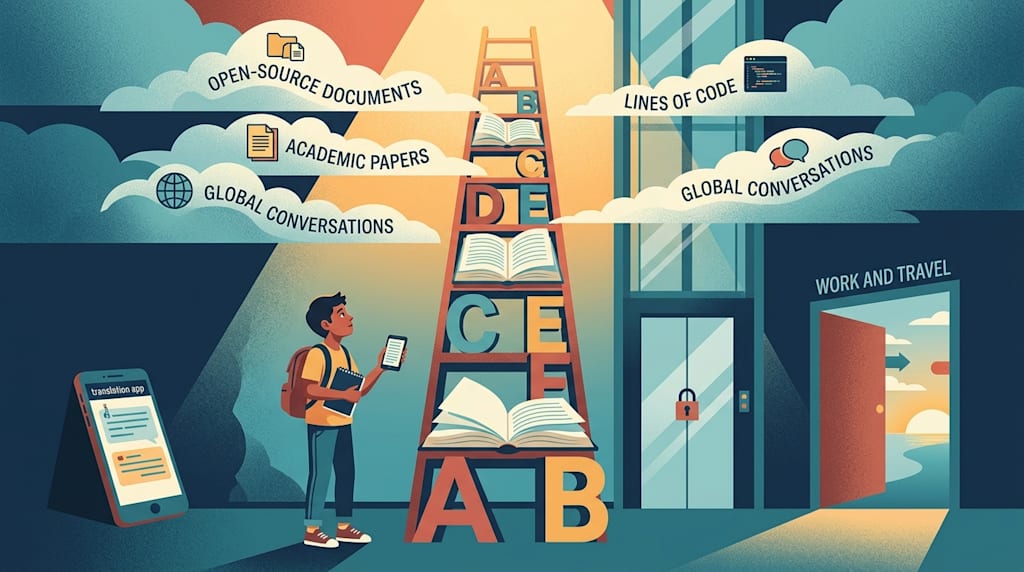
The argument over English as leverage flared again in September 2026. Supporters point to doubled salaries. Critics call it worship of a language. The surface fight is about English. The deeper question is whether ordinary people still have a low-cost way to change their situation.
My answer: English is useful. It is not a magic cure. It is one of the cheapest, fairest, longest-compounding levers an ordinary person can hold. A lever does not create force. It multiplies force. English does not hand you wealth. It multiplies your ability to get information, enter new markets, and connect with the world. Use it well, and it can move something. Use it poorly, and it is another subject you forget after the exam.
I. Information Gap: The Cost of Waiting for a Translation
The world is not flat. Information is layered.
More than half of the internet and over 90 percent of top scientific and technical literature are in English. If you know English, you can go to the source. You do not wait for someone else’s translation. You do not rely on second-hand interpretation. You do not sift through opinions that have already been filtered.
Translation has value. It also lags, filters, and misreads. A new concept, a new technology, or a new business model may take months or years to move from the English-speaking world to the Chinese-speaking world. Those months are a window.
A freelance developer had average English but could force his way through English documentation. When a new framework released its docs on GitHub, he read them overnight and started taking related contract work the next day. By the time he made his first money, no Chinese tutorial existed. Another developer, no less skilled, waited for the Chinese community to update. By the time it did, the market was crowded. Information gap becomes cognitive gap. Cognitive gap becomes income gap.
English lets you read open-source docs, industry reports, overseas podcasts, and international community discussions directly. You stop passively receiving information. You start actively searching for it. That initiative is rare, and it is valuable.
II. Career Premium: A Salesperson Who Knows English Is in International Trade
A common objection is that good English does not equal high income. True. Under equal conditions, people with good English have more choices.
Two salespeople. One knows English. His job is called international trade. The other does not. His job might be local street sales. Two customer service reps. One knows English and serves global clients. The other stays on the local hotline. Two programmers. One reads English docs and contributes to overseas open-source projects. His ceiling is higher. English does not directly give you a high salary. It pulls you out of the local labor market and into the international division of labor. A bigger pool means a higher chance of opportunity.
Foreign companies, cross-border trade, overseas postings, international organizations, study-abroad consulting, and cross-border e-commerce often use English as the first filter. It does not guarantee you get in. Without it, you cannot pass the resume screen. Job postings say fluent English. Those two words are a door. Behind the door, salaries are often several thousand yuan higher.
English itself is not the source of the premium. Communication, information processing, and cross-cultural collaboration are. Companies pay for people who can connect directly with the world. The most expensive thing for an ordinary person is not money. It is choice. English is one of the cheapest ways to buy choice.
III. Low Barrier, High Fairness: One Phone, One Internet Connection
Piano, horseback riding, painting, and golf are good skills. They need money, space, and networks. English is different. One phone, one internet connection, and free resources. What remains is daily persistence.
It does not depend on family background. It does not care about your origins. It does not require genius. Ten words a day. Ten minutes of a podcast. One page of an original book. A year later, you have one more window than your past self. A skill with a low barrier and high compounding is rare for ordinary people.
This is why higher-income groups care more about their children’s English education. They know English connects you to the world. Schools treat it as a subject. If English is removed from the core curriculum, it may become like piano, a standard fixture for middle-class and above families. Ordinary children lose even the chance to touch the keys. What chance do they have to enter finance, IT, or international organizations?
This is not alarmism. It is resource logic. Once a capability becomes a luxury, class rigidity speeds up. If English stops being a foundation of public education, it becomes a new gate. Ordinary people lose not just a language. They lose a channel to a larger world.
IV. A Reality Check: English Is an Amplifier, Not a Creator
A single language rarely achieves complete class crossing.
English works as an amplifier. It does not create value by itself. It amplifies your professional skills, your business thinking, and your technical value. If you have no profession, no skill, and no business thinking, even fluent English is just fluent mediocrity.
A translator who only knows English may be replaced by AI. An engineer who knows English, a doctor who knows English, an operations person who knows English, or a lawyer who knows English is harder to replace. English is a tool. Expertise is the core. English plus expertise is the combination that matters.
The domestic job market is increasingly competitive. IELTS, TOEFL, and other certificates become the first resume filter. These certificates give recruiters a kind of disclaimer. They are the ticket to a chance to show what you can do. A certificate is only a ticket, not the performance. Without a ticket, you cannot get in. With only a ticket, you cannot perform. What decides how far you go is still your professional depth and your ability to solve problems.
Do not treat English as a life-saving straw. It cannot save people without direction. It cannot save people unwilling to act. It can only give people already on the road an extra pair of wings.
V. The AI Era: Will English Disappear?
A common question is whether AI translation makes English unnecessary.
AI will change how English is used. It will not cancel the value of English. AI can translate a menu. It cannot negotiate for you. AI can translate a paper. It cannot understand context for you. AI can translate an email. It cannot build trust for you in a cross-cultural setting. Language is not just information transfer. It is culture, emotion, relationships, and judgment.
In the future, English ability will stratify. The bottom waits for translation. The middle uses translation. The top communicates directly. You do not need native-level mastery. You need the ability to use English deeply when it matters. If you can search, communicate, and judge directly in English, you have one more layer of initiative than people who can only wait for translation.
AI is not the terminator of English. It is the accelerator. People who can use English can treat AI as a tool. People who cannot use English can only wait for others to use AI to feed them. The gap will not disappear. It will take another form.
VI. The Ladder Argument
So is English the ultimate leverage for ordinary people?
It is one of the cheapest levers. The other end of the lever must be your expertise, your thinking, and your action. Without those, no matter how long the lever, it cannot move your fate.
Call English a ladder rather than the ultimate leverage. It does not promise you will reach the top. It gives you the right to look upward. It does not guarantee class mobility. It keeps you from being trapped by a single information source. It keeps you from living inside a cognitive cocoon.
The thing you learn is choice. The right to read first-hand material. The right to enter a larger market. The right to understand another culture. The right to understand, catch, and walk out when opportunity arrives.
Do not worship English. Do not underestimate it. Treat it as a tool, a ladder, a training wheel. A little every day. Combine it with expertise. Keep acting.
Tomorrow morning, open an English podcast. Listen for ten minutes. Then close it. Go to work.
About the Creator
Jin
Writer of reamstories
https://reamstories.com/jin
Enjoyed the story? Support the Creator.
Subscribe for free to receive all their stories in your feed. You could also become a paid subscriber, letting them know you appreciate their work.
Comments
There are no comments for this story
Be the first to respond and start the conversation.