
What If You Stopped Using AI, and Started Understanding How It Is Built?
A Book for People Who Want to Understand AI from the Inside.

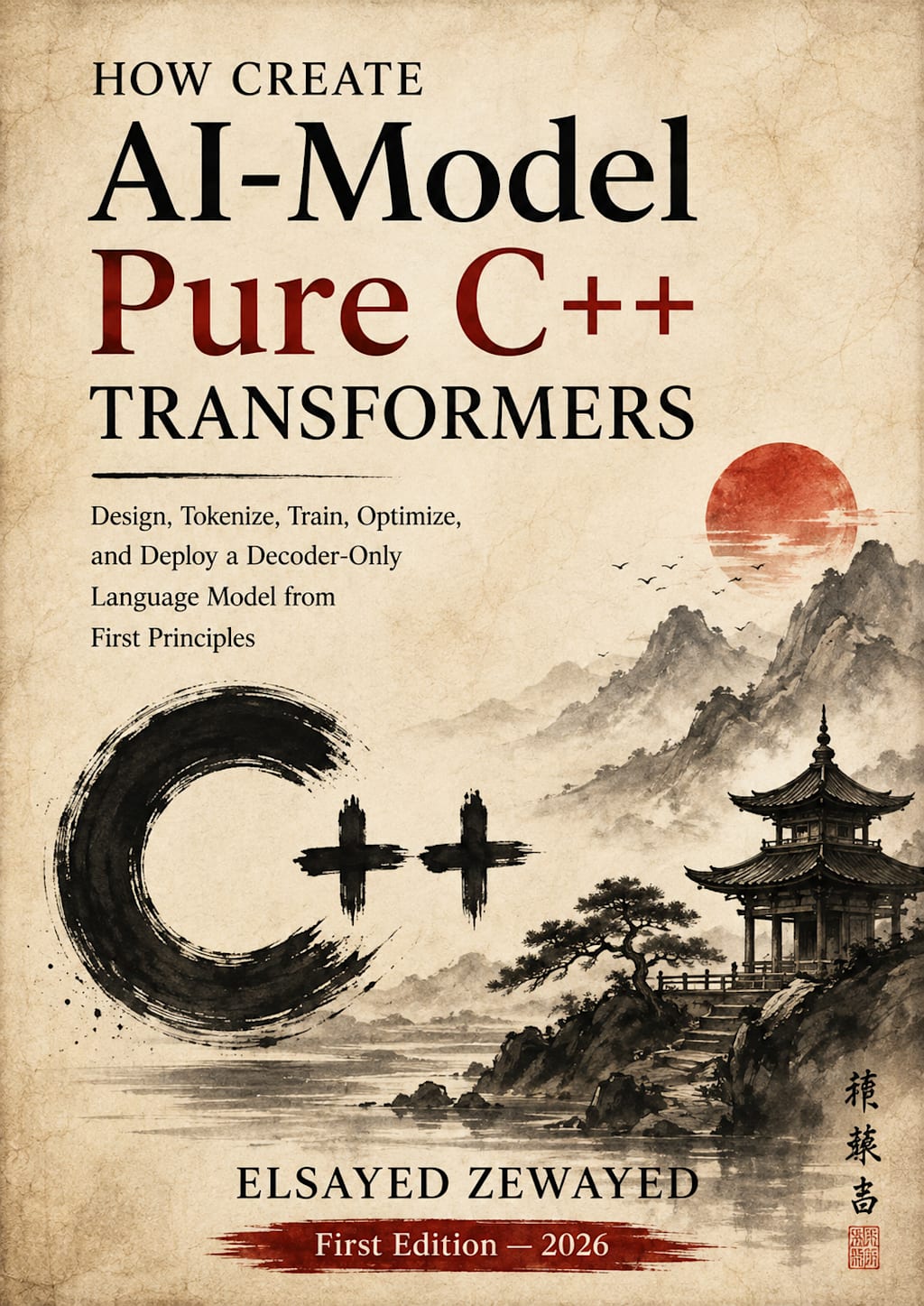
A Closer Look at Pure C++ Transformers: A Book for People Who Want to Understand AI from the Inside
There is no shortage of books about artificial intelligence right now. Some explain how to write prompts. Others introduce machine learning with Python. Many show readers how to download a pretrained model, run a notebook, and produce impressive results within an hour.
There is nothing wrong with that approach. In fact, it is probably the easiest way to enter the field.
But Pure C++ Transformers takes a noticeably different route.
The book is built around a simple question: what happens if, instead of learning how to use a language model, you try to understand how one is actually constructed?
That distinction matters.
The reader is not introduced to a Transformer as a mysterious object sitting behind an API. The model is gradually broken into smaller pieces: tokens, embeddings, attention, normalization, feed-forward networks, residual connections, logits, loss functions, gradients, optimizers, checkpoints, and inference.
It is an engineering view of AI rather than a consumer view of AI.
That is probably the book's strongest feature.
C++ Changes the Perspective
Choosing C++ for a book like this is slightly unusual. Python dominates machine learning education for good reasons. It is easier to read, the ecosystem is enormous, and experimentation is fast.
The book does not really try to argue that C++ should replace Python. That would be difficult to defend.
Instead, it makes a more interesting argument: C++ forces the developer to look at parts of the system that high-level workflows often make easy to ignore.
Memory matters.
Tensor shapes matter.
Data types matter.
CPU and GPU placement matter.
Build configuration matters.
Dependencies matter.
Runtime behavior matters.
When something fails, the programmer often has to understand why.
That can make the learning curve steeper, but it also makes the subject less abstract.
A tensor with dimensions [B, T, D] is not simply passed to another function and forgotten. The reader is encouraged to understand what those dimensions represent, how they change inside attention, and what happens when a hidden dimension is divided across multiple heads.
For someone trying to understand Transformer engineering rather than merely Transformer terminology, that approach has real value.
The Interesting Part Is What Happens Between the Diagrams
Most people who have spent time reading about Transformers have seen the familiar architecture diagram.
Tokens enter at the bottom. Attention appears somewhere in the middle. A feed-forward network follows. Several blocks are stacked. Eventually the model produces an output.
The diagram is useful, but it hides a lot.
What exactly creates Query, Key, and Value?
Why is the Key tensor transposed?
Why are attention scores divided by the square root of the head dimension?
What does a causal mask prevent?
Why does a decoder-only model need to hide future tokens during training?
These are the kinds of questions the book spends time on.
The mathematical expression for attention is presented alongside the corresponding computational operations. That connection between equation and implementation is particularly useful. Mathematics stops being something placed in a chapter for academic completeness and starts becoming an explanation of what the code is doing.
The same approach appears later with cross-entropy, AdamW, learning-rate scheduling, gradient clipping, and parameter counting.
Training Is Treated as a System
One of the better decisions in the book is that training is not described simply as “run the model on a dataset.”
Real training is more fragile than that.
A useful training pipeline has to manage batches, gradients, optimizer state, learning rates, numerical precision, checkpoints, and recovery.
The book spends time on questions that become important only after you have actually tried to train a model.
What happens when gradients become unstable?
Why does the optimizer require memory in addition to the model weights?
How much memory does a 100-million-parameter model really consume during training?
What happens if some tensors are FP32 while others are BF16?
What must be stored if training is expected to resume correctly after a shutdown?
These topics make the book feel closer to engineering practice than to a classroom introduction.
Checkpointing is a good example. Saving model weights is easy. Resuming an experiment from the exact previous state is not necessarily the same thing. Optimizer state, training progress, random state, configuration, and dataset position may all matter.
That is the kind of detail that beginners rarely think about until something goes wrong.
It Does Not Stop When Training Ends
Another strength is that the discussion continues into inference.
A trained model still needs a generation system.
The book looks at greedy decoding, temperature, Top-K, Top-P, repetition control, and KV caching. This helps demonstrate that generated behavior is influenced by more than the learned parameters alone.
KV caching is especially useful to understand because it exposes an important difference between training and autoregressive inference. During generation, previous Key and Value tensors can be reused rather than calculated repeatedly.
Again, the interesting part is not just learning that a KV cache exists. It is understanding what is stored, how positions are handled, and how cached generation should be validated against ordinary forward computation.
This Is Not a Five-Minute AI Book
That is also the book's main limitation, depending on the reader.
Someone completely new to programming will probably find it demanding.
The book assumes that the reader is willing to deal with C++, CMake, PowerShell, compiler configuration, libraries, tensors, and mathematical notation. It attempts to explain them progressively, but it does not pretend that building a Transformer is effortless.
That is actually a positive quality if the expectation is set correctly.
This is not a “build ChatGPT in twenty minutes” type of book.
It is better suited to programmers, engineering students, AI developers, and technically curious readers who want to understand what exists beneath the convenience layer.
The Real Value Is the Change in Perspective
Perhaps the most useful thing about Pure C++ Transformers is not any individual piece of code.
It is the way the subject gradually becomes less mysterious.
An AI model stops looking like a single intelligent object and starts looking like a system of understandable operations.
Text becomes tokens.
Tokens become vectors.
Vectors enter attention.
Attention changes representations.
Training measures prediction error.
Gradients modify parameters.
Checkpoints preserve state.
Inference turns those parameters back into language.
None of those pieces is particularly magical on its own.
The remarkable part is how they work together.
For readers who are satisfied with using AI tools, there are easier books.
For readers who have started asking what happens underneath those tools, this one takes the more interesting road.
About the Creator
Sayed Zewayed
writer with a background in engineering. I specialize in creating insightful, practical content on tools. With over 15 years of hands-on experience in construction and a growing passion for online, I blend technical accuracy with a smooth.
Enjoyed the story? Support the Creator.
Subscribe for free to receive all their stories in your feed.
Comments
There are no comments for this story
Be the first to respond and start the conversation.