
We’re Turning University Libraries Into Study Halls. We’re Losing the Accident That Makes Them Matter.
Students need quiet seats. They also need shelves they didn’t plan to walk past.
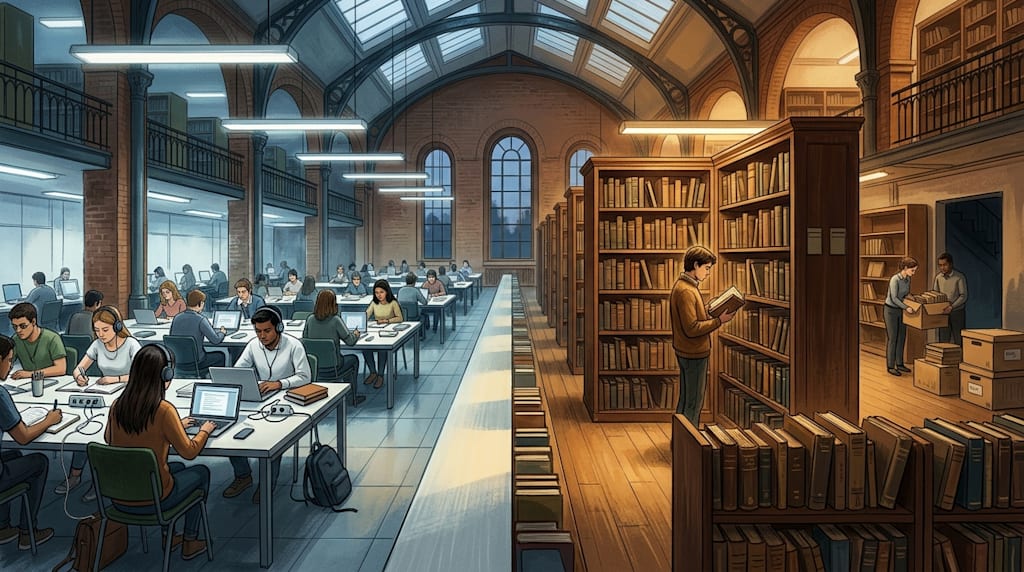
Two weeks before exam week, the line outside the library stretched from the first floor to the third. Someone arrives at 6:30, puts a bag on a chair, and then goes to buy breakfast. Someone else claims a seat but never shows up all day, leaving only a note that says “Taken.” Rows of students wear headphones, facing their computers and books, so quiet that the only sounds left are pages turning and keyboards clicking.
This scene is familiar. For many students, the library is the most stable, quietest, and most suitable place to review. A seat is hard to find during exam week, and it can be tight at other times too. Everyone needs more study space. This demand is entirely reasonable, and the school should not use “the library should be for reading” to deny it.
But “adding more study space” and “turning the library into a study hall” are two different things.
A study room solves “I need a place to finish a task.” The library also carries something else: I want to encounter knowledge I would not have actively gone looking for. These two things can happen at the same time, but they cannot replace each other.
If the library provides only desks, chairs, power outlets, and Wi-Fi, it is barely different from a public study room in a classroom building. What makes the library different is that it gathers a large number of books, journals, and knowledge from different fields in one space. This space is not just a container. It also creates a particular kind of encounter: you did not set out to find any particular book. You may have gone only to do homework or prepare for an exam. But as you walk between the shelves, you see a completely unfamiliar book, open it casually to a few pages, and only then does interest slowly begin.
Once in college, I went to the library to borrow a communication studies textbook. As I passed the shelves, I saw a book next to it about the history of city streets. The cover was old, and the title was not appealing. I pulled it out, flipped through two pages, and stood in front of the shelf reading for twenty minutes. That book had nothing to do with my exam, but I still remember it explaining how sidewalk width affects interactions between strangers. If those shelves had not been there, I would not have searched for “street history,” and the algorithm would not have pushed it to me.
Algorithms constantly push toward you what you already like. They are good at catering, and good at reinforcing preferences. Library shelves, by contrast, can take you into a field you had no plan to enter. You may go to borrow a book for a problem set and end up drawn to a nearby book on natural history, philosophy, or literature. You may care only about GPA and exams, and then one afternoon realize that there are questions that do not improve a grade but change how you see something.
If university education revolves only around GPA, graduate entrance exams, and job placement, students easily spend all their time completing clearly defined tasks. The library preserves a small space that is not quite so utilitarian. This space does not need to be large or refined, but it needs to exist.
I do not think the library should reject the demand for study space. Students do need a stable environment, and there is no need for the school to set reading and studying against each other. A more reasonable approach is functional zoning within the library: quiet study areas, discussion areas, and reading areas, each with clear rules. At the same time, build more independent study rooms to absorb the needs of exam-prep crowds. A public space can hold more than one use at once. Some people are preparing for exams, some are looking up sources, some just want to read a book for pleasure. As long as they do not disturb one another, these uses can share the building.
But functional zoning cannot remain a slogan. If reading areas are constantly compressed, new books and themed shelves pushed into corners, and the borrowing process made more and more inconvenient, then “the library still has a reading function” is only formal preservation. If the school wants to protect the library’s public reading character, it needs to provide guarantees in space and policy: make books easier to see, make interdisciplinary recommendations more visible, make borrowing convenient enough, and keep reading areas from being constantly squeezed by study demand.
Reverse the picture: if a university library ends up with only seats and power outlets, in the short term it improves study efficiency. A few years later, after renovation, the desks and chairs are neat, outlets are plentiful, the shelves have been gathered into the basement or a corner, students grind through problem sets efficiently, and no one stops anymore because they are passing the shelves. In the long term, the university loses a bit of its openness, freedom, and capacity for serendipitous discovery. This loss will not appear in any efficiency report, but it will appear in how students feel about “what a university is.”
Students themselves might also give the library a little more imagination. Even if it is only one book a month that interests you, even if it is only one hour outside of exams, walk among the shelves. Not everyone has to become a book person, but a university should at least preserve a place where people without a clear task can sit down, turn a few pages, and think about questions that do not yet have answers.
The next time you walk into the library, if you are only there to grind through problem sets, that is fine. But if you are willing, take two extra steps among the shelves. Those two steps will not raise your GPA, but they may lead you to a book you would not have actively searched for. The library needs to keep room for those two steps.
About the Creator
Jin
Writer of reamstories
https://reamstories.com/jin
Enjoyed the story? Support the Creator.
Subscribe for free to receive all their stories in your feed. You could also become a paid subscriber, letting them know you appreciate their work.
Comments
There are no comments for this story
Be the first to respond and start the conversation.