
We’re Raising the First Generation That Can’t Read Past 400 Words
The test scores keep falling. It isn’t intelligence. It’s the screens, the algorithms, the AI, and the silence at the dinner table.
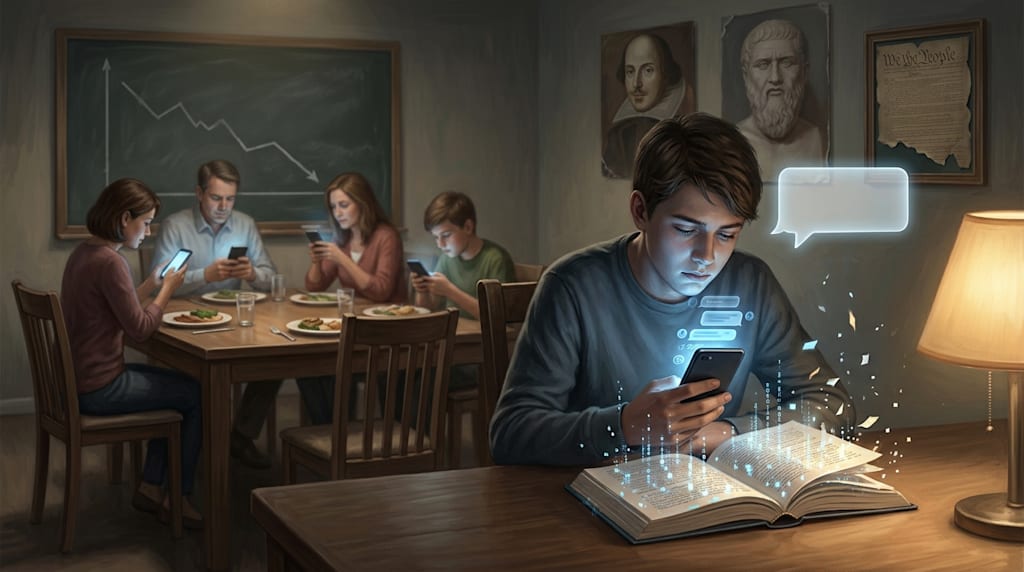
The vanishing reader: why Gen Z’s test scores are falling
In 2025, the OECD released its latest PISA results. Reading, mathematics, and science scores among 15-year-olds in most Western nations fell again. The decline started around 2012. After the pandemic, it sped up. Reading took the hardest hit. PISA tracks a group it calls rushed readers. These students skim questions, do not finish texts, and guess. In 2018, 6.6 percent of students fell into that group. By 2025, 11.4 percent. The number nearly doubled.
The data shows an environmental problem, not an intelligence problem. Screens, algorithms, and artificial intelligence now shape attention, memory, and reading habits. Test scores are not a verdict on ability. They are a warning about a changed world.
A digitized childhood
In the West, the average teenager spends more than seven hours a day in front of a screen. That time does not go to novels. It goes to scrolling, liking, sharing, and short videos. The smartphone is always on, always buzzing, always asking for attention.
Neil Postman warned in Amusing Ourselves to Death that a culture saturated with entertainment would lose its capacity for serious thought. Marshall McLuhan said the medium is the message. Nicholas Carr argued in The Shallows that the internet rewires the brain for distraction. These were predictions, not moral panics. They have come true.
Deep reading needs sustained attention. It needs patience, silence, and the willingness to be bored. Social media rewards speed, novelty, and constant stimulation. The brain adapts. It learns to skim. It does not learn to absorb. PISA data confirms this. Students read faster and understand less. They scan for keywords. They do not follow arguments. They cannot hold complex ideas in mind long enough to judge them.
The AI crutch
Artificial intelligence has made the problem worse. Tools like ChatGPT can write essays, summarize books, and solve math problems in seconds. Used well, they can be powerful tutors. Used poorly, they hollow out the mind.
Andreas Schleicher, the architect of PISA, warns that AI is hollowing out the skills young people need. PISA data shows that students who use AI often score lower than those who use it rarely. The gap can reach 20 to 30 points. That is roughly a year of schooling. Students who ask AI to draft essays or summarize texts also perform worse in science.
Learning requires struggle. The Socratic method and the seminar room depend on the learner wrestling with difficult material. AI removes the struggle. It gives answers before the student has formed the question. The result is a generation that can prompt but cannot think.
The collapse of family conversation
Learning does not happen only in classrooms. The family dinner table was once a school of language and logic. In France, 62 percent of parents regularly discussed school with their children in 2018. By 2025, that number had fallen to 48 percent. Similar declines appear in the United States, the United Kingdom, and Germany.
When families stop talking, children lose more than company. They lose practice in forming arguments and expressing complex emotions. They lose vocabulary. They lose curiosity. A screen in every hand can mean a silent house. Silent houses can produce silent minds.
The pandemic as accelerator
Many people blame COVID-19. School closures caused huge learning loss. Reading scores fell by the equivalent of more than a year of schooling. But the decline began before 2018. The pandemic exposed a problem that already existed. It sped up a trend already in motion.
Education systems lag behind
Schools have not adapted. Teachers are not trained to teach AI literacy, media criticism, or deep reading strategies. Curricula remain stuck in the twentieth century. At the same time, socioeconomic gaps are widening. Wealthy families can provide quiet rooms, books, tutors, and strict screen limits. Poorer families cannot. The Western ideal of public education as an equalizer is failing. The digital divide is becoming a cognitive divide.
The Flynn effect reversal
For most of the twentieth century, average IQ scores rose. This was called the Flynn effect. Now, in several Western countries, it has reversed. Average scores on executive function and memory have fallen.
The cause is environmental. The brain allocates resources where they are needed. In a world of notifications and instant feedback, the brain invests in rapid switching. It invests less in deep reading and sustained attention. The potential is still there. The practice is not.
What is lost
Western civilization was built on long-form reading. Plato and Shakespeare shaped how the West thinks about justice, love, power, and the self. Democracy depends on citizens who can read complex arguments and evaluate evidence. Thomas Jefferson insisted that an educated citizenry is the foundation of self-government. John Dewey argued that democracy and education are inseparable. Jürgen Habermas described a public sphere where reasoned debate shapes policy.
That system requires literacy. It requires the ability to read a book, follow an argument, and change one’s mind. A generation that cannot read beyond 400 words will struggle to defend self-government, sustain a public sphere, or inherit the Western tradition.
What can be done
Individuals can reclaim attention. Thirty minutes of daily reading with the phone off is a start. Writing by hand, without AI, rebuilds the muscle of thought.
Families can restore the dinner table. Read aloud. Discuss the news. Ask questions. Put the phone in another room.
Schools can teach AI literacy, critical thinking, and deep reading. They should not ban technology. They should teach students to use it without being used by it.
Policymakers can fund libraries and train teachers. They can also close the digital divide. They can treat attention as a public good rather than a private commodity.
Conclusion
The environment is the problem. The decline in test scores measures a culture that has traded depth for speed and wisdom for information. The West has adapted before. It adapted to the printing press. It adapted to television. It can adapt again.
But adaptation is not automatic. A fifteen-year-old who cannot finish a 400-word article will not finish a ballot measure or a lease. That is the stakes.
About the Creator
Jin
Writer of reamstories
https://reamstories.com/jin
Enjoyed the story? Support the Creator.
Subscribe for free to receive all their stories in your feed. You could also become a paid subscriber, letting them know you appreciate their work.
Comments
There are no comments for this story
Be the first to respond and start the conversation.