
We Already Have 1,000 Einsteins. They're Just Locked Out.
Bezos dreamed of a trillion minds to change the world. The real scandal is the 8 billion we're already wasting—and the single curve a child draws on a desk before the bell rings.
Jeff Bezos once said: If we had a trillion people, there would be a thousand Einsteins.
On first hearing, it sounds elegant. There is a kind of mathematical honesty to it—if the proportion of geniuses in the total population is roughly constant, then a larger base yields a larger absolute number. Following that logic, at a trillion people, humanity would simultaneously possess hundreds of minds capable of rewriting physics textbooks. Dozens of industrial revolutions would overlap on the timeline, and civilization would seem to have been fast‑forwarded.
But this reasoning rests on a hidden premise: that genius arises solely from the random shuffling of genes. That premise is wrong.
In 1921, in Salonica, Turkey, a boy was born into a modest Jewish family. His father had sold cloth; his mother stayed home with the children. If we follow the simple probability calculus, that boy should have been lost among the millions of other infants born that same year. But his city had a peculiar atmosphere—people of different languages conversed on the docks, people of different faiths haggled in the same bazaar. His elementary school teacher allowed him to arrive late, knowing that he stayed home reading physics books. He later changed his name to Einstein.
Move forward seventy years. In a mountain village in Hunan, another boy, at the same age, drew the solar system on a wall with charcoal. His math teacher walked over, looked, and said: "Walls are not for drawing." He later went to a Shenzhen electronics factory, tightening screws on an assembly line for fifteen years. If you met him in 2023, you would see a permanent callus between the index and middle fingers of his right hand. He does not know who Einstein is. He only knows that it is six days a week, twelve hours a day.
Between these two starting points, the difference is not genes—it is a door. The first door was open. The second was locked.
Among the "trillion people" Bezos speaks of, the ones who could actually grow into Einsteins are not a random draw of a trillion newborns. They are the tiny minority who happen to be placed in the "fertile soil." And that soil is never distributed evenly. It follows an older logic—parents' education, whether a primary school has a laboratory, whether there is someone in the community who can answer a ten‑year‑old's question about why light travels in a straight line, whether the examination system leaves a crack for those who do not think in standard answers.
Those cracks are narrowing.
This is not anyone's conspiracy. It is simply the inertia of a system running continuously. Quality educational resources gravitate toward higher‑income households—not through coercion, but through the price of school‑district housing. The intergenerational transmission of early cognitive stimulation does not rely on genetics, but on the number and complexity of bedtime stories. When a potentially gifted child is born into a family where both parents work overtime, his "genius" is more likely to manifest as lightning‑fast thumb movements on a phone screen than as the rudiments of general relativity.
Someone might say: so what? Even if only one in ten thousand among a trillion people can break through class barriers, that is still a hundred million. Among a hundred million breakthroughs, surely there should be a thousand Einsteins?
What this number game overlooks is that breaking through barriers itself consumes vast cognitive resources. One child must spend half his mental energy figuring out why he does not have a new school uniform, and the other half coping with exams. Another child can devote all his mental energy to asking what time is. The former is not less intelligent; he is just more exhausted.
This is not a romantic tragedy. It is a ledger of energy expenditure.
So when we revisit Bezos's statement, the real question is not whether a trillion people would be enough—it is why, with only eight billion people, we are already comfortably wasting the vast majority of our potential geniuses. We do not need to wait for population expansion to the trillion scale. We already have enough young people today. They sit in stuffy dormitories, scrolling through exam‑prep videos on second‑hand phones. One of them, on some afternoon, might stare at the clouds outside the window and suddenly wonder about atmospheric refraction—but the next second, the bell rings, and he must return to the standard problem about acceleration.
That question disappears. Along with his momentary trance.
In Bezos's dreamed trillion‑world, a thousand Einsteins may indeed be born. But where will they be born? What do their fathers do? At what age will they first see a microscope? When they first raise a "non‑standard" question, will they be encouraged, or corrected?
The answers to these questions determine everything, long before the base population does.
In 1982, a young Italian physicist named Carlo Rovelli was studying at the University of Padua. During a lecture on gravitational theory, his professor casually remarked: "There is actually another way to interpret this problem." That single sentence later led Rovelli to write The Order of Time. He later recalled that before that class, he had almost dropped physics for literature because he found it too dry.
One sentence. One moment. One space where "another interpretation" was permitted.
There are countless "almosts" in this world. Countless children, on the verge of touching the boundary of some question, are pulled back onto the standard track. The pull may come from an exam, from impatient parents, from a dismissive "don't think about useless things."
If we are truly to talk about the future of a trillion people, perhaps we should first talk about the present. About those minds that already exist, locked outside the standard answers. About how to make it possible for a factory worker, after his shift, to find a place where he can ask "why is light straight"—and truly have someone willing to answer him.
Not about fairness. Not about justice. Only about waste—we are wasting something far more scarce than oil or rare earths: that raw, untrained curiosity that, at age ten, makes a child stare at a puddle's reflection, untaught and unwatched.
In the parking lot of Caltech, a light still burns late at night. A graduate student is calibrating a spectrograph. He is not a genius—he admits that. He just likes, at two in the morning, when the whole building falls silent, to point the lens at a blank patch of sky and wait for a faint signal. He has been waiting for three years. If that signal appears, it will be named as an exoplanet. But what if it never appears?
He will keep calibrating.
This, too, is how human civilization advances—not through a thousand Einsteins having simultaneous epiphanies, but through millions of such people, each in their own corner, repeatedly adjusting, repeatedly waiting, repeatedly failing.
The vision of a trillion people is too distant. Distant enough to contain any fantasy, and to obscure any reality.
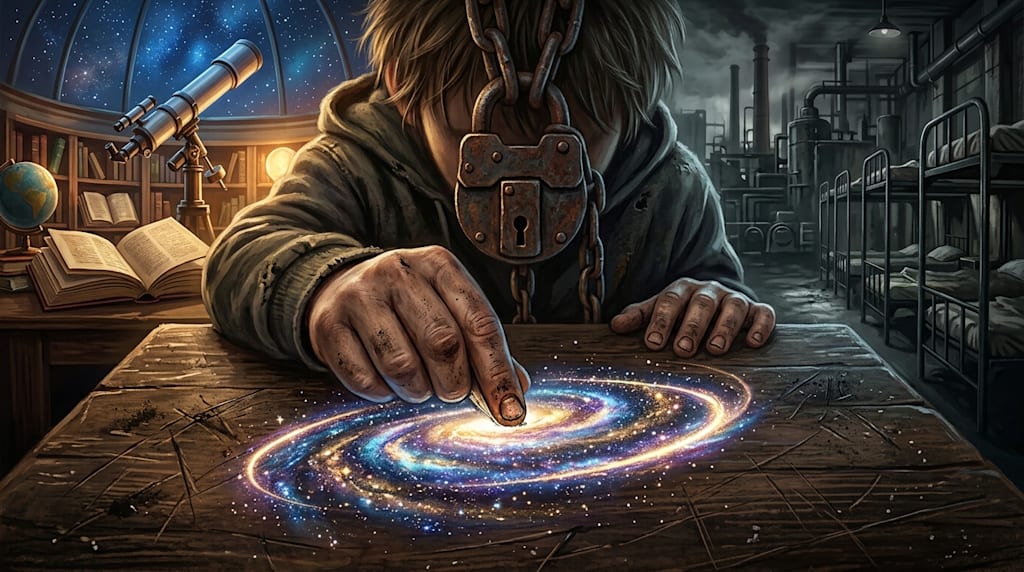
And the reality is this: at this very moment, somewhere on Earth, a child is drawing a curve on a desk with his fingernail—a curve he imagines should exist. No one knows what that curve is. He himself cannot explain it. He only knows it should not be straight.
If he can carry that curve to age thirty, if someone along the way hands him a piece of chalk, if someone at a blackboard says "show me"—then we do not actually need a trillion people.
We only need every such instant not to be cut short.
About the Creator
Jin
Writer of reamstories
https://reamstories.com/jin
Enjoyed the story? Support the Creator.
Subscribe for free to receive all their stories in your feed. You could also become a paid subscriber, letting them know you appreciate their work.
Comments
There are no comments for this story
Be the first to respond and start the conversation.