
TUPE: What It Protects, What It Doesn't, and Why Most Employees Get It Wrong
When a business is sold, outsourced, or transferred, most employees do one of two things: they panic, or they assume everything will be fine because "TUPE protects you." Both responses miss the point. TUPE does protect you — but only if you understand exactly what it covers and what it doesn't.

What Is TUPE and When Does It Apply?
TUPE stands for the Transfer of Undertakings (Protection of Employment) Regulations 2006. It applies in two main situations:
A business sale or merger where the business keeps its identity after the transfer — same work, same customers, similar operation
A service provision change — where work is outsourced to a contractor, moved to a different contractor, or brought back in-house (cleaning, IT, catering, security)
If either of those applies to you, your contract transfers to the new employer automatically. Your salary, holiday entitlement, hours, and most other terms stay the same. And your continuous service — the years you've built up — transfers with you, which matters for redundancy pay and unfair dismissal rights.
What TUPE Actually Protects
Here is what the law guarantees:
Your contract transfers as-is — the new employer takes it on exactly as it stands
Your continuous service is preserved — the years count for redundancy pay calculations and unfair dismissal thresholds
Dismissal because of the transfer can be automatically unfair — if the transfer is the sole or principal reason and there is no valid ETO reason
Contract changes because of the transfer are void — the new employer generally cannot cut your pay or worsen your terms simply because a transfer happened
Your employer must inform and consult you before the transfer — and the consequences of failing to do so are severe
That last point matters more than most employees realise.
The Consultation Rule — and the Penalty Most Employees Never Claim
Before a TUPE transfer takes place, affected employees must be informed through their representatives (or directly where permitted). If measures are planned — changes to working arrangements, location, structure — proper consultation is required.
If your employer skips this process, or does it in name only, the compensation is up to 13 weeks' uncapped gross pay per affected employee. Not statutory pay. Your actual gross weekly pay, multiplied by up to 13.
"I was given 48 hours' notice that my contract was transferring. No meeting, no letter, nothing in writing about what would change. My new employer tried to change my start time within a month of the transfer. My solicitor told me I had a TUPE consultation claim I hadn't even known existed."
— Reader, hospitality sector
What TUPE Does Not Protect — This Is the Part Most People Get Wrong
This is where things go wrong. TUPE does not protect you from:
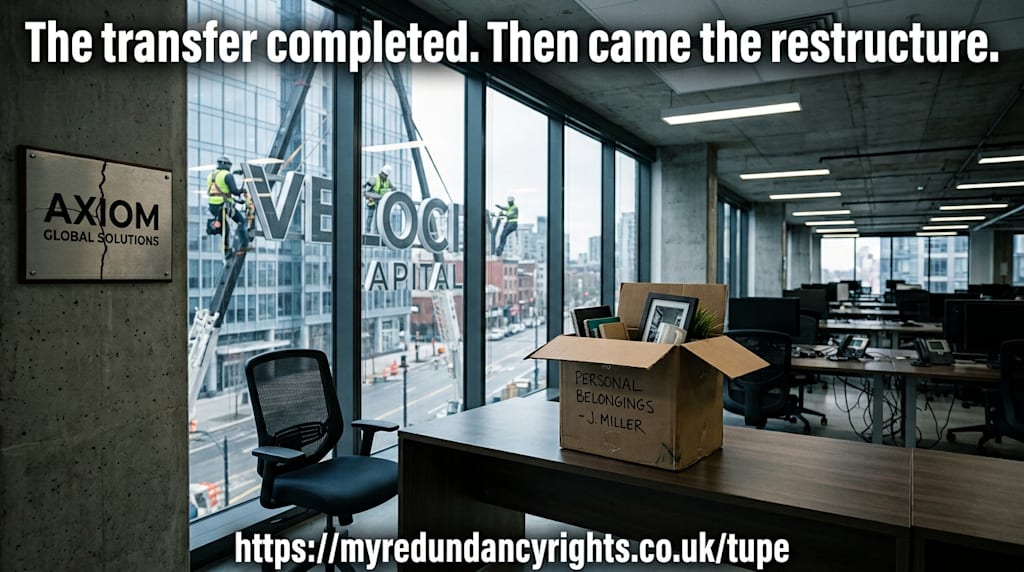
Redundancy for genuine business reasons — the new employer can still make redundancies if there is an economic, technical, or organisational (ETO) reason that involves workforce changes. The transfer itself cannot be the reason — but a genuine restructure after it can be
Pension rights — your old pension scheme terms generally don't transfer. The new employer must provide minimum pension provision, but it may be significantly different from what you had
Refusing to transfer — if you object to transferring to the new employer, your employment simply ends. In most cases, you receive no redundancy pay. You do not get to claim unfair dismissal. You just leave
That third point catches people off guard. If your new employer is someone you do not want to work for — perhaps because of reputation, distance, or terms you expect to change — you need to take advice before you object. Refusing is usually irreversible.
What Should I Do If I'm Facing a TUPE Transfer?
Get confirmation in writing. Ask your current employer to confirm in writing that TUPE applies and give you details of the transfer — the new employer's identity, the date, and any measures planned
Check your contract will transfer unchanged. If you are told your terms will change, ask for the legal basis. Changes because of the transfer are void
Do not refuse to transfer without advice. Speak to an employment solicitor or use our free resources before you object
If consultation was inadequate, make a note of what happened and when. A TUPE consultation claim has a strict three-month time limit
Use our free TUPE eligibility checker at myredundancyrights.co.uk/tupe/am-i-covered to find out exactly where you stand
Real Consequences
According to employment tribunal statistics, TUPE-related claims are among the most consistent sources of successful employee outcomes — particularly consultation failures, where liability falls on both the outgoing and incoming employer.
The law is on your side. But it only helps you if you use it.
About the Creator
myredundancyrights
Free, plain-English UK employment law guidance — redundancy, unfair dismissal, gross misconduct, PIPs and more. Know your rights before it's too late.
Enjoyed the story? Support the Creator.
Subscribe for free to receive all their stories in your feed.
Comments
There are no comments for this story
Be the first to respond and start the conversation.