
Top 10 Backend Frameworks for Web App Development in 2025
Why Your Web App’s Success Starts with the Right Backend What to Look for in a Backend Framework (Before You Start Building) Top 10 Backend Frameworks for Fast, Reliable Web Applications Which Framework Works Best? A Quick Look at Strengths and Use Cases Need Help Choosing the Right Backend Framework?

In 2025, web applications are expected to generate over 60% of global internet traffic, and the backbone of every successful one? A solid backend framework. Whether you're building a customer portal, a SaaS platform, or a content-heavy site, the right backend choice can make or break performance, scalability, and maintainability.
With so many options out there—from Node.js and Django to FastAPI and NestJS—choosing the right one can feel overwhelming. That’s where a trusted web app development company comes in, helping you match the framework to your goals, team, and timeline.
In this blog, we break down the top 10 backend frameworks for web app development in 2025—covering what makes them stand out, where they shine, and how to pick the best fit for your project.
Why Your Web App’s Success Starts with the Right Backend
The backend does more than just power your web app—it defines how well it performs under pressure.
It manages data, handles user requests, connects with databases, and ensures everything runs smoothly behind the scenes.
Choosing the right backend framework early on helps avoid performance issues, security risks, and scaling headaches later.
That’s why getting the backend right isn’t optional—it’s essential to your app’s long-term success.
What to Look for in a Backend Framework (Before You Start Building)
Choosing a backend framework isn’t just a tech decision—it’s a strategic one. Before you start building, here’s what to keep in mind:
Will it support your project size and speed goals?
Some frameworks are better for quick MVPs, while others are built for complex, high-traffic platforms.
Is your team comfortable working with it?
A powerful framework isn’t helpful if your developers spend weeks learning how to use it. Familiarity can save time and budget.
How well does it handle real-world traffic and scaling?
Look for frameworks known for their performance under load—especially if you’re planning for growth.
Is it actively maintained and widely used?
A strong developer community means faster troubleshooting, frequent updates, and better long-term stability.
Does it offer built-in security features?
Things like input validation, protection against SQL injection, and session handling should come baked in—not added later.
Can it integrate smoothly with other tools?
Whether it’s your database, payment gateway, or a third-party API, your framework should connect without a hassle.
The best backend framework isn’t the trendiest one—it’s the one that fits your project’s needs today and can grow with you tomorrow.
Top 10 Backend Frameworks for Fast, Reliable Web Applications
Here’s a quick rundown of the top backend frameworks developers are relying on in 2025 to build fast, scalable, and reliable web applications:
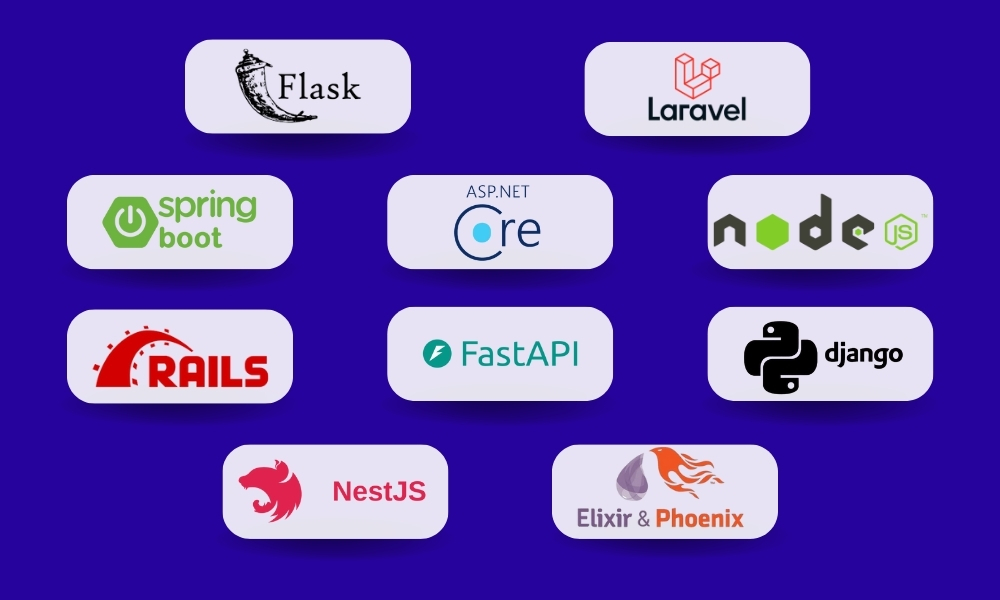
1. Node.js (with Express.js)
Node.js isn’t technically a framework, but it’s the foundation for many powerful backend setups—especially when paired with Express.js.
It’s built on Chrome’s V8 engine, making it incredibly fast for I/O-heavy tasks like APIs, real-time chat, and streaming.
Express.js, the most popular Node framework, offers minimal setup and a lightweight approach, giving developers full control.
It's non-blocking and event-driven, which helps it handle thousands of connections at once without breaking a sweat.
✅ Best for: Real-time apps, REST APIs, and single-page apps.
💡 Tip: Ideal for teams already using JavaScript on the frontend—it lets you use the same language throughout.
2. Django (Python)
Django is a batteries-included Python framework designed to help developers build secure and maintainable apps quickly.
It comes with an admin panel, authentication, ORM, form handling, and security features right out of the box.
Django enforces a clean, pragmatic design pattern (MTV—Model Template View), which speeds up development and reduces bugs.
Its active community and rich plugin ecosystem make it a go-to for developers building content-heavy or database-driven apps.
✅ Best for: CMS platforms, healthcare apps, eCommerce, and educational portals.
💡 Tip: Great choice if you want security and structure without needing to set up everything from scratch.
3. Laravel (PHP)
Laravel modernised PHP backend development with clean syntax, expressive routes, and built-in tools that cover most use cases.
Comes with powerful features like Eloquent ORM, Blade templating, task scheduling, and built-in testing.
Laravel’s ecosystem includes tools like Laravel Forge (server management) and Laravel Nova (admin panels), speeding up development.
It’s highly readable and beginner-friendly, yet powerful enough for enterprise-grade applications.
✅ Best for: SaaS apps, custom CMS, and web apps where speed-to-market is key.
💡 Tip: Perfect if you're building in PHP and want an elegant, full-featured framework.
4. FastAPI (Python)
FastAPI is one of the newer frameworks but has gained huge traction for building high-performance APIs.
It’s built on Starlette (for web handling) and Pydantic (for data validation), offering automatic docs via Swagger and ReDoc.
Native support for asynchronous programming (async/await) makes it super fast and scalable.
It’s also type-hint friendly, reducing bugs and improving the developer experience.
✅ Best for: Modern APIs, machine learning apps, and services requiring fast response times.
💡 Tip: Ideal when performance matters and you need a clean, developer-friendly API.
5. Spring Boot (Java)
Spring Boot takes the powerful Spring ecosystem and makes it easier to configure and deploy.
It simplifies Java development for enterprise-level apps with prebuilt configurations, embedded servers, and microservice support.
Built-in security, monitoring, and production-readiness make it a favourite for banks, insurance, and large organisations.
It integrates well with cloud platforms, containerization (like Docker), and CI/CD pipelines.
✅ Best for: Enterprise apps, large-scale systems, and teams already using Java.
💡 Tip: Choose this when performance, security, and long-term support are critical.
6. NestJS (Node.js + TypeScript)
NestJS is a progressive framework that brings structure and scalability to Node.js projects using TypeScript.
It’s inspired by Angular’s modular architecture, which makes large codebases easier to manage.
Supports GraphQL, REST, WebSockets, and microservices out of the box.
It’s well-documented and ideal for enterprise-grade Node projects that need type safety and strong architecture.
✅ Best for: Scalable APIs, real-time apps, and enterprise-level Node.js projects.
💡 Tip: If your team prefers TypeScript and clean architecture, NestJS is a standout choice.
7. Ruby on Rails
Rails is famous for “convention over configuration,” which helps developers build quickly without reinventing the wheel.
It includes almost everything by default—ORM, routing, caching, migrations, security, and more.
Rails has matured over the years and is still actively used for MVPs, admin panels, and fast product launches.
It’s also known for a supportive developer community and clean syntax.
✅ Best for: MVPs, early-stage startups, and admin-heavy applications.
💡 Tip: Use Rails when you want to build and iterate quickly, especially with smaller teams.
8. ASP.NET Core (C#)
ASP.NET Core is Microsoft’s open-source, cross-platform framework built for modern web apps.
It’s blazing fast, especially when paired with C# and the .NET runtime.
Comes with strong security, dependency injection, and seamless integration with Azure.
It’s ideal for building APIs, enterprise software, and anything that needs tight performance and structure.
✅ Best for: Enterprise-grade apps, Microsoft environments, and high-performance services.
💡 Tip: Great for teams already using Microsoft tools or targeting Windows-heavy infrastructure.
9. Phoenix (Elixir)
Phoenix leverages the power of Elixir, a language built for concurrency and fault tolerance.
Ideal for handling thousands (even millions) of real-time connections at once.
Comes with built-in WebSocket support, PubSub architecture, and LiveView for reactive UIs.
Its lightweight design and fault-tolerant capabilities make it a strong choice for real-time systems.
✅ Best for: Chat apps, trading platforms, and any real-time, high-concurrency environment.
💡 Tip: Choose Phoenix if your app needs to handle many users simultaneously without breaking.
10. Flask (Python)
Flask is a micro-framework that gives you flexibility and control.
It’s minimal by design, so you can plug in exactly what you need—nothing more.
Perfect for developers who prefer building their own stack instead of relying on heavy abstractions.
It has a simple learning curve, making it great for prototypes and small-to-medium apps.
✅ Best for: Small projects, microservices, and lightweight APIs.
💡 Tip: A good pick if you want full control over your stack and don’t need a built-in admin or ORM.
Which Framework Works Best? A Quick Look at Strengths and Use Cases
Choosing the “best” backend framework depends less on popularity and more on what your project actually needs. Here’s a quick look at which frameworks shine in different situations:
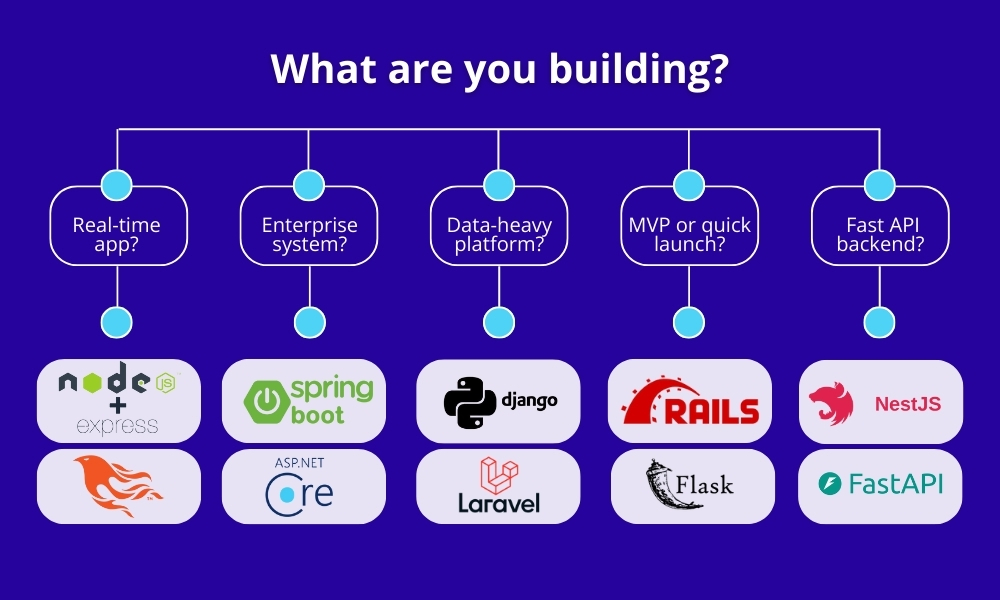
Need something fast and flexible for real-time apps?
Node.js + Express is a solid choice. It’s lightweight, non-blocking, and ideal for chat apps, streaming services, or live dashboards.
Building a secure, data-heavy platform like an eCommerce store or a healthcare portal?
Go with Django. It comes packed with built-in security, admin tools, and an ORM—so you’re not starting from scratch.
Launching a product quickly or testing a new idea?
Ruby on Rails helps you build MVPs fast, thanks to its convention-over-configuration approach and rich built-in features.
Planning a large-scale enterprise app?
Spring Boot or ASP.NET Core are both top-tier for complex systems, offering strong architecture, security, and performance under heavy load.
Focused on building fast APIs with modern Python tooling?
FastAPI is built for exactly that. It’s async-friendly, highly performant, and perfect for ML apps or microservices.
Want the structure of JavaScript but love TypeScript?
Try NestJS—it brings a clean, modular approach that’s great for scaling and maintaining big apps.
Expecting high concurrency, like in trading platforms or multiplayer games?
Phoenix (with Elixir) is built to handle thousands of simultaneous users without blinking.
Working on a custom PHP project or CMS?
Laravel offers an elegant, developer-friendly experience with powerful built-in tools and a rich ecosystem.
Need Help Choosing the Right Backend Framework?

There’s no universal “best” backend framework—it all comes down to what you’re building, who’s building it, and where you want it to go. Whether you need real-time performance, enterprise-level stability, or a fast way to launch your MVP, the right framework makes all the difference.
And if you’re still weighing your options, don’t stress. That’s exactly where the right partner comes in.
At VT Netzwelt, our web app development services are designed to help you choose the right tech stack and build something that’s fast, scalable, and built to last.
Got an idea in mind? Let’s turn it into a web app that works.
About the Creator
VT Netzwelt
VT Netzwelt is a leading software development company in India, the US, and Germany that has completed over 700 projects. 🏆 We delivered high-quality web and mobile software on time, ensuring 100% customer satisfaction.
Enjoyed the story? Support the Creator.
Subscribe for free to receive all their stories in your feed.
Comments
There are no comments for this story
Be the first to respond and start the conversation.