
They Were Forced to Pose With the Word “Humiliation.” Fifty Days Later, the Investigation Is Still Silent.
In Leibo County, twenty teachers were publicly shamed over exam scores. The apology took a day. The accountability has taken fifty days and counting.
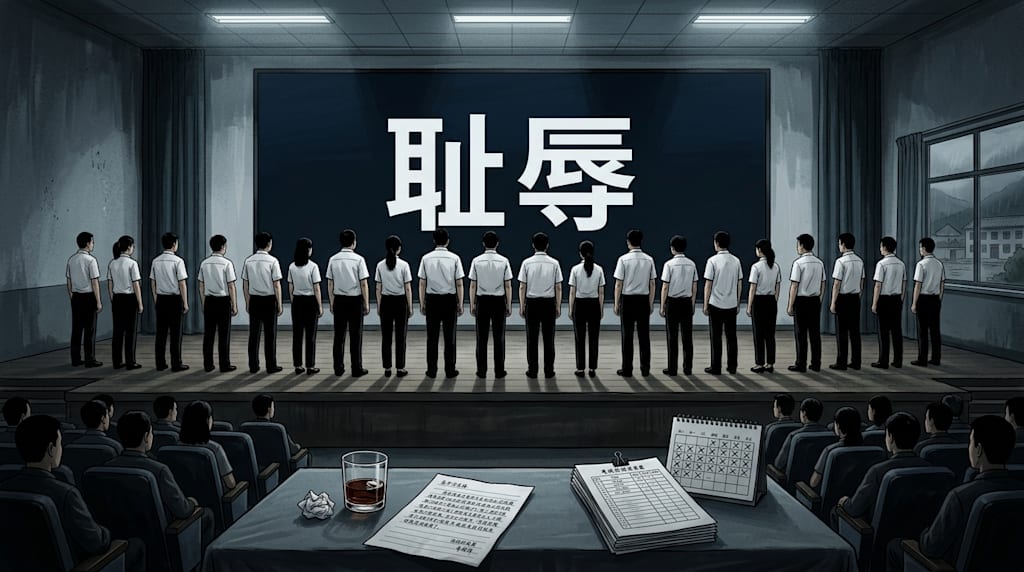
On August 26, 2026, Leibo County in Sichuan’s Liangshan Prefecture held its autumn education administration meeting. More than twenty teachers were called to the stage. They wore white shirts and black trousers. Behind them, on a large screen, were two Chinese characters: 耻辱. Humiliation.
The reason was on the screen. Their middle school classes had average final exam scores below 15. Their primary school classes had averages below 30. Colleagues from across the county sat in the audience. The teachers stood in front of them.
Photos spread on August 28. That afternoon, a joint investigation team from Liangshan Prefecture arrived in Leibo. That night, the county government issued an apology. It admitted the treatment of teachers was wrong and said it caused serious psychological harm. It announced a special task force.
The apology came in less than a day. By mid-October, nearly fifty days had passed. No conclusion. No decision on who was responsible. No plan to fix the system. Someone asked on a public inquiry platform. The county education bureau replied that the provincial and prefectural task force was still investigating and that a specific answer could only come after the final results.
The apology took hours. The accounting has taken fifty days and counting.
The investigation is not hard if the only question is what happened. The photo is real. The meeting is real. Officials admitted it. A staff member at the Liangshan education bureau said, “We did not understand it either when we saw the photo.” The facts are not in dispute.
The hard part comes after the facts.
First, whose scores were they? The screen said “average scores.” Were they students’ final exam averages or teachers’ individual assessment scores? That distinction determines the legal and disciplinary framing. If they were student scores, the county ranked and punished teachers based on exam results. That violates the Ministry of Education’s March 2026 negative list. Article 9 bans ranking schools or rewarding and punishing teachers based on enrollment rates or exam scores. If they were teacher assessment scores, the practice is still abusive, but investigators would need score sheets, assessment plans, and meeting preparation documents. That work is not technically difficult. It still has to be done.
Second, who is responsible? Who proposed it? Who approved it? Who decided to put “Humiliation” on the screen? Who arranged the photo? The prefectural education bureau said it had never used such a punishment. This was Leibo County’s own action. Responsibility has to land on specific people. Interviews, verification, findings, punishments: each step has procedural requirements. The case also started as a county self-investigation, then moved to a provincial and prefectural joint task force. The final conclusion must be released by the county party committee’s propaganda department. Only one office can speak. If it stays silent, no other department can answer.
Third, and hardest: once the conclusion is published, the county will not just admit that a few officials made a mistake. It will have to admit that a method was wrong.
In March 2026, the Ministry of Education issued a notice with twenty negative items. Article 9 says plainly: do not assess and rank schools by enrollment rates or exam scores. Do not rank, reward, or punish teachers by those numbers. This was not the first year. 2024 was the year of standardized management. 2025 was the year of improvement. 2026 is the year of consolidation. The red line is redrawn every year. It was drawn in March. By August, someone had crossed it.
Leibo County is not alone. The Paper interviewed teachers in several places who described similar experiences. Teachers are ranked by scores. They are called to mass meetings to read self-criticisms. If students do poorly, the teacher is treated as the guilty party. One teacher who worked at an ethnic village primary school in western China said she taught twenty classes a week. The teaching load was not the worst part. After each semester’s exams, the school held a “quality analysis meeting.” Every teacher’s name, class, and subject scores appeared on a PowerPoint slide. Teachers at the bottom went on stage to read self-criticisms. She remembered a male teacher crying while he read.
She went on stage twice herself. Years later, she still feels the shame. “It was as if all my effort had turned into foam because of one last-place score.”
Why does this practice keep returning? Ranking is simple. It is visible. It is easy to administer. China Education Daily noted that ranking remains a powerful management habit, and schools often struggle to find a workable replacement.
A serious investigation cannot stop at firing a few people. It has to answer a harder question. If teachers are not ranked by scores, what should be used to evaluate them? What replaces the ranking? In a county with limited resources and pressure to produce high exam results, can administrators build an evaluation system that is fair and practical?
Removing one official is easy. Admitting that an entire method fails and then building a new one is the real reason fifty days have passed.
Leibo County sits deep in the Daliang Mountains. It was lifted out of poverty in February 2020. Mountains cover 84 percent of its land. It is a national key county for rural revitalization. It has 300,000 residents, 79 schools, more than 50,000 students, and about 3,200 full-time teachers. Many children are left behind by parents who work elsewhere. Family support is thin. Some children arrive at school without fluent Mandarin.
Lei Wanghong, an associate professor at Central South University’s School of Public Administration, has studied county high schools across China. She says negative incentives only work if the student body can respond to them. Leibo’s teachers face pressure from two directions.
The first is shortage. Mountain teachers say one teacher can teach twenty classes a week, cover several subjects, and move between grades. One physics teacher taught several classes. Most did reasonably well. One class averaged below 15. He was still called on stage.
The second is targets. County high school teachers are judged by how many students get into Tsinghua and Peking University, how many score above 600, and what share reaches the first-tier university line. The pressure moves down the administrative chain. By the time it reaches the classroom, it becomes that group photo.
Blaming a teacher for one exam score is unfair. The deeper question is why that unfairness became institutionalized, public, and routine.
One detail keeps coming up. After the meeting, one teacher went home and drank alone. His family said he normally only drank during Chinese New Year. Another teacher cried on stage while reading a self-criticism.
Those details matter because they show what happened to the teachers’ dignity. It was not a private warning. It was not a one-on-one conversation. It was a public ceremony. They stood on stage, in front of colleagues, under two large characters: Humiliation.
Guangming Online wrote that publicly shaming teachers over one exam score may violate the Teachers Law. The law allows administrative punishment for insulting teachers. The Civil Code protects personal dignity. The legal basis is not missing. The investigation is stalled because the practice may have been treated locally as normal management. To call it wrong is to reject a whole operating logic.
One teacher asked a simple question: “How can an unhappy teacher teach happy students?”
That is not a rhetorical flourish. It is basic. When a teacher’s dignity is publicly stripped away, the damage does not stop with the teacher. Students watch. They see when a teacher is holding on, when a teacher is afraid, when a teacher is reading from a script. A humiliated teacher sends a signal every day: this work does not deserve respect. Students receive that signal.
The risk now is that the trending topic fades. Attention moves on. The pressure disappears. A bland notice arrives. “Relevant responsible persons have been dealt with. We will learn from this.” The case closes.
Who are the relevant responsible persons? What was done? After the lesson is learned, will teachers still be ranked by scores? After the next final exam, will teachers be called on stage again?
Those are the answers people are waiting for.
An apology is a gesture. Accountability is the result. A fast gesture with no result loses value.
The teachers who stood on that stage will return to their classrooms. They will face their students. How that photo is resolved is not just Leibo County’s problem. It asks a larger question. When education management turns against education itself, someone has to pull it back. No one has said who.
Fifty days. Still waiting.
About the Creator
Jin
Writer of reamstories
https://reamstories.com/jin
Enjoyed the story? Support the Creator.
Subscribe for free to receive all their stories in your feed. You could also become a paid subscriber, letting them know you appreciate their work.
Comments
There are no comments for this story
Be the first to respond and start the conversation.