
They Opened the Dorms at -4°C. They Didn’t Ask the Students.
A small county had 10,000 tourists, 400 hotel rooms, and one emergency plan. The plan left students out.
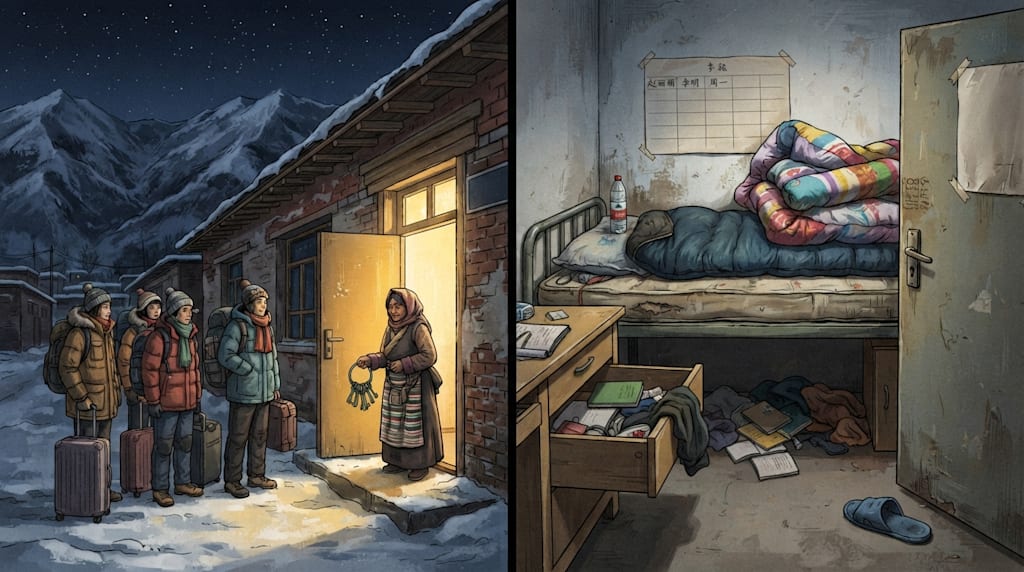
On the night of October 4, the temperature in Qilian County fell to minus four. The hotel front desk put up a No Vacancy sign. Tourists stood on the street with their suitcases. Staff from the Culture and Tourism Bureau arrived with a list and led them to two middle schools. The dormitory door opened. The matron stood to one side, a ring of keys in her hand. The culture and tourism director bent down to make the beds. The bedding was new. The bed boards had been slept on by students. Tourists said thank you. The director said it was what they should do. No one asked who used to sleep in that bed.
The next day, a student’s phone buzzed. A classmate sent a video: someone was lying on her bed. A half-drunk bottle of water sat by the pillow. She zoomed in. The course schedule taped to the wall was still there, half covered by the quilt. She messaged her class adviser: What about my things? The adviser replied: The school packed everything up. It should be fine. She asked again: Who packed it? The adviser did not reply.
Qilian County has 50,000 residents. During the National Day holiday, more than 100,000 visitors arrived in a single day. More than 400 hotels and guesthouses were full. Tourists were stranded. The night was cold. The culture and tourism department opened school dormitories. Tourists thanked them. Online, people praised them. Then a question trended: Did the students agree?
Students pay to live in those rooms. During their years in school, they have the right to use the room, to keep their belongings there, and to keep those belongings private. A holiday does not erase those rights. Beds, lockers, and drawers are not public space. Tourists may move things, dirty them, or lose them. Students cannot be assumed to agree just because they are away. A dormitory is not ownerless just because it is empty for a week. A lawyer from Jiangsu Yingte Donghua Law Firm said a school cannot open beds to others for the night without student consent. That holds even during a holiday. It holds even if tourists use new sheets.
The county had already put “use student dormitories to house tourists” in its emergency plan. This was not a last-minute decision. It was a plan written in advance. A plan needs steps. Tell students and parents before the holiday. Tell students to take valuables. Register, photograph, seal, and store what they leave behind. Tell tourists not to use student belongings. Afterward, disinfect, inventory, repair, and pay for losses. Public reports do not show that students and parents were told in advance. Tourists were sent into dormitories. They moved students’ things and emptied beds. Staff told them, “Do not touch the children’s things.” That warning does not solve the problem. A student still does not know if her drawer was opened, if her towel was used to wipe feet, if her charging cable is still there.
The law allows emergency requisition. Article 12 of the Emergency Response Law says county-level or higher governments may requisition property to respond to emergencies. The property must be returned after use. If it is damaged or lost, the government must pay fair compensation. The Civil Code has a similar rule. But the power to requisition is not the power to skip every step.
Public resources should be used in order. First, commercial places: hotels, guesthouses, restaurants, bathhouses, foot massage parlors. Next, empty public buildings: guesthouses, Party-mass service centers, cultural activity centers, sports venues, public cultural venues, Party school dorms, idle government dorms, vacant schools, vacant nursing homes. Last, in-use school dorms and nursing homes, places where people live and store their things. Did Qilian County use the first two groups? Were the gymnasium, cultural center, government hall, and Party-mass service centers open? If those places sat empty while student dorms were opened, the county did not lack options. It chose the easiest one. Students have little power. Schools are easy to ask. Open the door, make the bed, finish the job. The cost is low. Students pay it.
Other places have done this better. Barkol County was hit by wind and snow. The Beijing-Xinjiang Expressway closed. Drivers and passengers were stranded. The county opened the Public Cultural Activity Center first. Staff laid out emergency bedding, water, instant food, and first-aid supplies. Yumen City opened its gymnasium and fire training hall. It housed more than 4,300 people and gave out mattresses, quilts, water, and food. Guazhou County housed more than 25,000 stranded people in 93 temporary sites, including hotels, community centers, and nursing homes. It used more than 6,000 hotel and restaurant beds. It also opened hotel meeting rooms, restaurants, cultural venues, and community activity rooms. It asked restaurants, taekwondo gyms, and postpartum care centers to help. During the May Day holiday, Fengjie County used the Party school guesthouse as an emergency backstop. Staff cleaned rooms, stocked supplies, and registered guests. None of these places pushed student dorms to the front line.
The problem is not only this one decision. Some offices sacrifice the people inside their system to win praise outside it. Tourists thanked the culture and tourism department. The department talked about how many requests for help it received. No one mentioned whether students had agreed. Tourists without plans were happy. Who cleaned the students’ beds? Who paid for lost belongings? Who apologized when a private thing was seen? If student dorms can be used today, what about apartment buildings tomorrow? Whoever is easy to push gets pushed. Public trust is thin. It does not take much to tear.
Tourists have a part in this too. More people travel without a plan. They do not check rooms or book ahead. They follow a trend to a small town. When rooms run out, they assume the local government must fix it. They think about their own rights. They do not think about their own responsibility to plan. A working system needs both sides. Local governments need early warnings, clear plans, and a service floor. Tourists need to plan, travel with sense, and carry their own risk. Asking for help is fine. Treating “go as you please” as someone else’s problem is not. Students should not pay for it with their beds, privacy, and belongings.
What can be fixed? Put student dorms and nursing homes last on the requisition list. Tell students and parents before the holiday. Have them take valuables and store the rest. Have the school register, photograph, seal, and store what is left. Tell tourists not to touch student belongings. Make them pay if they damage or lose something. After they leave, disinfect, inventory, and repair. Pay for losses. Apologize for privacy violations. Hold officials accountable when they skip the rules. Publish the scope, dates, and compensation plan. Build an emergency housing network with hotels, guesthouses, venues, and bathhouses. Sign agreements before the crisis. Use those first.
On October 6, the dorm matron at that middle school in Qilian County taped a sheet of paper by the entrance. It said: The tourists have left. Students whose items are lost, please register on the first floor. Under the paper lay a flattened slipper. It was blue, for the left foot. The sole was covered in dried mud.
About the Creator
Jin
Writer of reamstories
https://reamstories.com/jin
Enjoyed the story? Support the Creator.
Subscribe for free to receive all their stories in your feed. You could also become a paid subscriber, letting them know you appreciate their work.
Comments
There are no comments for this story
Be the first to respond and start the conversation.