
The Writer's Workshop
Volume One / Installment One - Instructor: Scott Wade

Introduction
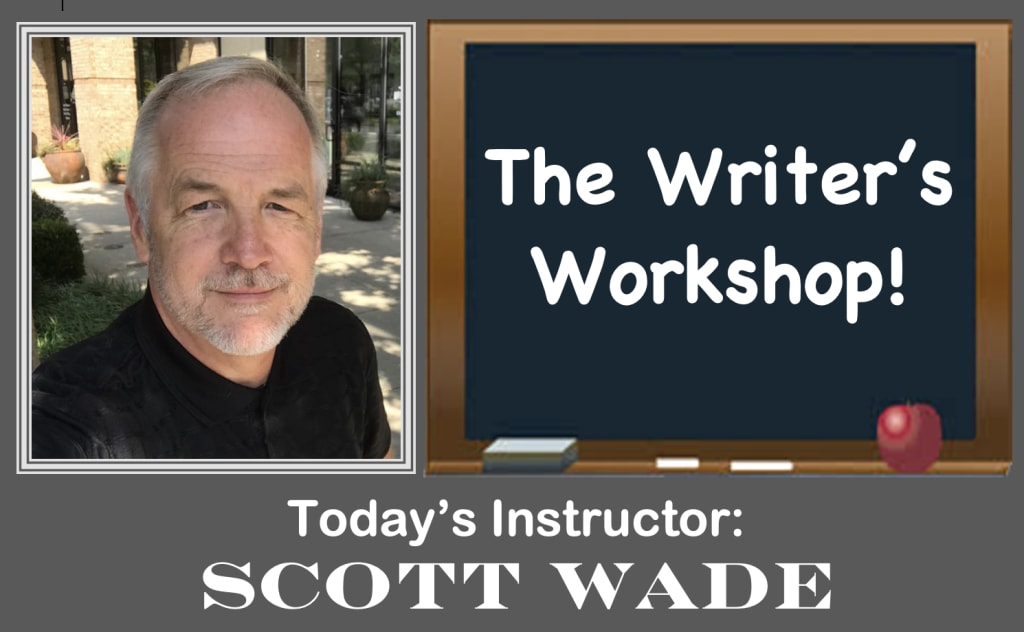
The Writer's Workshop is an educational series in which seasoned/educated writers/authors will share their insights on developing writing skills. This Workshop is sponsored by Rick Henry Christopher and the Facebook group Vocal + Assist
This Installment's Instructor is Scott Wade
Scott Wade's Credentials
My first foray into writing began when I was musical director for a community theater utilizing my Masters in Music. I wrote two Broadway style musicals that were produced locally to fill calendar gaps and were well received. Christmas of ’41 and Sleeping Beauty (a children’s theater production). Three years ago, with a plethora of ideas in my head but without the fundamental skills and tools needed to produce good stories I explored and enrolled in several online writing classes. Soon after, I discovered Vocal Media and entered the Black Book challenge knowing that my entry would rock the Judges and I’d win. I didn’t and that marked the beginning of my real desire to be a writer. My best lessons have come from interactions with experienced writers around the world on Vocal like the late Tom Bradbury, Judey Kalchik, Lesley Anne, in the Vocal Creators Lounge and a plethora of other fantastic creators early on. Many have migrated elsewhere on their writing journey. New creators and friends have emerged on Vocal through the Facebook groups like Vocal + Assist and Great Incantations that amaze me. I stand in awe of these master writers who push and challenge me to improve and one day graduate from a novice to a master like them.
Advice for New Writers
The early lesson is still the absolute truth. Just write. Do you have a moleskin or a notepad that you carry with you everywhere? Journaling sounds mundane, but capturing that idea in just a sentence or word is worth its weight in gold. Penciling notes is great practice. Ex. If you are outside and a hawk soars overhead, write down what you are seeing and feeling. It’s a record of your observations. Writing a story is more than a gaggle of words but a transference of action, feelings, and observations that your reader the audience can decode and live for a while in your story.
$pending Money to Learn Writing Skills
The best investment I made as a writer was enrolling in three online classes over a year’s time with Gotham City Writers in New York City. The instructor for each class was a creative writing professor from Rutgers University. The cost was $400 per ten week class but became the foundation that I continue to build on. The experience fundamentally restructured what I thought creative writing to be for the good.
The "Show Not Tell" Technique
Showing is creating a word picture utilizing strong verbs and nouns using the five senses to immerse our readers in all aspects of the story. Eliminate most, if not all adverbs. “Ly” words feel easy coming out of our minds but disappear into the void when the reader wants to see, hear, feel, smell, and touch. Practicing through journaling with brief exercises can develop this skill. Writing poetry has helped me.
My first complete connection with showing versus telling became my most read story in Dia de Los Muertos. “Three thousand feet below, spread over miles, thousands of lights failed to emulate the celestial stars that spanned the heavens overhead…” versus. “I drove past the valley below.” The reader wants to be in the scene to see, feel, touch, smell and hear in 5D. Films are great to watch but will never be able to connect with the readers five senses like a writer can.
Yawn! This is Boring
Cut. Ax, Chop, Kill. Rewrite. Sometimes the sentence is boring because it doesn’t deserve to survive. I have torn many pages out of my notebook. We do not like to kill our words but a poor sentence needs to be destroyed to eliminate the mental block it can create. What led up to the boring sentence? It may need to be chopped also. Sometimes changing the point of view will stimulate the right words. In Terminus Unknown I struggled with the story in third person because of this very thing. Boring. I rewrote the story in a mixed POV alternating first person and third. My character came to life and the first draft went into the trash heap. Rewriting is the real work and must be done.
Connecting with Your Emotions
Emotions come from our characters. Poetry has helped me tune in to how words express feelings. Through our character’s dialogue and body language we can generate joy, sadness, anger, etc. I believe writers must be very empathetic to our characters. Do we want the reader to like them, hate them, envy them, or love them? I have cried with some of my characters and laughed with others. That is my self-test. If I don’t, my readers won’t and I have failed.
Bonding with Your Readers
I do everything in my power to be true to myself and honest. Readers seek authenticity or they will not let you into their minds and hearts. I love a good hook or twist but fight hard to be accurate and not play word tricks. The stories and the characters must be believable or the reader will feel betrayed.
How Do I Improve My Writing Skills
A. Write and rewrite. The Rutgers Professor once marked up a 3rd person story with these words, “Good premise. Rewrite 1st person.” The story was transformed.
B. I highly recommend a creative writing course or two like Gotham City Writers. Knowing what not to write is just as important as conveying the best words and sentences.
C. Be active with other writers on Facebook like Vocal + Assist. Ninety percent of my perceived improvement has come from reading other works, feedback, and helping others. Assisting others will strengthen your own skills.
D. Understand that not every story you write will connect with your audience but it’s just as important as the ones that do. Each is a stepping stone in our growth as a writer. Every challenge may not be my “cup of tea” but I have learned from each of them.
E. It’s okay to utilize a thesaurus and dictionary in your search for the best words. I didn’t for years treating writing as a closed book test. I don’t know what I was thinking. Silly me. A FB Vocal friend gently called me out.
F. Last, read, read, read the greats. When you read as a writer your brain begins to see the structure. You will learn as you intake their work and will be able to formulate your own style.
The Last Word
I hope this is aid to someone as so many have helped me - Scott W
The Writer's Workshop
Volume One / Installment One
About the Creator
Rick Henry Christopher
Writing fulfills my need for intellectual stimulus, emotional release, and soothing the bruises of the day.
I’m an open book. I’m not afraid to show my face or speak my mind
https://www.facebook.com/groups/vocalplusassist
Enjoyed the story? Support the Creator.
Subscribe for free to receive all their stories in your feed. You could also become a paid subscriber, letting them know you appreciate their work.
Comments
There are no comments for this story
Be the first to respond and start the conversation.