
The Secret Compartment Economy: Why Schools Cannot Win the Phone War
Students hide phones in water bottles. Sellers call it a feature. Teachers get stuck in the middle.
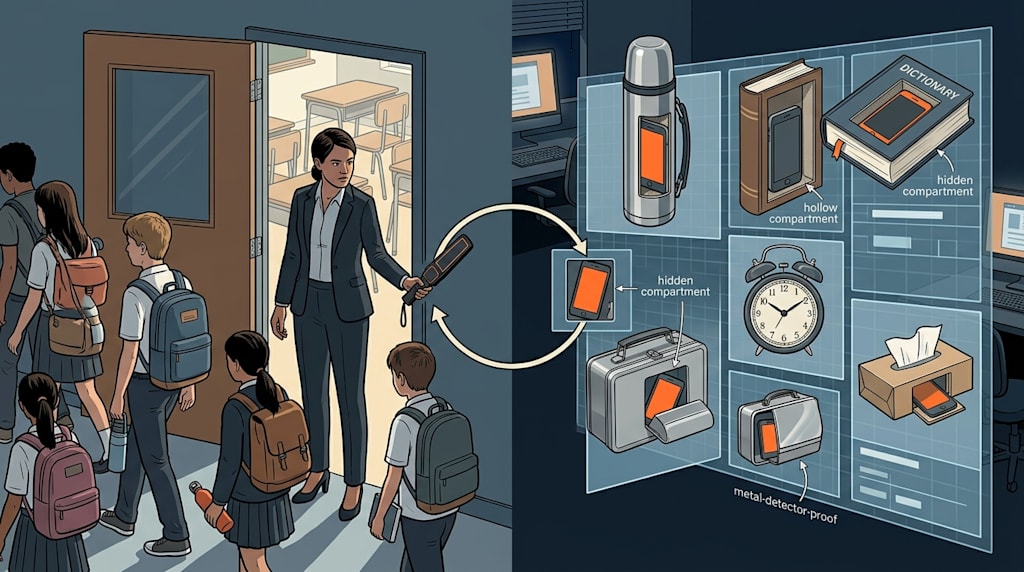
On e-commerce platforms, one thermos has an inner liner whose bottom unscrews into a compartment. The product page says: “Double-layer hidden compartment, metal-detector-proof.” Next to it is a storage box shaped like a fake book. Open the cover and inside is a phone-sized hollow, with the product image helpfully labeled “lockable.” Scroll further and alarm clocks, desk lamps, lunch boxes, and tissue boxes have all been remade for the same purpose: hiding phones.
Prices range from a few dozen to over a hundred yuan. Platform data shows some single items sell more than 500 units a month; some have cumulative sales above 4,000. In the reviews, you occasionally see comments like “my kid says it works great,” while merchants openly advertise “guard against surprise inspections” and “evade detection.”
There is no high technology here. The so-called “metal-detector-proof” principle is almost comically simple: the thermos itself has a metal liner, the lunch box itself has a metal clasp. The detector beeps, the teacher glances down, sees a water bottle, waves it through. The hidden compartment hides inside those few seconds, covered by the alarm. Extremely low cost, crudely made, but sufficient.
Sufficient because it wedges itself precisely into a gap: students want to bring phones into school, schools want to keep phones outside the gate, and when these two forces collide, a business falls out of the middle.
Who buys them, and why
Teenage students spend ten-plus hours a day on campus, from morning self-study to after-school programs. During the ten-minute break, they want to say a word to a friend in the next class, glance at the score of the team they follow, or check what new comments appeared under a video they did not finish last night. These needs are not grand, not rebellious, and barely count as “addiction.” They are the ordinary look outward of a growing person toward the wider world and toward peers.
But the school rule is rigid: phones may not be brought onto campus. So the look outward becomes concealment. The water bottle has a compartment, the lunch box has a lining, the tissue box has a bottom lid that opens to reveal a phone. Students do not necessarily think of this as some great act of resistance. More often it is the instinctive workaround: when there is a policy above, there is a way around below. If checks are loose, they simply do not bring the phone. If checks tighten, they find somewhere to stuff it. People in their teens are best at finding breathing room inside the cracks of rules.
Merchants see that room. Someone wants to hide, so someone sells hiding tools. The business logic is simple and direct: not illegal, not against platform rules, and there is money to be made. Complain about the water bottle, and tomorrow they list a “storage pencil case,” switch categories, and keep selling. In platform keyword search, the phrase “phone-hiding gadget” says what it is: a demand with a product page.
The loop of detectors and hidden compartments
On the school side, the management pressure is real. Education authorities have requirements, parents have expectations, classroom order must be maintained. So metal detectors are deployed, surprise inspections are scheduled, and homeroom teachers are told to “keep an eye out.” The teacher stands at the classroom door with a detector, thinking: I need to catch a few today.
On the student side, hidden compartments, linings, and lockable lunch boxes escalate layer by layer. You search water bottles, I switch to lunch boxes; you go through backpacks, I hide it in a tissue box. Every update in inspection method spawns a new batch of “gadget” keywords on e-commerce platforms.
Both sides invest. The school invests management costs and teacher energy; the student invests pocket money and the effort of dealing with inspections. In this loop, detectors and hidden compartments are mutually causal: the more you search, the more they hide; the more they hide, the more you search. No side wins through escalation, but one side makes a guaranteed profit: the sellers of hidden compartments.
The loop also changes the nature of rule education. When the center of management falls on “catching the person hiding a phone,” what students learn is not “why I should not use a phone in class,” but “how to hide so I will not be found.” Rules shift from external discipline to a game of detection and counter-detection. A student who hides a phone in a compartment for three years graduates not only with a phone, but with a set of experience: rules are meant to be bypassed.
The people in the middle
The school sets the rules, and the pressure of enforcement is passed down layer by layer until it lands on homeroom teachers and frontline teachers.
Confiscate, and students are unhappy; parents may complain, “Why did you take my child’s phone?” Do not confiscate, and you cannot answer to leadership; when an inspection comes and someone in your class has a phone, you are the one criticized. Today the student brings a water bottle, tomorrow a lunch box, the day after a tissue box. How much energy does the teacher spend distinguishing, checking, and maneuvering? No one has calculated that account.
Phone management should be systemic work at the school level: how rules are set, how parents are communicated with, how far inspections should go, how discoveries should be handled. These require a complete plan. In practice, it is often reduced to one sentence: “Homeroom teachers must implement it fully.” Frontline teachers are pushed to the front line of the conflict with insufficient tools. What they face is not a simple violation, but a knot twisted together from student needs, parental expectations, school assessments, and commercial supply.
The screen time you cannot police
Campus management can control the eight or ten hours students spend at school. It cannot control the few hours after they go home.
Behind phone management there is often a more everyday question: is there anything at home more interesting than a screen? If, after going home, the adults scroll short videos and the child plays games, each staring at their own screen, then no matter how the school manages the daytime, the effect will be limited. If parent-child communication is reduced to “Have you finished your homework?” and “Stop playing on your phone,” then the phone is not just an entertainment tool. It becomes the only thing in the child’s hand that does not require watching the adults’ moods.
Experts have discussed the deeper layer of this problem: behind phone addiction there is often a lack of rich family life and an absence of parent-child communication. If the school pulls hard on one side and the family does not keep up, the effect of management leaks away between the school gate and the home door. Needs suppressed on campus rebound harder outside school, are brought back on Monday, and the cycle starts again.
Treat the phone as an enemy, or as a tool
There is an even more basic question that is rarely discussed seriously: what exactly are we managing?
If the goal is “no phones visible on campus,” then metal detectors plus hidden-compartment checks are the logical endpoint, and the arms race will continue indefinitely. If the goal is “students learn to use phones at appropriate times and put them down at inappropriate times,” then what is needed is completely different.
The former relies on containment; the latter relies on education. Digital literacy cannot be replaced by prohibition. Students know how to hide a phone, but they may not know why the algorithm keeps pushing the same kind of video, how the “like” button is designed, or what is happening in the brain when they cannot stop scrolling. If these things are not taught, students will forever oscillate between “being led by the phone” and “being managed by the school,” with no middle option.
Some schools are already trying different paths. Some divide management by scenario: strict prohibition in class, necessary communication allowed during breaks, guided reasonable use after school. Some set up a unified “phone station” for storage while leaving “green-use periods” at lunch break. These practices admit the same point: the phone is a tool that must be learned, not an enemy that can be banned into nonexistence. Only by acknowledging the need can guidance begin.
One more point is easily overlooked: if rules are only imposed from above, students will always be the ones subject to enforcement. But if students participate in discussion, why phones cannot be used in class, how long is appropriate during breaks, how violations should be handled, then rules become possible to understand. A compact discussed and produced by students themselves is more likely to be taken seriously than a ban handed down by the school. If a student has participated in a discussion about “why we should not scroll phones in class,” then the next time he takes out his phone, what sounds in his head is not only “do not let the teacher see,” but also “I myself agreed not to play in class.”
Beyond the hidden compartment
A water bottle can hide a phone; an alarm clock can hide a phone; a lunch box can hide a phone. As long as the demand exists, the ban exists, and the merchants exist, hidden compartments will keep appearing in new everyday objects. Block the water bottle, and tomorrow a storage bag pops up; block the storage bag, and the day after a pencil case pops up. The containment list is endless.
The question that needs answering is not “what is the next thing that will hide a phone,” but “why do students insist on using phones at school?” If that question is not figured out, the cycle of detectors and hidden compartments will not stop. And in this cycle, the school spends management energy, teachers bear the pressure of being caught in the middle, students practice bypassing rules, and merchants take away profits. No side wins in the educational sense.
It is easy to remove the hidden compartments from water bottles and alarm clocks. The hard part is making a student feel that those forty-five minutes in class are worth watching more than the screen in the hidden compartment.
About the Creator
Jin
Writer of reamstories
https://reamstories.com/jin
Enjoyed the story? Support the Creator.
Subscribe for free to receive all their stories in your feed. You could also become a paid subscriber, letting them know you appreciate their work.
Comments
There are no comments for this story
Be the first to respond and start the conversation.