
The Math AI Can’t Do for Us
AI can generate proofs. It cannot decide what they mean, why they matter, or what mathematicians should ask next.
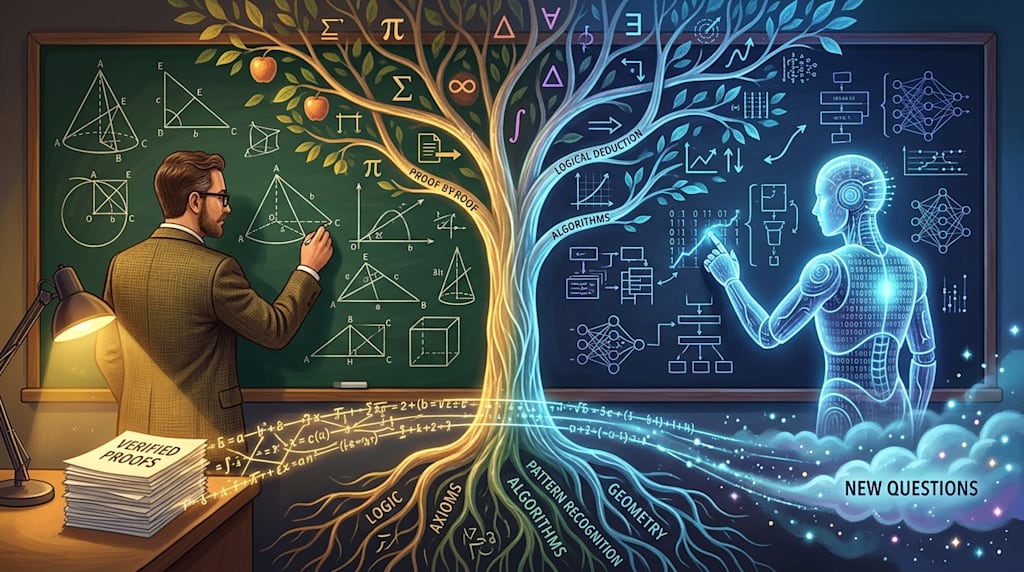
Mathematical research aims to discover new mathematical knowledge. That sounds tautological, but it is often reduced to a narrower claim: the aim is to produce the first proof of an unsolved problem. These are not the same thing. A theorem proved true is an important kind of knowledge. Mathematical knowledge also includes methods, concepts, proof paths, error estimates, structural insight, the ecology of problems, and the judgment of what is worth pursuing. Proofs are the hard currency of mathematics. They are not the whole of its wealth.
If progress means only checking off open problems, much important work gets undervalued. Shiing-Shen Chern’s intrinsic proof of the higher-dimensional Gauss–Bonnet theorem is a good example. An extrinsic proof already existed. Combine it with the Nash embedding theorem and you can apparently reach the same conclusion: embed the manifold in a high-dimensional Euclidean space, prove the result there, then pull it back. So why bother with an intrinsic proof? Because it established a set of reusable methods in higher-dimensional intrinsic geometry. It works directly with the relation between a manifold’s curvature and its topological characteristic classes. It does not use an ambient embedding space as an intermediary. Chern–Weil theory, characteristic classes, and local index formulas grew out of that work. They serve this theorem, and they also reach a much wider range of geometric and topological problems. The intrinsic proof did more than solve one open problem. It changed how an entire field was organized.
This is where mathematical knowledge differs from a registry of truth values. A theorem’s truth is a fact. A proof’s being understood is knowledge. A method’s being abstracted and reused is a capacity. Facts can be registered once. Capacities keep growing. An extrinsic proof plus Nash embedding may be logically equivalent to an intrinsic proof, but it is not mathematically equivalent. Nash embedding is nontrivial. Embeddings add structure. Intrinsic methods address manifolds, fiber bundles, and more general geometric objects directly, without embedding. Logical equivalence is not mathematical equivalence. Knowing the answer is not understanding the problem.
The prime number theorem tells a similar story. It already had proofs based on complex analysis, and those proofs often give sharper error terms. The elementary proof of Selberg and Erdős avoids complex analysis as far as possible. It uses elementary real analysis, sieve methods, and identities. It is not “completely based on calculus,” but it does show the power of methods internal to number theory. Its conclusions are usually less precise than complex-analytic proofs with error terms. It is still a valuable exploration and a piece of new mathematical knowledge. It influenced sieve methods, elementary number theory, and later work on error terms. It told mathematicians that complex analysis is not the only road. Structures internal to number theory can support a deep conclusion. The possibility of that method is itself knowledge, and it travels well.
The unit of mathematical progress is not only the theorem. It is also the method, the concept, the proof path, and the ecology of problems. The theorem is the fruit. The method is the tree. The proof is the road. Understanding is the map. Count only fruit and you miss the tree. Walk the road without drawing the map and you underestimate the richness of mathematics.
AI makes this judgment harder to avoid. AI produces many candidate proofs of famous open problems. That matters. A counterexample or a positive proof tells mathematicians whether a proposition is true or false, and it keeps them from exploring in the wrong direction. A counterexample can destroy a conjecture. It can also pinpoint the hidden assumption the conjecture overstepped. A positive proof, even a rough one, may offer a new angle of attack. AI proofs may yield reusable methods and deepen human understanding of mathematical structures. AI-generated proofs should not be dismissed just because they are “not yet verified.”
There is another side. A large number of unverified candidate proofs increases the verification burden. It does not automatically save time. What is scarce in mathematics is not only the capacity to generate proofs. It is also the capacity to verify, understand, abstract, and communicate them. If a candidate proof cannot be read by humans, cannot be formally verified, and cannot be distilled into reusable lemmas, its value remains potential. A more accurate description is this: AI generates candidate proofs or proof sketches. Their value depends on verifiability, formalizability, extractability of method, and novelty. If an AI proof can be checked by Lean or Coq, or if humans can extract key lemmas from it, its value rises. Otherwise it may transfer the cost of verification to humans.
Giving a proof should not be seen as killing the problem. Mathematical problems rarely end with a single proof. After a proof, the problem often enters a new phase: quantification, generalization to variants, shorter proofs, essentially different proofs, formalization, algorithmization, and the study of the proof’s boundaries. The simplified proofs and formalization efforts after the four-color theorem are examples. So are the study of error terms and the Riemann hypothesis after the prime number theorem, and the simplification and formalization efforts after the classification theorem. A proof is not the grave of a problem. It is a turning point in the ecology of problems. It changes the problem’s position. It does not terminate it.
AI should be a supplement to human mathematics, not a replacement for human mathematicians. AI is good at search, combination, counterexample generation, conjecture testing, literature association, formal verification, and cross-domain analogy. Humans are good at problem selection, judgments of significance, conceptual abstraction, and judging what is worth understanding. The aim of mathematics is not only to know truth values. It is also to understand. Understanding is hard to outsource to a system that only outputs proof texts. A system can tell you “this is a proof.” It has a harder time explaining why this is a good proof, what it reveals, and where it belongs. Those judgments require the aesthetic sense, tradition, and problem consciousness of the mathematical community.
A more operational evaluation of AI’s mathematical contributions would use a set of criteria: correctness, verifiability, novelty of method, generalizability, conceptual clarity, and impact on the ecology of problems. By that standard, an AI candidate proof may have local value even if it is eventually refuted. It may expose hidden assumptions, offer clues for counterexamples, or suggest new computational paths. Only after verification, explanation, and abstraction does it become mathematical knowledge. AI can produce mathematical events. Mathematical knowledge requires digestion by the community.
This does not mean human mathematicians can rest easy. AI will change the division of mathematical labor. Repetitive verification, large-scale conjecture testing, searching the gaps in the literature, and filling in formal proofs may increasingly go to machines. Problem selection, concept creation, theoretical integration, and judgments of significance will still require humans. Mathematics will not become unnecessary because of AI. It will increasingly need humans to do the part of mathematics that machines are not good at. That part is method, concept, and understanding.
Return to the beginning. The aim of mathematical research is to discover new mathematical knowledge. New mathematical knowledge is not completely equivalent to the first proof of an unknown problem. Chern’s intrinsic proof, the elementary proof of the prime number theorem, and AI-generated candidate proofs all remind us that mathematical progress is multilayered. A proof can be an answer. It can also be a key. It can close a question. It can also open a field of questions. What matters is whether it makes mathematics more understandable, more reusable, and more capable of growth.
AI should be a supplement to human mathematics, not a replacement for human mathematicians. It can help us reach some places faster. Where to go and why go there remain the enterprise of the mathematical community. Mathematics is not merely a collection of proofs. It is an enterprise of understanding. Beyond proof there is method. Beyond method there is concept. Beyond concept there is the human pursuit of the meaning of mathematics.
About the Creator
Jin
Writer of reamstories
https://reamstories.com/jin
Enjoyed the story? Support the Creator.
Subscribe for free to receive all their stories in your feed. You could also become a paid subscriber, letting them know you appreciate their work.
Comments
There are no comments for this story
Be the first to respond and start the conversation.