
The Hidden Layer of Search Is Where Companies Can Start Losing Before the Dashboard Shows It
Why the most influential part of search now happens before traditional analytics can even see it

Most companies think they understand how customers find them.
That confidence is getting riskier.
The visible layer still looks familiar: rankings, traffic, conversions, attributed revenue. But LLM Authority Index’s Hidden Layer of Search argues that a new discovery layer now sits upstream of those systems, shaping shortlists before traditional analytics can see it clearly.
In the source article, that layer is AI-mediated discovery. It is commercially meaningful, recommendation-driven, and often influential before the website visit ever happens.
The part most teams are not measuring
The article makes the shift plain. When users ask AI systems what to buy, who to trust, which company to choose, or what options are best for a specific problem, they are not just gathering information.
They are entering a decision environment that narrows the field early. By the time they click through to a site, if they click at all, the answer may already have shaped the shortlist, framed the category, and tilted preference toward one company and away from another.
That is the hidden layer.
Not because it is unimportant.
Because most measurement stacks were built for what happens after the click, after the visit, after the pageview, or after the conversion event.
Watch this video to get a complete overview of the topic in a few minutes.
Search used to help people browse. AI increasingly helps them decide.
One of the strongest ideas in the source is the move from search engines to decision engines. Traditional search gave users a set of results and encouraged browsing.
AI systems increasingly interpret intent, synthesize options, reduce noise, generate summaries, and recommend outcomes. The role of the interface changes from helping users find information to helping users decide what matters in that information.
That changes competition.
In the older model, the path often looked like this: search, browse results, open multiple tabs, compare companies, make a decision gradually.
In the AI-mediated model, it often looks more like this: ask a commercial question, receive a compressed answer, accept a shortlist of options, move toward one of those options, validate rather than explore from scratch.
Why this layer stays invisible
Search Console, web analytics, and attribution software can still show page-level discovery, search result performance, click-based behavior, and visit-based attribution.
They do not reliably show recommendation frequency, response ranking, answer framing, AI-mediated influence, or competitive positioning within generated outputs.
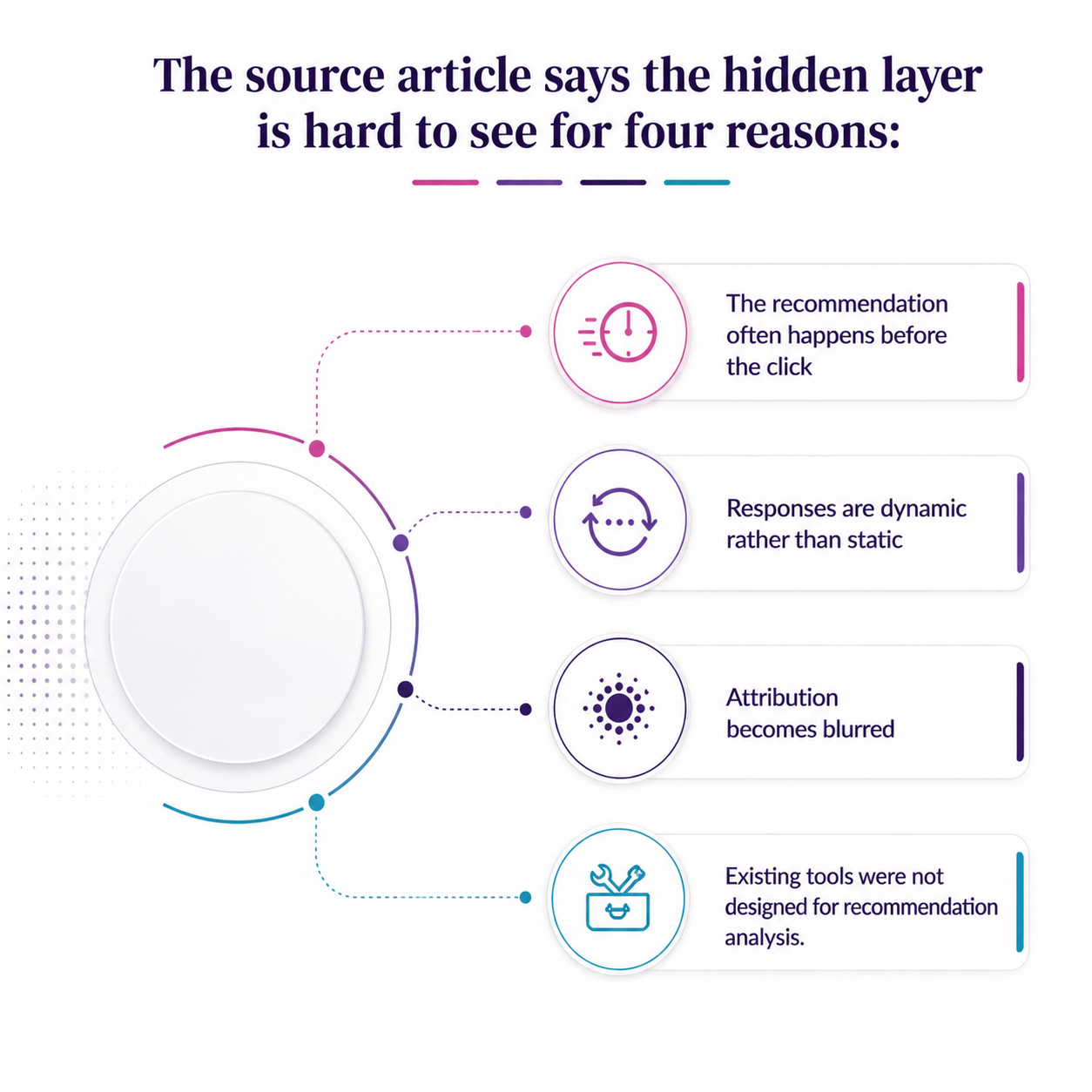
That is the real measurement failure.
And it connects directly to Your AI Visibility Report Is Probably Misleading You, which argues that many reports confuse exposure with commercial visibility by blending unlike prompts together and treating a mention like a recommendation.
Its warning is simple: owning a lot of low-value prompts is not the same as owning high-value buying moments.
The danger is not sudden collapse. It is delayed recognition.
The article is especially sharp on the illusion of stability. A company can look fine on the surface because rankings remain strong, revenue has not yet softened, branded demand is still healthy, and traffic looks steady.
But underneath, competitors may already be appearing more often in AI-generated answers, being described more favorably, ranking first more consistently in high-intent prompts, and expanding into prompt clusters your company does not own.
That is where the time-lag problem starts.
The source says AI-driven shifts often occur in this order: recommendation patterns change, user consideration shifts, comparative preference changes, traffic or conversion effects emerge, and revenue consequences become visible.
By the time the downstream numbers confirm the problem, the upstream recommendation shift may already be advanced.
Why recommendation mechanics matter more now
This is also why the related article How AI Actually Chooses Which Companies to Recommend fits so naturally here. It argues that AI does not merely retrieve pages and display them in order.
It evaluates information, compresses complexity, synthesizes a response, and often guides the user toward a conclusion. Its framework points to three core layers of recommendation: presence across relevant contexts, consistency of positioning, and reinforcement across sources.
Once you see that, the hidden layer stops looking like a reporting nuance.
It starts looking like the place where future market pressure forms first.
The bigger shift
The article’s broader point is hard to ignore: traditional search creates a discovery model that is visible, page-based, and measurable through rankings and clicks. AI creates a discovery model that is partially invisible, response-based, influential before the visit, and only weakly captured by legacy analytics.
That is why the companies that understand this layer early gain an advantage. They can identify where AI is reshaping competition before the change is widely understood.
About the Creator
Kristopher
Breaking down real-world case studies to uncover what drives attention, trust, and decision-making in business and culture.
Enjoyed the story? Support the Creator.
Subscribe for free to receive all their stories in your feed.
Comments
There are no comments for this story
Be the first to respond and start the conversation.