
The Halal Food Industry: A Global Growth Story That's Just Getting Started
Few industries tell a more compelling story of quiet, steady, unstoppable growth than the global halal food market.

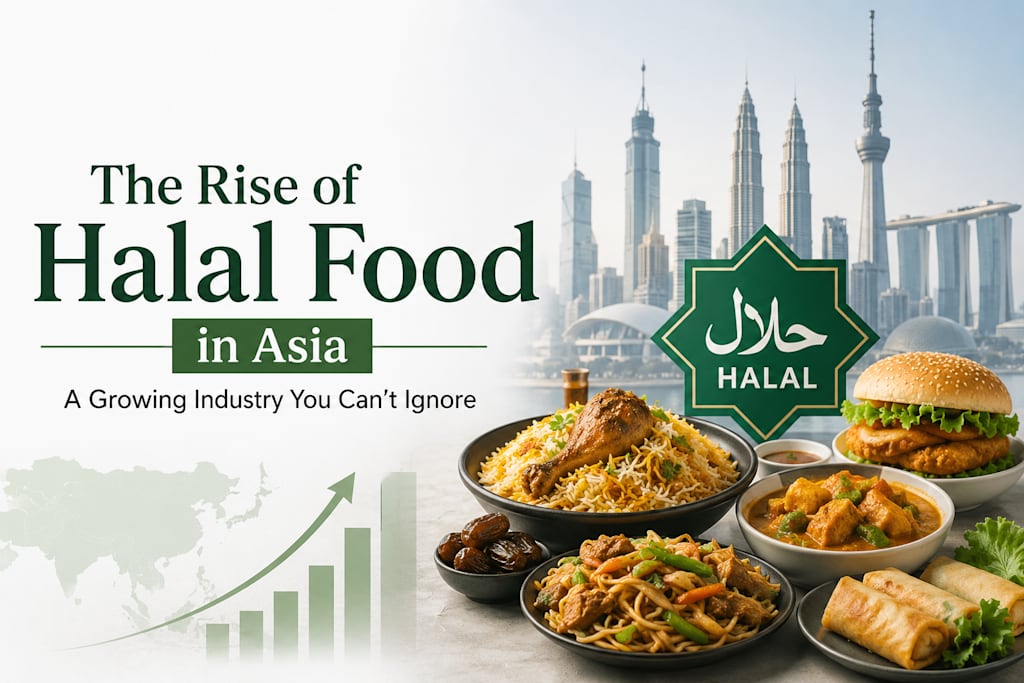
Few industries tell a more compelling story of quiet, steady, unstoppable growth than the global halal food market. What was once considered a niche dietary category confined to Muslim-majority countries has evolved into one of the most significant forces reshaping the global food economy — and the numbers make this impossible to ignore.
The global halal food market was valued at USD 3.30 trillion in 2025 and is projected to reach USD 10.42 trillion by 2035, expanding at a compound annual growth rate of 12.19%. To put that in perspective — that's larger than the entire GDP of most countries on earth, growing at a pace that outstrips many of the world's most celebrated technology sectors.
More Than a Religious Market
The common misconception about halal food is that its growth is purely demographic — driven only by rising Muslim populations. The reality is far more nuanced and far more interesting.
As of June 2025, 70% of consumers in England preferred halal meat over conventional meat — a striking statistic in a country where Muslims represent a small minority of the population. Non-Muslim consumers are increasingly drawn to halal products for reasons that have nothing to do with religion: cleaner processing, stricter quality controls, ethical animal treatment, and greater transparency in the supply chain.
Rising demand for halal convenience foods, increasing cross-border halal food trade, expansion of halal e-commerce platforms, and growing non-Muslim consumption of halal food are all key drivers projected to sustain this growth through 2030 and beyond.
This crossover appeal is quietly transforming halal from a religious requirement into a global quality standard.
Asia Leads — But the West Is Catching Up
Asia Pacific currently dominates the global halal food market with a share of over 48.5% in 2025, driven by rising consumer awareness, rapid multiculturalism, globalization, and the growing requirements of the Muslim community for halal certified food.
Indonesia alone reported halal product exports of approximately USD 64 billion by 2024, cementing its position as the world's single largest halal food producing nation. Malaysia, Pakistan, India, and Bangladesh collectively account for over 70% of Asia's Muslim consumer base — and spending is accelerating as disposable incomes rise across these economies.
But the West is no longer standing still. Europe registered a halal food and beverage market of USD 302 billion in 2025, with France, Germany, and the United Kingdom leading demand driven by significant Muslim minority populations, growing halal retail chains, and expanding immigrant consumer communities.
In North America, the story is equally compelling. The United States halal food segment reached an estimated USD 290 billion in 2025 — driven not just by a growing Muslim population but by a broader consumer shift toward ethical, traceable, and clean-label food products.
The E-Commerce Transformation
Perhaps the most underreported dimension of this industry's growth is the role of digital commerce. Across every major market — from Tokyo to Toronto — Muslim consumers are increasingly turning to online halal grocery stores to access certified products that mainstream supermarkets still fail to stock consistently.
More than 35% of new packaged food products launched in Southeast Asia during 2023 carried halal certification, reflecting how deeply the standard has embedded itself into mainstream food manufacturing. As certification becomes more accessible and e-commerce infrastructure matures, the gap between halal and conventional food retail is narrowing fast.
What This Means for the Decade Ahead
The halal food industry is no longer waiting at the margins of the global food economy. It is actively reshaping it. New certifications, government mandates, cross-border trade agreements, and a growing generation of Muslim consumers who refuse to compromise on quality or faith are all converging to create sustained, structural demand that will outlast any short-term market cycle.
For businesses, investors, and policymakers paying attention — the message is clear. Halal food is not a trend. It is the future of ethical, quality-driven food consumption on a global scale.
Sources: Precedence Research (2026), IMARC Group (2025), Research and Markets (2026), Fortune Business Insights, Maximize Market Research
About the Creator
Juliana Ericson Tan
Blogger and internet geek. Ten years in Japan. Came from Singapore, stayed for reasons I'm still trying to explain to my family. I write about life in Japan the way it actually feels — not the cherry blossom version
Enjoyed the story? Support the Creator.
Subscribe for free to receive all their stories in your feed.
Comments
There are no comments for this story
Be the first to respond and start the conversation.