
Halal Food Market: Convenience Foods, Retail Expansion & Industry Opportunities
The halal food market is expanding with growing demand for processed, packaged, and ready-to-eat halal products.

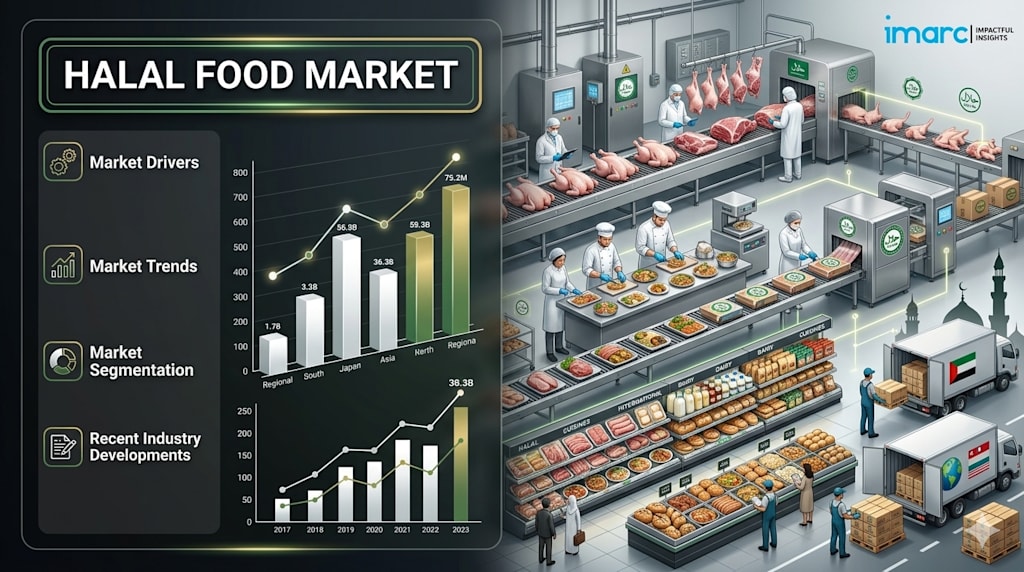
According to IMARC Group's latest research publication, the global halal food market reached a value of USD 2,956.4 Billion in 2025. Looking forward, IMARC Group expects the market to reach USD 6,329.3 Billion by 2034, exhibiting a growth rate (CAGR) of 8.56% during 2026-2034.
How AI is Reshaping the Future of Halal Food Market
- AI-Enabled Halal Supply Chain Traceability and Certification Artificial intelligence is transforming halal food supply chains by enabling end-to-end traceability and verification of halal compliance. AI-powered blockchain and tracking systems monitor sourcing, processing, storage, and distribution, ensuring adherence to halal standards. These technologies enhance transparency, build consumer trust, and reduce risks of contamination or mislabeling.
- Smart Food Processing and Quality Assurance Systems AI-driven automation is improving halal food production by ensuring strict quality control and hygiene standards. Machine learning algorithms analyze production processes, detect contamination risks, and maintain compliance with halal certification requirements. Computer vision systems further assist in monitoring slaughtering procedures and packaging integrity.
- Demand Forecasting and Personalized Consumer Insights AI is enabling halal food manufacturers and retailers to predict demand patterns and optimize inventory management. Advanced analytics leverage consumer behavior, cultural preferences, and regional trends to offer personalized product recommendations, improve supply efficiency, and enhance customer engagement across online and offline channels.

Halal Food Industry Overview
The halal food industry is experiencing significant growth driven by increasing global Muslim population, rising awareness of halal-certified products, and expanding adoption among non-Muslim consumers seeking safe, ethical, and hygienic food options. Asia-Pacific dominates the market with over 48.5% share, supported by large Muslim populations and strong government initiatives promoting halal certification and food processing industries.
Halal Food Market Trends & Drivers
The rising global Muslim population represents the primary growth driver, significantly increasing demand for halal-certified food products across regions. Expanding purchasing power and urbanization further strengthen consumption patterns.
The growing preference for clean-label, ethical, and hygienic food is boosting adoption among non-Muslim consumers as well. Halal food is widely perceived as safe, high-quality, and compliant with strict preparation standards.
The expansion of e-commerce and modern retail channels is accelerating market growth by making halal products more accessible globally. Online platforms allow consumers to easily purchase certified products, especially in urban areas with busy lifestyles.
Additionally, increasing product diversification and innovation—including ready-to-eat meals, processed foods, and packaged halal products—is widening the consumer base and driving industry expansion.
Leading Companies Operating in the Global Halal Food Industry
Nestlé S.A.
Cargill, Inc.
BRF S.A.
American Halal Company Inc. (Saffron Road)
Midamar Corporation
Al Islami Foods
QL Foods Sdn Bhd
Crescent Foods
Al Kabeer Group
Prima Agri-Products
Halal Food Market Report Segmentation
By Product Type:
Meat, Poultry & Seafood
Dairy Products
Fruits & Vegetables
Cereals & Grains
Oil, Fats & Waxes
Confectionery
Others
Meat, poultry, and seafood dominate the market, as halal dietary laws strongly emphasize permissible meat consumption and processing standards.
By Distribution Channel:
Supermarkets & Hypermarkets
Traditional Retailers
Online
Others
Supermarkets and hypermarkets lead the segment, offering a wide range of certified products and ensuring product authenticity and accessibility.
Regional Insights
North America (United States, Canada)
Asia Pacific (China, India, Indonesia, Malaysia, Others)
Europe (Germany, France, United Kingdom, Italy, Spain, Others)
Latin America (Brazil, Mexico, Others)
Middle East and Africa
Asia Pacific dominates the market, driven by large Muslim populations, supportive government policies, and increasing demand for processed halal food products.
Recent News and Developments in Halal Food Market
February 2026: Companies increasingly adopted blockchain and AI technologies to improve halal certification transparency and traceability across global supply chains.
January 2026: Leading food manufacturers expanded halal-certified product portfolios across supermarkets and online platforms to meet rising global demand.
Note: If you require specific details, data, or insights that are not currently included in the scope of this report, we are happy to accommodate your request. As part of our customization service, we will gather and provide the additional information you need, tailored to your specific requirements. Please let us know your exact needs, and we will ensure the report is updated accordingly to meet your expectations.
About the Creator
sujeet. imarcgroup
With 2 years of hands-on experience at IMARC Group, I have conducted in-depth market research and analysis across diverse industries including technology, healthcare, agriculture, and consumer goods.
Enjoyed the story? Support the Creator.
Subscribe for free to receive all their stories in your feed.
Comments
There are no comments for this story
Be the first to respond and start the conversation.