
The Employer's Guide to Gross Misconduct
How to Dismiss Fairly and Stay Tribunal-Proof

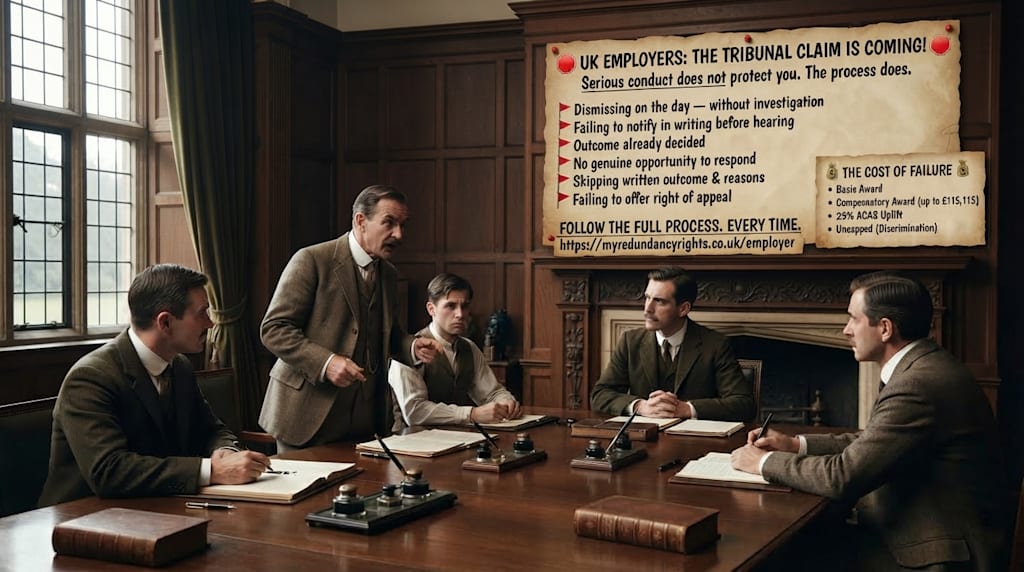
Most UK employers believe that serious misconduct protects them from tribunal claims. It does not. The process you follow matters as much as what the employee did — and skipping a single step can make a fair dismissal unfair.
This is one of the most expensive misconceptions in UK employment law. An employee caught stealing, committing fraud, or engaging in serious harassment can still bring a successful unfair dismissal claim if the employer failed to follow the correct procedure. The tribunal does not only ask what happened. It asks how the employer handled it.
What Gross Misconduct Actually Means
Gross misconduct refers to behaviour so serious that it fundamentally destroys the employment relationship — justifying summary dismissal without notice. Common examples include:
Theft, fraud, or deliberate falsification of records
Physical violence or threatening behaviour
Serious breaches of health and safety procedures
Gross insubordination or deliberate damage to company property
Serious harassment, bullying, or discrimination
Unauthorised disclosure of confidential information
Critically, what constitutes gross misconduct must be clearly defined in the employee's contract or the company disciplinary policy — and communicated to employees in advance. Employers who attempt to apply gross misconduct retrospectively, or to behaviour not previously categorised as such, face significant legal exposure.
Why Serious Misconduct Does Not Automatically Protect You
The Employment Rights Act 1996 provides employees with the right not to be unfairly dismissed. A dismissal is assessed on two grounds at tribunal: whether there was a potentially fair reason — and whether the employer acted reasonably in treating that reason as sufficient to dismiss.
Even where the reason is sound, the tribunal will examine the procedure followed. Under the ACAS Code of Practice on Disciplinary and Grievance Procedures, employers are required to follow a fair process regardless of the severity of the alleged conduct.
"We thought the CCTV footage was enough," said one HR manager at a retail business, speaking after an unfair dismissal finding at tribunal. "We told him what we had found and dismissed him the same day. The tribunal agreed the conduct was gross misconduct — but awarded compensation because we had not given him the opportunity to respond. It cost us more than the original theft."
According to ACAS, procedural failures are one of the most common reasons employers lose unfair dismissal claims — even in cases where the underlying conduct is not disputed.
The Process You Must Follow
Every gross misconduct dismissal must go through the following steps to be defensible at tribunal:
1. Suspend if necessary — but do not prejudge
Where the allegation is serious, a period of suspension on full pay while the matter is investigated may be appropriate. Suspension must be kept as short as possible and must not signal a predetermined outcome.
2. Carry out a thorough investigation
Before any disciplinary action is taken, a reasonable investigation must be completed. The scope depends on the allegation — but it must be genuine, documented, and proportionate. Skipping or rushing the investigation is one of the most common procedural failures.
3. Notify the employee in writing
The employee must receive written notification of the allegation, the potential consequences — including dismissal — and the date, time, and location of the disciplinary hearing. They must be given reasonable time to prepare.
4. Hold a disciplinary hearing
The employee has the legal right to be accompanied at the hearing by a colleague or trade union representative. The hearing must be a genuine opportunity for the employee to respond to the allegations — not a formality where the outcome has already been decided.
5. Make a reasonable decision
The decision to dismiss must be within the band of reasonable responses — meaning another reasonable employer in the same situation might have made the same decision. If the conduct was serious but dismissal was disproportionate, the tribunal may find the dismissal unfair even where the process was followed.
6. Issue a written outcome
The decision must be communicated in writing, with reasons, and within a reasonable timeframe after the hearing.
7. Offer the right of appeal
Every employee dismissed for gross misconduct must be offered the right of appeal. Failing to do so is a procedural failure that can increase any compensation awarded at tribunal by up to 25% under the ACAS Code uplift provisions.
Notice Pay and Payment in Lieu
Where gross misconduct is established through a fair process, the employer may dismiss without notice — summary dismissal. However, if the contract contains a Payment in Lieu of Notice (PILON) clause, that clause must be honoured. Failure to do so may give rise to a wrongful dismissal claim in addition to any unfair dismissal proceedings.
Accrued holiday pay and any unpaid wages remain payable regardless of the reason for dismissal.
What a Tribunal Can Award
Where an unfair dismissal claim succeeds, the tribunal can award:
A basic award — calculated using age, length of service, and weekly pay
A compensatory award — up to a statutory cap of £115,115 from April 2025
An ACAS uplift of up to 25% where the employer failed to follow the Code
Where the dismissal is found to have involved discrimination, the compensatory award is uncapped.
Your Action Plan as an Employer
Ensure your disciplinary policy clearly defines what constitutes gross misconduct — and that all employees have received and acknowledged it
Never dismiss on the day an allegation arises — suspend on full pay and begin a proper investigation
Follow every step of the ACAS Code: investigation, written notification, hearing, written outcome, right of appeal
Document everything — every meeting, every decision, every piece of evidence
Ensure the decision to dismiss is proportionate and within the band of reasonable responses
Always offer the right of appeal in writing with a clear deadline
A fair process protects your business. An unfair one — regardless of what the employee did — can cost you thousands.
About the Creator
myredundancyrights
Free, plain-English UK employment law guidance — redundancy, unfair dismissal, gross misconduct, PIPs and more. Know your rights before it's too late.
Enjoyed the story? Support the Creator.
Subscribe for free to receive all their stories in your feed.
Comments
There are no comments for this story
Be the first to respond and start the conversation.