
The Development of the Nuclear Bomb: A Defining moment in Mankind's Set of experiences
The development of the nuclear bomb remains quite possibly one of the most extraordinary and questionable crossroads in mankind's set of experiences. It changed the essence of fighting as well as always modified the political and moral scene of the twentieth 100 years. Brought into the world from a logical virtuoso, extraordinary wartime pressures, and international technique, the improvement of the nuclear bomb finished in the US's Manhattan Undertaking during The Second Great War. The narrative of the bomb is an intricate interchange of logical revelation, military need, and moral uncertainty.
The Groundworks of Atomic Material Science
The excursion toward the creation of the nuclear bomb started sometime before The Second Great War, established in the spearheading work of physicists in the mid _twentieth hundred years. The underpinning of atomic material science was laid with the disclosure of radioactivity by Henri Becquerel in 1896 and the ensuing examinations by Marie and Pierre Curie. These researchers disentangled the secrets of nuclear construction and prepared for grasping atomic responses.
In 1905, Albert Einstein presented his renowned condition, E=mc², which set that energy and mass are compatible. This guideline recommended the chance of saddling the tremendous energy locked inside nuclear cores. Nonetheless, it was only after the revelation of atomic parting in 1938 by German physicists Otto Hahn and Fritz Strassman, and the ensuing translation by lise Meitner and Otto Frisch, that the way to nuclear energy was completely opened. They found that when a uranium core is barraged with neutrons, it parts into more modest parts, delivering a huge measure of energy. This disclosure was set up for the advancement of atomic weapons.
The Job of The Second Great War
The Second Great War was the impetus that sped up the competition to foster the nuclear bomb. In the last part of the 1930s and mid _1940s, as pressures raised in Europe and the Nazi system sought its forceful extension, the likelihood that Adolf Hitler's Germany could foster an atomic weapon turned into a grave concern. Many driving physicists, including some who had escaped Nazi mistreatment, perceived the risks of such a weapon falling into Hitler's hands. Among them was the conspicuous physicist Leo Szilard, who, alongside Albert Einstein, composed a letter to President Franklin D. Roosevelt in 1939 encouraging the US to start nuclear examination. This letter was a critical calculation of the inevitable development of the Manhattan Undertaking.
In 1942, under the bearing of the U.S. Armed Force Corps of Architects, the Manhattan Undertaking was authoritatively sent off. General Leslie Forests was named to lead the huge, mysterious work to construct a nuclear bomb, and physicist J. Robert Oppenheimer was chosen as the logical chief. The undertaking would ultimately more than 130,000 individuals and cost almost $2 billion (identical to about $30 billion today).
The Manhattan Venture: Building the Bomb
The Manhattan Venture united the absolute most prominent logical personalities of the period, including Enrico Fermi, Niels Bohr, and Richard Feynman. Its essential goal was to foster a functioning nuclear bomb before Germany or Japan could do so. The venture's innovative work was completed at various mystery areas across the US, most quite at Los Alamos, New Mexico, where Oppenheimer and his group attempted to plan and build the bomb.
Two sorts of bombs were created: a uranium-based bomb (code-named "Young Man") and a plutonium-based bomb (code-named "Chunky Man"). On July 16, 1945, the primary fruitful trial of a nuclear bomb, code-named "Trinity," was directed in the desert of New Mexico. The blast made a fireball noticeable for more than 200 miles and delivered an energy discharge comparable to 20,000 tons of dynamite. The time of atomic weapons had started.
Hiroshima, Nagasaki, and the Consequence
With the fruitful trial of the nuclear bomb, the U.S. confronted a great choice. By mid-1945, the conflict in Europe had finished with the loss of Nazi Germany, yet the conflict in the Pacific against Japan proceeded. The U.S. military assessed that a traditional intrusion of Japan could bring about a large number of American and Japanese losses, prompting conversations about utilizing the nuclear bomb to drive Japan's acquiescence.
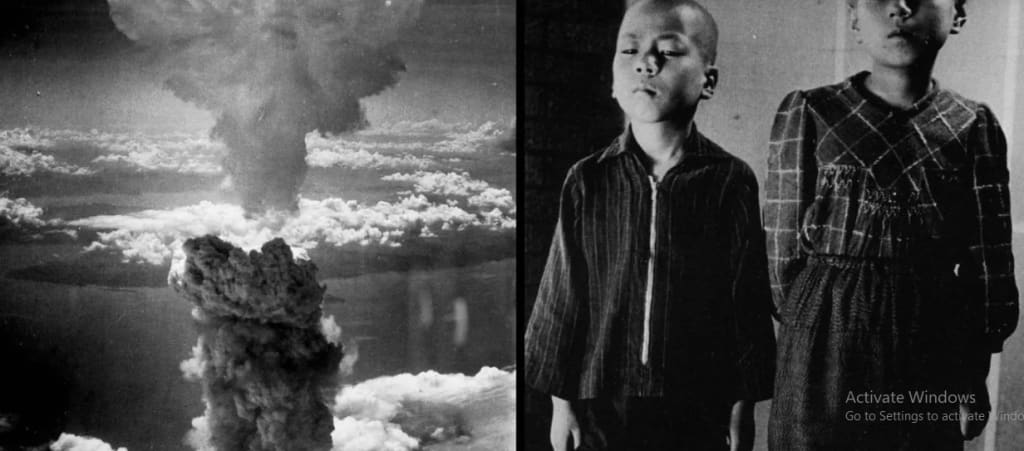
On August 6, 1945, the US dropped the "Young Man" bomb on Hiroshima, killing an expected 140,000 individuals before the year was over, either immediately or from radiation infection. After three days, on August 9, the "Hefty Man" bomb was dropped on Nagasaki, killing roughly 70,000 individuals. Japan gave up on August 15, 1945, successfully finishing The Second Great War.
While the nuclear bombings of Hiroshima and Nagasaki carried a sudden finish to the conflict, they likewise introduced another period of atomic nervousness. The size of annihilation brought about by the bombs, especially the drawn-out impacts of radiation openness, stunned the world. The pictures of smoothed urban areas and the enduring of survivors, known as hibakusha, became permanent images of the detestations of atomic fighting.
Moral and Political Ramifications
The development and utilization of the nuclear bomb brought up significant moral issues that keep on resounding today. A few contended that the bombings were important to save lives by staying away from a drawn-out battle, while others fought that Japan was at that point near the precarious edge of giving up and that the utilization of such destroying weapons was ridiculous. The choice of remaining parts is perhaps the most controversial point ever.
Past the quick annihilation, the nuclear bomb essentially changed worldwide international relations. It set off the Virus War weapons contest between the US and the Soviet Association, as the two superpowers tried to create and store atomic weapons. The danger of commonly guaranteed obliteration turned into a focal component of worldwide relations during the last 50% of the twentieth hundred years, prompting tense deadlocks like the Cuban Rocket Emergency of 1962.
Conclusion
The creation of the nuclear bomb was a turning point in mankind's set of experiences. It addressed the victory of logical inventiveness yet in addition released exceptional horrendous power. While it finished The Second Great War, it made the way for the atomic weapons contest and another period of worldwide strain. The moral, political, and human outcomes of the nuclear bomb keep on molding our reality, helping us to remember both the potential and hazards of human mechanical headways.
About the Creator
Enjoyed the story? Support the Creator.
Subscribe for free to receive all their stories in your feed.
Comments
There are no comments for this story
Be the first to respond and start the conversation.