
The Day Your Financial Advisor Becomes an AI: How Wealth Management Is Quietly Changing Forever
The First Wave: Automation Replaces Repetition

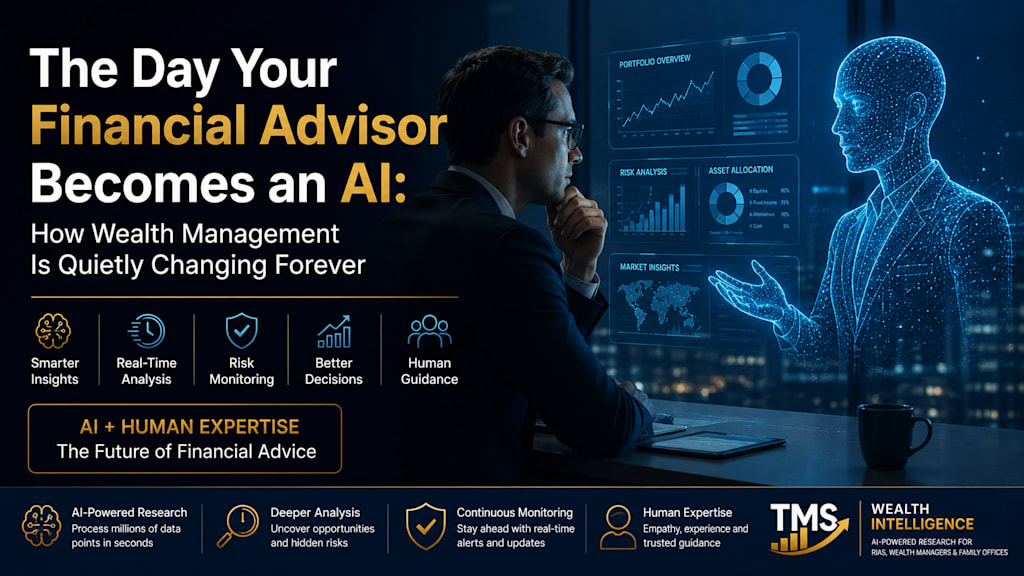
For decades, the relationship between an investor and a financial advisor looked remarkably similar.
A client sat across a desk. An advisor reviewed statements, discussed goals, recommended investments, and periodically adjusted a portfolio. The process evolved with technology, but the basic structure remained unchanged.
Today, that structure is beginning to crack.
Not because investors no longer need advice.
Not because advisors are becoming obsolete.
But because artificial intelligence is starting to perform many of the tasks that once justified the entire profession.
The transformation is not arriving through headlines or dramatic announcements. It is unfolding quietly inside wealth management firms, retirement planning offices, family offices, and registered investment advisor practices across the United States.
The future of financial advice may not be human versus machine.
It may be human plus machine.
And that future is arriving faster than most people realize.
## The First Wave: Automation Replaces Repetition
Financial advice has always contained two separate jobs.
The first is intellectual labor.
Researching investments.
Analyzing portfolios.
Monitoring markets.
Comparing products.
Producing reports.
The second is human labor.
Building trust.
Managing emotions.
Helping clients navigate uncertainty.
Explaining complex financial decisions.
For years, technology focused primarily on the administrative side of the business.
Portfolio management software reduced paperwork.
Customer relationship management systems organized client information.
Online custodians simplified account opening.
Artificial intelligence is different because it targets the intellectual side of the profession.
Tasks that once required analysts, researchers, and junior advisors can now be completed in seconds.
An AI system can summarize a 50-page fund prospectus.
It can compare dozens of ETFs.
It can identify tax-loss harvesting opportunities.
It can monitor hundreds of economic indicators simultaneously.
Most importantly, it can do these things continuously.
While humans sleep, AI continues processing information.
The result is not merely faster research.
It is an entirely different operating model.
## Why Wealth Management Is Especially Vulnerable
Many industries are discussing artificial intelligence.
Few are as exposed to its effects as wealth management.
The reason is simple.
Financial advice depends heavily on information.
Markets generate information.
Companies generate information.
Governments generate information.
Investors generate information.
Every day, millions of data points influence financial decisions.
Historically, the ability to process information created competitive advantages.
The advisor who understood more often performed better.
Today, information itself is becoming abundant.
What becomes scarce is interpretation.
Investors no longer pay premium fees simply to access information.
They pay for judgment.
That distinction is changing how advisory firms compete.
## The Rise of AI-Native Wealth Intelligence
A new category is emerging inside financial services.
Instead of building products first and research second, these firms build intelligence first.
Research platforms increasingly use artificial intelligence to analyze market developments, summarize regulatory changes, identify investment themes, and highlight emerging risks.
Rather than replacing advisors, these systems act as force multipliers.
One advisor can now perform work that previously required an entire support team.
A solo practitioner can access institutional-quality research.
A small RIA can compete more effectively against national firms.
The playing field begins to level.
That may be the most important consequence of AI.
Not replacing professionals.
Empowering smaller ones.
## The Client Experience Is Changing Too
Investors have already become accustomed to digital convenience.
Banking moved online.
Trading moved online.
Financial planning is following the same path.
Clients increasingly expect answers immediately.
They want portfolio updates in real time.
They want tax insights throughout the year rather than once every April.
They want personalized information.
Artificial intelligence makes these expectations achievable.
An AI-powered platform can monitor portfolios continuously and identify opportunities that human advisors might miss.
It can generate customized reports.
It can explain complex strategies in simple language.
It can deliver insights at scale.
As expectations rise, advisors who embrace technology gain an advantage.
Those who ignore it risk appearing outdated.
## The Human Advantage Remains
Despite the excitement surrounding artificial intelligence, one reality remains unchanged.
Money is emotional.
Investors do not panic because spreadsheets tell them to panic.
They panic because they are human.
The most important moments in financial planning are often psychological rather than analytical.
A retirement decision.
The sale of a business.
An inheritance.
A market crash.
A sudden job loss.
An AI system can provide data.
It cannot replace empathy.
When uncertainty strikes, people still seek human reassurance.
This is why the future of wealth management is unlikely to be fully automated.
The winners will combine technological efficiency with human trust.
## Family Offices and the New Information Arms Race
The impact may be greatest among family offices.
Wealthy families increasingly face a flood of information.
Private credit.
Private equity.
Alternative investments.
Tax policy changes.
Estate planning strategies.
Global macroeconomic developments.
Managing complexity has become a full-time challenge.
Artificial intelligence offers a way to filter noise and surface what matters.
Instead of reading hundreds of pages of reports, decision-makers can focus on actionable insights.
The competitive advantage shifts from collecting information to acting on it faster.
That shift favors organizations willing to embrace technology.
## A Future Defined by Augmentation
Many discussions about AI focus on replacement.
History suggests a different outcome.
Technology often augments professionals rather than eliminating them.
Calculators did not eliminate accountants.
Spreadsheets did not eliminate analysts.
Electronic trading did not eliminate investors.
Artificial intelligence is likely to follow a similar path.
The advisor of the future may spend less time gathering information and more time applying it.
Less time preparing reports.
More time advising clients.
Less time searching for answers.
More time making decisions.
In that world, the value of advice increases rather than decreases.
Because judgment becomes more important when information is abundant.
## The Next Decade
Ten years from now, investors may look back at today's wealth management industry the same way we view financial services from the 1990s.
Not because the fundamentals changed.
But because the tools changed.
Artificial intelligence is becoming the new infrastructure layer of financial advice.
Quietly.
Gradually.
Almost invisibly.
Yet the implications are enormous.
The firms that learn to combine human expertise with machine intelligence will likely define the next generation of wealth management.
The question is no longer whether AI will influence financial advice.
The question is how quickly the industry adapts.
And somewhere in the near future, a client may receive an investment insight, a tax-planning recommendation, or a portfolio alert generated by artificial intelligence before their advisor even arrives at the office.
When that day comes, wealth management will not have become less human.
It will have become more intelligent.
And that may be the most valuable investment of all.
About the Creator
ABDELALI EL KHADMAOUI
Associate Editor of financial news at Market signals where he writes and edits original analysis in and around the wealth management, as well as other parts of the financial markets and economy. He has more than five years of experience
Enjoyed the story? Support the Creator.
Subscribe for free to receive all their stories in your feed.
Comments
There are no comments for this story
Be the first to respond and start the conversation.