
The Chinese University Name Mystery Hiding in One Missing Character
Tsinghua’s history page still says “Department of Mechanical Engineering Studies.” The sign outside says something shorter. That gap explains 70 years of mainland and Taiwan naming.
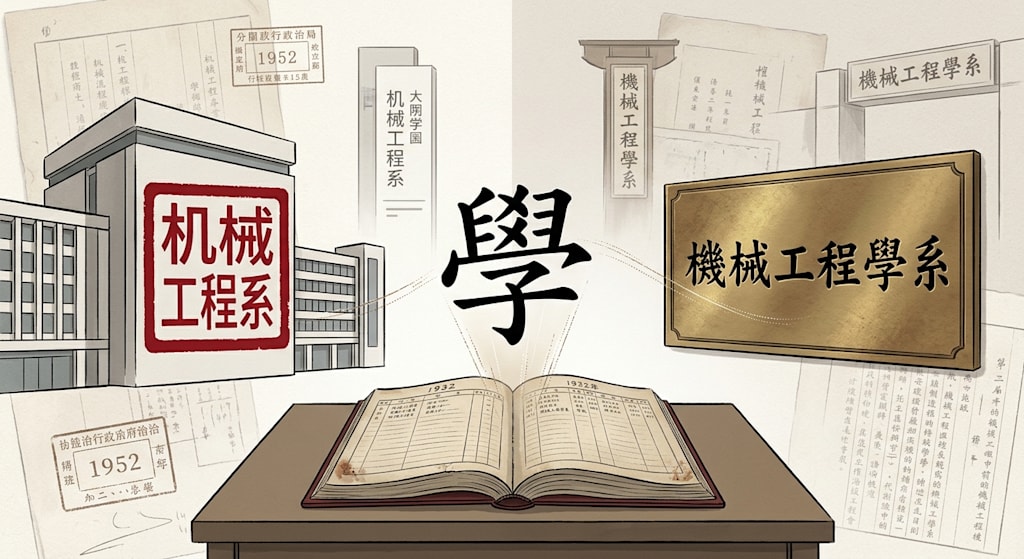
Tsinghua’s Department of Mechanical Engineering opens its history page with an older name: “The Department of Mechanical Engineering traces its origins to the Department of Mechanical Engineering Studies established in 1932 in the School of Engineering of Tsinghua University.” The current sign reads “Department of Mechanical Engineering.” The history page keeps 学; the seal does not.
In 1932 Tsinghua created its School of Engineering. Beneath it sat the Department of Mechanical Engineering Studies, the Department of Electrical Engineering Studies, and the Department of Civil Engineering Studies. Seventeen years later, Liang Sicheng published “Draft Plan for the Academic System and Curriculum of the Department of Construction Studies (Now Called the Department of Architectural Engineering Studies) of Tsinghua University” in Wen Hui Bao. By 1952, after the departmental adjustments, Tsinghua had eight departments: Mechanical Manufacturing, Power Machinery, Civil Engineering, Hydraulic Engineering, Architecture, Electrical Engineering, Radio Engineering, Petroleum Engineering. None carried 学.
The subject names barely moved. The generic unit name did. In the Republican period, a department’s full title was “X Studies Department,” with 学系 (xuexi, “studies department”) acting as one unit name. After 1952, the university-college-department system became a university-department system, and 系 (xi, “department”) replaced 学系. “Department of Mechanical Engineering Studies” became “Department of Mechanical Engineering”: mechanical engineering plus studies department turned into mechanical engineering plus department. Tsinghua restored the department in 1978 and again in 2012. Neither restoration brought back 学. The current institution is a 系; only the historical narrative says 学系.
Taiwan kept the older unit name. National Taiwan University’s College of Engineering lists “Studies Departments and Graduate Institutes,” “Graduate Institutes,” and “Research Centers.” “Studies department” works there as a single unit name, parallel to “graduate institute.” NTU’s Department of Civil Engineering Studies, Department of Mechanical Engineering Studies, and Department of Chemical Engineering Studies all keep 学 in their full names. NTU is old. When its Department of Mathematics and Department of Chemistry were formally established after Taiwan’s retrocession, the two sides of the strait had not yet separated, and “Department of Mathematics” and “Department of Chemistry” survived by inertia. Read as mathematics plus studies department, “Department of Mathematics Studies” and “Department of Chemistry Studies” are redundant. Language does not always follow logic.
Tamkang University made the redundancy explicit. In 1958, when it became a four-year undergraduate institution, the administration established the “Department of Chemistry Studies,” the “Department of Mathematics Studies,” and the “Department of Chinese Literature Studies.” NTU calls its corresponding unit the “Department of Chinese Literature,” an older name carried over from the mainland. Tamkang ignored the convention and added 学系 after the subject name. Chemistry plus studies department. Mathematics plus studies department. Institutional consistency beat semantic fluency.
College names followed a similar route. In the Republican period, the College of Arts, College of Law, College of Science, College of Engineering, College of Commerce, College of Agriculture, and College of Medicine treated 学院 (xueyuan, “college”) as one unit name, not as study plus college. When Taiwanese universities split their law colleges, two readings surfaced. In 1993, National Chengchi University divided its College of Law into the College of Law and the College of Social Sciences (社会科学学院). In 1999, NTU divided its college into the College of Law and the School of Social Sciences (社会科学院). NCCU treated 学院 as the whole unit. NTU treated 院 as the whole unit. In 2003, NTU established the College of Life Science (生命科学院); mainland universities generally call theirs the College of Life Sciences (生命科学学院). Mainland usage treats 学院 as the whole unit, so it cannot drop 学 and call the unit 院. Department names on the mainland lost 学. College names kept it.
After reform and opening up, mainland universities rebuilt college-level structures. Early colleges often amounted to departments with new signs. When departments of mathematics and chemistry became colleges, the naming problem arrived with them. Peking University established the School of Mathematical Sciences in 1995 on the basis of its Department of Mathematics and Department of Probability and Statistics. Its Department of Chemistry became the College of Chemistry and Molecular Engineering in 1994. Fudan created the School of Mathematical Sciences in 2005. Nanjing created the College of Chemistry and Chemical Engineering in 1993. Lanzhou formed the College of Chemistry and Chemical Engineering in 1998, then abolished its Department of Mathematics in 2004 to create the School of Mathematics and Statistics. These names gave the college a larger disciplinary-group identity; they did not swap one word in a department name.
Some universities used the direct name. Nankai formed its College of Chemistry in April 1995. In July 2000, the college became an incorporated entity built from the former Department of Chemistry, the Institute of Elemento-Organic Chemistry, the Institute of Polymer Chemistry, the Institute of Applied Chemistry, the Institute of New Energy Material Chemistry, the National Pesticide Engineering Research Center, and the Central Laboratory. Sichuan University has a School of Mathematics and a College of Chemistry. Jilin University has both. Shandong University has a School of Mathematics. Beijing Normal University has a College of Chemistry. Mainland universities do have Schools of Mathematics and Colleges of Chemistry. Schools with earlier college-system reform and more complete disciplinary groups simply use expanded names more often.
“College of Philosophy” (哲学院) sounds smoother than “College of Mathematics” (数学院) or “College of Chemistry” (化学院) because it carries a discipline category. Renmin University established its College of Philosophy in 2005. Nankai turned its Department of Philosophy into a College of Philosophy in 2010. Fudan turned its into a College of Philosophy (哲学学院) in 2006. Philosophy is a discipline category; mathematics and chemistry are first-level disciplines under the science category. The three-character “X College” pattern came down from the Republican period: College of Arts, College of Law, College of Science, College of Engineering. It addressed broad categories. Forestry colleges sit at the edge: forestry science belongs to agriculture, but forestry institutions are a separate category by institutional type. Renmin University’s 2005 School of Chinese Classics and its call for a Chinese classics discipline category follow the same pattern.
That pattern is a tendency, not a law. Schools of Mathematics and Colleges of Chemistry are legitimate and common. Nankai’s College of Chemistry shows a college integrating institutes, centers, and laboratories rather than merely rebadging a department. Whether a name expands depends on what the university wants to emphasize. Tsinghua’s mechanical engineering page keeps the old sentence: “traces its origins to the Department of Mechanical Engineering Studies established in 1932 in the School of Engineering of Tsinghua University.” The history page keeps 学; the current seal keeps 系. A unit can have one name on the seal and another in its lineage. Both are real. They sit on different pieces of paper.
About the Creator
Jin
Writer of reamstories
https://reamstories.com/jin
Enjoyed the story? Support the Creator.
Subscribe for free to receive all their stories in your feed. You could also become a paid subscriber, letting them know you appreciate their work.
Comments
There are no comments for this story
Be the first to respond and start the conversation.