
The Benefits of Cloud ERP for Manufacturing Businesses
ERP for the Manufacturing Industry
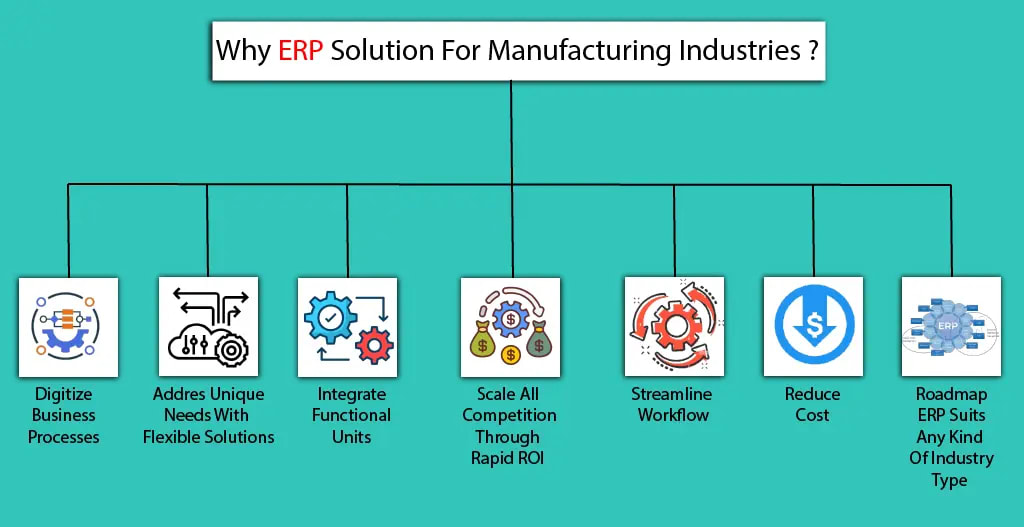
Enterprise Resource Planning (ERP) is a suite of integrated software applications that helps businesses manage all of their core processes, from accounting and finance to manufacturing and supply chain management. For manufacturers, ERP can provide a number of benefits, including:
Improved visibility and control: ERP systems provide a single, unified view of all of a manufacturer's data, which can help to improve visibility and control over operations. This can lead to better decision-making, reduced costs, and improved customer service.
Increased efficiency: ERP systems can help to automate many of the manual processes involved in manufacturing, which can lead to increased efficiency. This can free up employees to focus on more strategic tasks, and can help to reduce errors.
Improved compliance: ERP systems can help manufacturers to comply with a variety of regulations, such as those governing product safety, environmental compliance, and financial reporting. This can help to protect the manufacturer from legal liability and can also improve their reputation with customers and partners.
Enhanced decision-making: ERP systems can provide manufacturers with a wealth of data that can be used to make better decisions. This data can include information on sales, inventory, production, and costs. By analyzing this data, manufacturers can identify trends, make informed predictions, and optimize their operations.
How ERP can benefit manufacturing businesses
ERP can benefit manufacturing businesses in a number of ways, including:
Improved planning and forecasting: ERP systems can help manufacturers to improve their planning and forecasting capabilities. This can help them to ensure that they have the right inventory levels, that they are meeting customer demand, and that they are making the most efficient use of their resources.
Increased visibility into operations: ERP systems can provide manufacturers with a single, unified view of their operations. This can help them to identify and correct problems more quickly, and to make better decisions about how to allocate resources.
Reduced costs: ERP systems can help manufacturers to reduce costs in a number of ways. For example, they can help to improve efficiency, reduce waste, and improve compliance.
Improved customer service: ERP systems can help manufacturers to improve customer service by providing them with a better understanding of customer needs and by making it easier to track orders and shipments.
The benefits of cloud ERP for manufacturing
Cloud ERP is a type of ERP system that is hosted and managed on the cloud. This means that manufacturers do not need to own or maintain their own hardware or software, which can save them money and time. Cloud ERP is also more scalable than traditional ERP systems, so it can be easily adapted to the changing needs of a manufacturing business.
Some of the benefits of cloud ERP for manufacturing include:
Reduced upfront costs: Cloud ERP systems do not require manufacturers to make any upfront investments in hardware or software. This can save them a significant amount of money, especially for small and medium-sized businesses.
Easy scalability: Cloud ERP systems are easily scalable, so manufacturers can easily add or remove users and modules as their needs change. This can help them to avoid overpaying for features that they do not need.
Improved security: Cloud ERP systems are hosted in secure data centers, so manufacturers can be confident that their data is safe.
Ease of use: Cloud ERP systems are typically easier to use than traditional ERP systems. This is because they are designed to be accessible from any device with an internet connection.
The future of ERP for manufacturing
The future of ERP for manufacturing is bright. As the manufacturing industry continues to evolve, ERP systems will need to adapt to meet the changing needs of businesses. Some of the trends that are expected to shape the future of ERP for manufacturing include:
The rise of cloud ERP: Cloud ERP is becoming increasingly popular among manufacturers, as it offers a number of advantages over traditional ERP systems.
The increasing importance of data analytics: ERP systems will need to be able to collect and analyze large amounts of data in order to help manufacturers make better decisions.
The growing need for integration: ERP systems will need to be able to integrate with other business systems, such as CRM and SCM systems.
Conclusion
ERP can be a valuable tool for manufacturing businesses. By automating processes, providing visibility into operations, and helping to make better decisions, ERP can help manufacturers to improve efficiency, reduce costs, and improve customer service. As the manufacturing industry continues to evolve, ERP systems will need to adapt to meet the changing needs of businesses. Cloud ERP, data analytics, and integration are all trends that are expected to shape the future of ERP for manufacturing.
For More Details - Click here
About the Creator
Enjoyed the story? Support the Creator.
Subscribe for free to receive all their stories in your feed.
Comments
There are no comments for this story
Be the first to respond and start the conversation.