
The AI Discovery Gap Is What Happens When Market Leaders Stop Looking Like Leaders in AI
Why strong market position no longer guarantees strong visibility where AI starts shaping demand


A company can still look dominant on paper and already be losing the next layer of demand.
That is the uncomfortable premise behind the AI Discovery Gap. As LLM Authority Index explains on its website, the problem is not that traditional business metrics stopped mattering.
It is that they no longer describe the whole competitive picture once AI systems start guiding customer discovery.
A business can have strong revenue, brand recognition, distribution, and growth, yet still be weak in the environments where AI recommends, ranks, and frames options for buyers.
The gap is simple, but the risk is not
LLM Authority Index defines the AI Discovery Gap as the difference between a company’s real-world market position and its position inside AI-driven discovery systems.
On one side is business strength in the real world, including revenue, market share, brand recognition, distribution scale, and customer base.
On the other side is discovery strength in AI environments, including how often the company appears in AI responses, how highly it is ranked, how often it is recommended first, and how strongly it is framed relative to competitors.
When those two line up, a company’s AI position reflects its market strength. When they do not, a strategic mismatch appears.
The article argues that this mismatch matters because AI is starting to mediate first impressions. If a company is missing from relevant AI recommendations, or appears only weakly inside them, it may be losing future demand even while current performance still looks strong.
Why smaller companies can suddenly look stronger
The source makes the idea concrete with a stark example: Company A has $200 million ARR, strong brand awareness, and a strong sales organization, but weak presence in AI responses and is rarely recommended first in category prompts.
Company B has $20 million ARR, limited mainstream brand awareness, and a much smaller business, but strong AI presence and frequent recommendations in high-intent prompts. By traditional logic, Company A is the obvious leader. At the discovery layer, Company B may already be winning attention.
That is what makes the concept so unsettling. Discovery influences consideration. Consideration influences demand. Demand influences growth. What looks like a modest mismatch today can become a much larger competitive problem tomorrow.
The shift is from traffic to recommendation
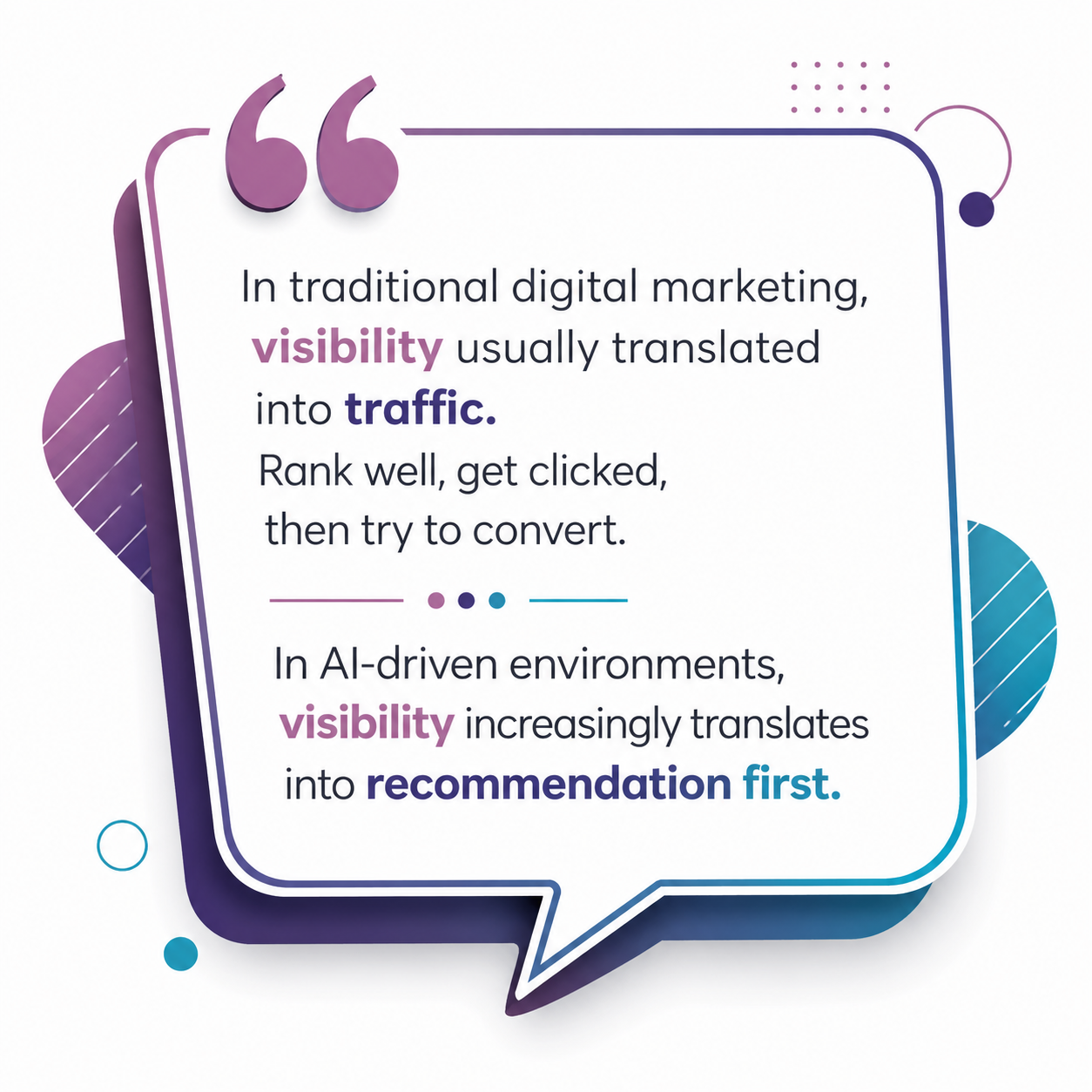
One of the strongest ideas in the article is that AI changes the value chain. In traditional digital marketing, visibility is usually translated into traffic. Rank well, get clicked, try to convert. In AI-driven environments, visibility increasingly translates first into recommendation.
The system interprets the question, reduces complexity, and suggests which company appears most relevant, trustworthy, or appropriate. The article’s point is blunt: recommendation is stronger than exposure. A click is an opportunity. A recommendation is a directional push.
That logic overlaps naturally with LLM Authority Index’s article on AI Discovery Economics, which argues that not all AI visibility has equal value.
It distinguishes between being mentioned, being included in comparisons, and being recommended, and treats recommendation as the economically important layer because it has the strongest influence on choice.
It also defines Discovery Value as the economic impact of being visible, and preferably recommended, in AI-generated responses to commercially meaningful prompts.
For a quick rundown of the topic, watch this video:
Why incumbents face a hidden kind of risk
The source article says the most dangerous version of the AI Discovery Gap appears when a strong incumbent underperforms in AI discovery relative to its real-world status.
That creates what it calls discovery risk. It often shows up as fewer new users hearing about the company first, more competitors being recommended in top positions, weaker prompt coverage in high-intent queries, declining influence at the consideration stage, and reduced narrative control over how the category is framed.
Crucially, this can happen before revenue visibly declines.
That is why the gap can stay hidden. Traditional dashboards still show traffic, search rankings, CAC, conversions, brand awareness, pipeline, revenue, and retention. Those metrics are useful, but the article argues that none directly show how AI is positioning a company at the point of recommendation. They reveal downstream performance, not what AI is doing earlier in the decision journey.
Why ranking inside AI matters so much
The article is also clear that the gap is not just about presence. It is about position. A company can appear in many AI responses and still be weakly positioned if a competitor is listed first and framed more strongly.
Its shorthand is especially useful: presence measures inclusion, ranking measures preference. A company with high inclusion and low preference still has a gap.
That is exactly where the related article How AI Actually Chooses Which Companies to Recommend sharpens the story. That piece argues AI works less like a search engine and more like a synthesis engine. It narrows options, structures the answer, and implies hierarchy.
It also says recommendation outcomes are shaped by a mix of contextual presence, consistency of positioning, and reinforcement across sources. So the companies that win are not just visible. They are easier for the system to justify choosing.
The gap compounds over time
This may be the most important point in the whole framework. The AI Discovery Gap is not static. It expands. As AI systems repeatedly recommend certain companies, those firms may gain more attention, more selection, more mentions, more reviews, and more reinforcing context.
Meanwhile, weakly represented companies receive fewer chances to be chosen and accumulate fewer signals that would strengthen future recommendation.
Which leads to the real strategic question: are you measuring current business strength, or are you measuring who AI is training the market to choose next?
About the Creator
keith Dickson
Exploring how AI, search, and recommendation systems reshape modern visibility and brand choice.
Enjoyed the story? Support the Creator.
Subscribe for free to receive all their stories in your feed.
Comments
There are no comments for this story
Be the first to respond and start the conversation.