
The AI College Boom Is Outrunning the Teachers Who Have to Make It Work
China added 10,200 program points and more than 90 AI colleges. The hard part starts after the ribbon cutting.
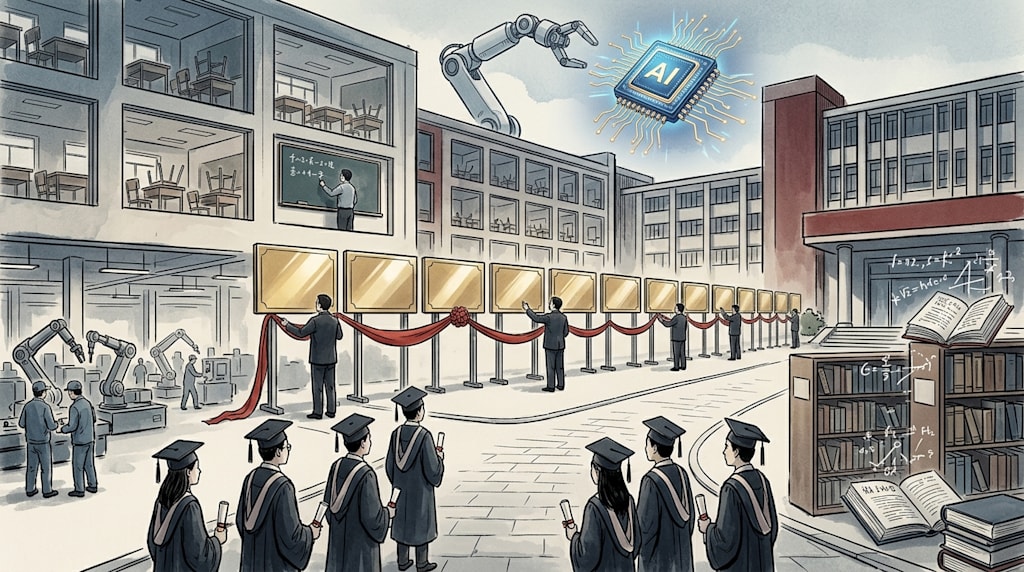
In September 2026, the busiest thing on Chinese campuses was not opening ceremonies. It was plaque unveilings.
Northwestern Polytechnical University launched a School of Flexible Electronics. Xiamen University unveiled a School of Intelligent Manufacturing. Nanjing Medical University’s Changzhou campus launched six innovation platforms at once. Earlier, Huazhong University of Science and Technology applied to add four majors, including Embodied Intelligence and Brain-Computer Science and Technology. Communication University of China sought to add Game Science and Technology, Esports, and other programs. Harbin Institute of Technology, Beihang University, and seven other schools introduced embodied intelligence majors. Anhui Normal University, a teacher-training school, launched three new engineering colleges aimed at artificial intelligence.
Over the past year, undergraduate institutions have established more than 200 new colleges. More than a quarter have “intelligent” in the name. During the 14th Five-Year Plan, universities added 10,200 undergraduate program points and cut or suspended 12,200. The cumulative adjustment ratio passed 30 percent. This year it broke 10 percent for the first time.
This is a redrawing of the disciplinary map. The map is easier to redraw than the classroom is to staff.
Where money and people are going
Start with numbers.
The Ministry of Human Resources and Social Security predicts a 4.5 million talent gap in intelligent manufacturing. In 2026, college graduates will number about 12.7 million. Many graduates cannot find work. Emerging industries cannot find the people they need. A discipline catalog updated every five years cannot fix that mismatch.
Employment data suggest the direction makes sense. For 2025 graduates, intelligent manufacturing engineering majors earned 7,134 yuan a month, above the engineering average of 7,033 yuan. Their job relevance was 75 percent, above the engineering average of 70 percent. Artificial intelligence majors in matched jobs earned 7,651 yuan a month, 1,189 yuan more than those in mismatched jobs. The market pays for people who can do the work.
Money is following. On the day Xiamen University’s School of Intelligent Manufacturing opened, it signed agreements with Henan Huanghe Whirlwind, Xiamen Tungsten, Shandong Linuo Pharmaceutical Packaging, and Suzhou Baikong Sensing. Four university-enterprise R&D platforms were created, with nearly 20 million yuan in cooperation funding. Anhui Normal University partnered with Chery Holding Group and moved classrooms onto the factory floor. Dalian Institute of Engineering and Unitree Robotics built an embodied intelligence industry college. They are co-developing courses, textbooks, and faculty sharing. Nanchang Hangkong University’s School of Mechanical and Electrical Engineering piloted a “3+1” model with Jiangxi Jiashite. Students finish graduation projects inside the company.
Since 2024, the Ministry of Education has tested a program in eight provinces and municipalities to match disciplines and majors with regional development. Around regional billion-yuan and trillion-yuan industrial clusters, 247 discipline clusters have been built. Shandong created an early-warning and exit system. If a discipline or major drifts from the school’s mission, loses industry demand, or produces low employment rates, it gets a warning in year one, suspended enrollment in year two, and elimination in year three.
Those steps are more useful than a new plaque.
But other numbers cut the other way
More than 90 universities have created artificial intelligence colleges. In 2025 alone, more than 20 opened. A college’s strength does not live in its name.
Vice Minister of Education Du Jiangfeng warned that new majors are not just a new label on the same bottle. They need courses, faculty, and platforms behind them. A plaque can go up in three months. A good teacher can take ten years to train.
The employment side shows the strain. Job satisfaction for intelligent manufacturing engineering majors is 76 percent, five points below the engineering average. Fifty-two percent say they work too much overtime. For artificial intelligence majors, only 56 percent work in a job related to their field. The engineering average is 70 percent. Thirty-one percent take unrelated jobs because they cannot meet the requirements of related work. That is 17 points above the engineering average.
A large share of AI graduates spend four years studying and still cannot find work in the field. Majors are being created faster than industry can absorb and train the people they produce.
Basic disciplines face their own pressure. In 2026, Communication University of China shut down or merged 16 undergraduate programs, including translation, photography, and some economics and management majors. Jilin University suspended 19 undergraduate programs. East China Normal University suspended 24. The cuts fall hardest on traditional management, language, and arts programs.
The Central Leading Group on Education issued the Higher Education Discipline and Major Setting Adjustment and Optimization Action Plan for 2025 to 2027. It includes a Basic Disciplines Leapfrog Action. Policymakers see the problem. Resources still follow policy. Disciplines that produce results slowly, miss honor rolls, and cannot tell a funding story that wins grants get squeezed out. Artificial intelligence comes down to mathematics. Chips come down to physics. Everyone knows that. Funding and staffing decisions often say something else.
In four years, will the wind still blow?
One old problem is the time lag between training and industry.
In the past, universities adjusted majors every few years. Manufacturing firms now digitize production lines in one or two years. A hot major launched today may be crowded four years from now.
There is precedent. “The 21st century is the century of biology” sent high-scoring students into biology departments. Later, people coined “the four great pits of biology, chemistry, environment, and materials.” When the Internet of Things major was hot, universities rushed to enroll students before labs were built. Once the wind passed, the major kept appearing on elimination lists. Law, English, and some management majors have gone through the same cycle.
Schools can try, fail, and adjust in five years. Students do not get another four years. If an eighteen-year-old spends four years in a program that does not match reality, who returns that time?
How to judge a new college
For students and parents, ignore the name. Check three things.
First, how deep is the foundation? Xiamen University’s School of Intelligent Manufacturing rests on a century of mechanical engineering. That is restructuring and upgrading. Some new AI colleges were once a computer teaching office. Faculty did not expand. Courses did not change much. That is a name change.
Second, where do the people come from? Did the school bring in industry practitioners, or did it hand new office nameplates to the same faculty? Check the faculty list, the résumés of industry mentors, and the new courses on the syllabus.
Third, do companies actually teach? Industry-education integration on paper and in the classroom are different. Are partner companies leading projects, giving lectures, and supervising graduation projects? Or did they sign a document and stamp a seal at the opening ceremony? Current students know.
The pace is the problem
The direction is not in doubt. The country needs industrial upgrading and new quality productive forces. Higher education must keep up. Moving disciplines and majors from the school’s own small logic toward the country’s large logic is the stated goal.
The problem is pace.
At a State Council Information Office press conference, Vice Minister of Education Du Jiangfeng said major setup must be linked with enrollment, training, and employment. Graduate employment must be an important consideration. If that sentence becomes practice, it will do more than a hundred new plaques.
Three things need to move together.
New majors need an exit mechanism. A plaque should not be permanent. If employment rates fall short, faculty are missing, and courses stop changing three years after enrollment, the school needs early warning and adjustment. Shandong’s “one-year warning, two-year suspension, three-year elimination” model deserves wider use.
Existing majors need upgrade paths. Schools cannot only add. Traditional engineering still has value. It needs curriculum reform, updated labs, and industry projects. Elimination is the easiest move. It is not always the responsible one.
Basic disciplines need protection. The Basic Disciplines Leapfrog Action cannot live only in documents. Funding guarantees, evaluation reform, and long-term support must follow. Otherwise, marginalization is a matter of time.
Conclusion
The biggest risk in this round is confusing restructuring with renaming.
The most valuable thing about a university is not on the department list. It is in the minds of generations of teachers and in the polishing of each course. Names are easy to copy. Brains are hard to move. A grand opening ceremony cannot take four years of classes for students.
Build the faculty first. Polish the courses. Move industry-education integration from agreements into classrooms. Then hang the plaque. It will not be too late.
About the Creator
Jin
Writer of reamstories
https://reamstories.com/jin
Enjoyed the story? Support the Creator.
Subscribe for free to receive all their stories in your feed. You could also become a paid subscriber, letting them know you appreciate their work.
Comments
There are no comments for this story
Be the first to respond and start the conversation.