
The 318/320 That Shouldn’t Exist
A high schooler with no advanced training allegedly used AI to score near-perfect in China’s physics olympiad. The real scandal is what the exam room didn’t have.
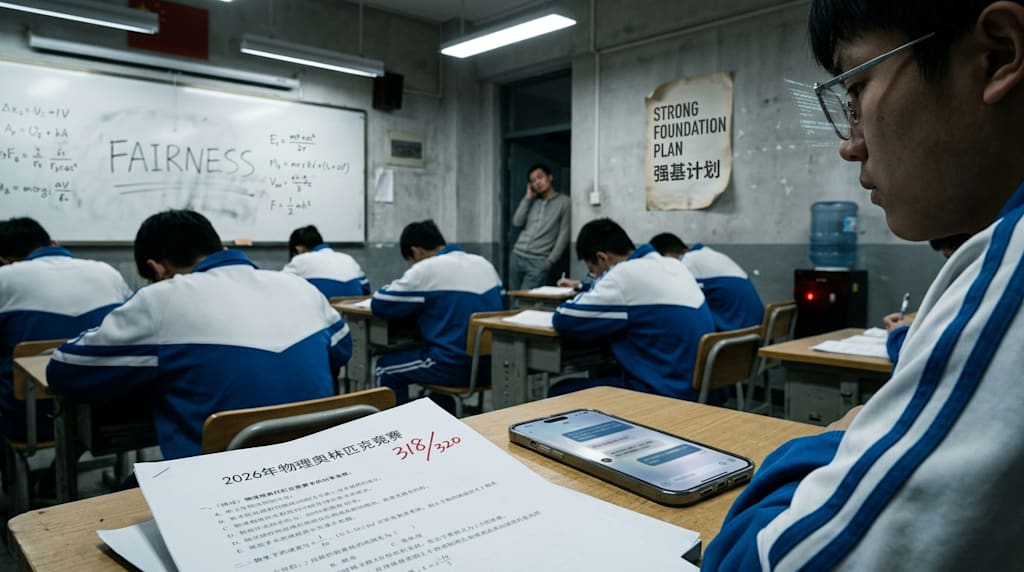
318. Full marks for the theoretical round: 320.
On the Jiangsu regional score sheet, that number is followed by a name: a second-year student at Haian Middle School. Experimental score: 73. Total: 391. Another competitor is mentioned repeatedly: from Nanjing Normal University Affiliated High School—second in Quantum, first in Aipeiyou joint exam, total 340.
Difference: a few points? Difference: a study history.
Known information: this 318 student has not attended any theoretical training camp, has not studied the “four mechanics,” has not stopped classes, has not worked through Problems and Solutions in Physics Olympiad or Training and Selection for the International Physics Olympiad. Two experimental training camps. Preliminary score: 390. At the same school, a student had already been disqualified from the semifinal for using AI to cheat during the preliminary round.
At the end of the corridor, the water dispenser’s red light is on. The invigilator leans against the door frame.
Jiangsu test site is in Nanjing, split between No. 1 Middle School and the Affiliated High School. A candidate who took the exam at No. 1 Middle School for three years describes: one invigilator per room, one or two roving invigilators per floor. Students go to the bathroom on their own. No electronic device checks. No signal jamming. Thirty people, separated. Information on the Affiliated High School site is pending, but from disclosed descriptions, the difference is small.
A door without a lock.
The semifinal scoring system depends on process derivation, model construction, and physical imagery. A correct final answer without key steps may earn only 30 percent. Someone who does not understand this logic, if handed a “standard answer” to copy word for word, may instead earn a very high score because the answer is “perfect.” Replace Zuoyebang with GPT. Take five photos. Copy. That is the simplest cheating path.
A more hidden method does not require pulling out a phone. Smart glasses use optical waveguide technology: the image is directed at the wearer’s eye from a specific angle, invisible to others. Micro cameras sit in the temples. A remote gunner receives the image in real time. Bone conduction returns answers as audio. Externally, it looks like a student thinking. The exam room has no signal jamming, no electronic device checks. The technical threshold has dropped to nearly zero.
A layer of dust on the keyboard cover.
AI’s ability in physics competitions is no longer “assistance.” An August 2026 study showed that a GPT-5.5-based model grading handwritten physics olympiad papers reached total-score correlations of 0.91 to 0.97 with official scores, and could even reproduce the official Olympic selection team list. In July 2026, an AI model scored 28.6 out of 30 on the theoretical exam of the International Physics Olympiad—a gold-medal level score. In the IPhO 2025 theoretical exam, GPT-5.4 Pro scored 93.5 percent, first on the public leaderboard. The HiPhO benchmark shows top closed-source reasoning models collected 6 to 12 gold medals across 13 physics olympiads. Gemini-2.5-Pro scored 22.7 out of 29.4 in IPhO-2025. Of the 37 human gold medalists, 21 scored higher, but it already stands in the gold zone.
ScienceArena expert scoring notes say GPT-5 “often earns full marks on local symbolic derivations,” and experts describe several early subparts as “basically perfect.” The same notes list weaknesses: tasks requiring mapping symbols to diagrams, selecting correct curves, propagating measurement uncertainty. In S2 C1-C2, it scored 0/1 for failing to identify a conserved total force constraint. These weaknesses target IPhO-level top problems. At semifinal difficulty, AI performs far more steadily.
A Strong Foundation Plan brochure is pasted by the print shop door. The corner is curling.
In 2026, many universities tightened or canceled competition exception channels in the Strong Foundation Plan. Beijing Normal University, South China University of Technology, and Lanzhou University explicitly canceled competition exception entry to school tests. Xi’an Jiaotong University and Tongji University raised the exception threshold from silver to gold or first prize. This adjustment has continued for years. In 2025, Harbin Institute of Technology and Xi’an Jiaotong University already recognized only gold as an exception entry condition. Beihang University canceled the competition exception channel entirely. In 2026, of the 39 pilot universities in the Strong Foundation Plan, 15 have no competition exception channel.
One competition coach at a key high school interprets: “In the past, some parents treated competitions as a ‘springboard for admission.’ Even if the child had no talent, they forced them to stop classes and train.” The official logic is written clearly: curb the utilitarian tendency in competitions, correct the deviation of some students “stopping classes to chase awards” for admission.
Policy is “de-utilitarianizing.” Exam administration remains on the assumption that “everyone is honest.” When the admission value of competitions is cut, does the organizer’s incentive to invest resources in exam security fall in step? No public answer.
On the meeting room whiteboard, the word “fairness” from the last seminar is still there. Not wiped clean.
Official handling faces an evidence dilemma. Unless caught on the spot or with confirmed communication records or money transfers, it is hard to make a formal cheating finding based on “abnormal score” alone. Under current rules, an abnormal high score can be explained as “exceptional performance” or “favorable problems.” In the 2015 physics competition preliminary leak, the response was to report to police. In the 2019 36th final leak allegations, the official investigation concluded “no leak.” In the 2026 Physics Bowl, faced with clustered abnormal high scores, the response was to cancel the global Top 100 ranking—no explanation, no characterization, no continued ranking.
The most likely result: during score review, cancel the scores of one or two candidates on grounds of “abnormal answer sheet” or “procedural issue,” and issue no public statement admitting “large-scale AI cheating.” This avoids admitting systemic failure in the short term. The cost: competitors, coaches, and university admissions officers cannot be sure the scores are real.
The 2015 leak was “a few people got information early.” The scope could be defined. Responsibility could be traced. AI cheating is “anyone can get all answers at low cost.” The impact is diffuse, untraceable, impossible to fix through local adjustments. When AI can generate an answer sheet that is nearly flawless under the scoring standard, what is the competition selecting? The person who best understands physics, or the person best able to obtain correct answers?
Terence Tao, discussing AI participation in the IMO, pointed out that directly comparing AI and human contestants is unfair, and AI should have its own competition system. The suggestion is logically sound. In practice, it has one precondition: human competitions must be able to prove results come from humans. The current exam administration cannot guarantee that precondition.
On the score sheet: 318. In the exam room: phones unchecked. In the Affiliated High School corridor: the roving invigilator walks past. The water dispenser’s red light is still on. No one knows which exam room the next photo will be taken in.
About the Creator
Jin
Writer of reamstories
https://reamstories.com/jin
Enjoyed the story? Support the Creator.
Subscribe for free to receive all their stories in your feed. You could also become a paid subscriber, letting them know you appreciate their work.
Comments
There are no comments for this story
Be the first to respond and start the conversation.