
Teaching Media Literacy
Introducing the basics to empower people


I am currently teaching an online Media Literacy course for Ukrainian college students and thought I could use this as an opportunity to share some ideas while they are still fresh.
First of all, I want to share my impression of Ukrainian students. I wish I could transplant them into my American classroom. They diligently read the assigned material in advance, listen actively in class without being glued to their phones, and willingly participate in the discussions. I think the conditions of war they are living in make them hyper-aware of the information environment and hungry for knowledge, especially on the topics of today's reality.
When I teach media literacy, I start with basic definitions so that we are all on the same page. Here are the most important definitions that we arrive at through discussion in the first class:
Communication (Merriam-Webster): the act or process of using words, sounds, signs, or behavior to express or exchange information or to express thoughts, feelings, etc., to another person (sender to receiver).
Communication can be practiced at different levels: intrapersonal (when we talk to ourselves), interpersonal, small group/organizational, and mass.
Depending on whether any technology is used, communication can be mediated (on the phone, Internet, or through mass media) or non-mediated (face-to-face communication).
Communication can also happen in different settings, such as professional, personal, religious, etc.
As humans, we are so immersed in communication and take it so much for granted that we only understand its true value and function when we are taken out of it, like water out of fish. Remember Tom Hank's movie Cast Away, where desperate for communication his character humanizes a volleyball, calls him Wilson, and talks to him all the time? This is a good example of how important communication is to us as social creatures.
Media: various channels, platforms, and devices that facilitate and mediate communication and information exchange.
In the 20th century, we used to think of mass media (capable of reaching many people in different geographic locations at the same time) as newspapers, magazines, radio, TV and the Internet. In today's oversaturated information environment, your smartphone is a mass medium because it allows you to instantly tap into the vast repository of human knowledge and navigate the ocean of information we are all swimming in, trying not to drown.
Literacy: at the very basic level – ability to read and understand the written word. But being literate also means being educated, cultured.
Media literacy (US National Association for Media Literacy Education): The ability to access, analyze, evaluate, create, and act using all forms of communication.
The NAMLE definition above is an excellent working definition, especially for teachers of K-12 or secondary school education who are teaching today's kids to navigate the modern media environment.
In higher education, however, we go deeper and complicate things by adding meanings and layers to the phenomena we study and practice. So the definition that James Porter, the most prominent scholar of media literacy in the United States and author of Media Literacy, a leading textbook that will come out in its 11th edition this August, reads like this:
Media literacy is a set of perspectives we actively use when we expose ourselves to media messages, to process and interpret their meaning.
What makes this definition more complicated, abstract, and academic is the "set of perspectives." Why is it important? Because to truly understand how and why media today produce certain content and how it effects us, we need to shift perspectives and think not only as consumers of information but also as producers of media content and policy makers who have the power of influencing it. Thus, media literacy is multi-layered and includes:
basic literacy - we still need to be able to read and write to navigate the information environment;
visual literacy - the ability to understand the meaning of various images as we live in a highly visual culture ushered in by television and completely oversaturated in the age of the Internet-based and AI technologies;
information literacy - the ability to tell facts from opinions, to evaluate credibility of the sources, and understand the message intent;
narrative literacy - the ability to understand main rules, principles and techniques of storytelling; and
computer literacy - the ability and skills in using computer-based and Internet technologies, which today also include artificial intelligence.
It's a lot to learn and master. But if we don't develop these skills and abilities, we will be just floating purposelessly in the media environment, allowing media content producers to easily suck us in, while we give them our time, attention, and money. Basically, enslaving us and making us into insatiable mindless content consumers who constantly want a new hit of dopamine delivered by entertainment coming our way from every possible channel. It's Amusing Ourselves to Death (a famous book by Niel Postman about effects of television on society) on steroids. The floating fatty glued to a screen in Wall-E is not as dystopian as it may seem.
So, how do we develop media literacy? We need to start with the younglings. I used to think that a good place to start with basic media literacy skills would be middle school. Now I think it might be too late. We need to teach elementary school children about media and their power of influence in age-appropriate ways, for example by explaining to them how advertising works (if you've ever seen toddlers being fascinated by ads, you know what I mean).
Potter suggests that we all go through various stages of media literacy development, starting at the basic levels in blue, with the goal of getting to the advanced ones, as explained here:
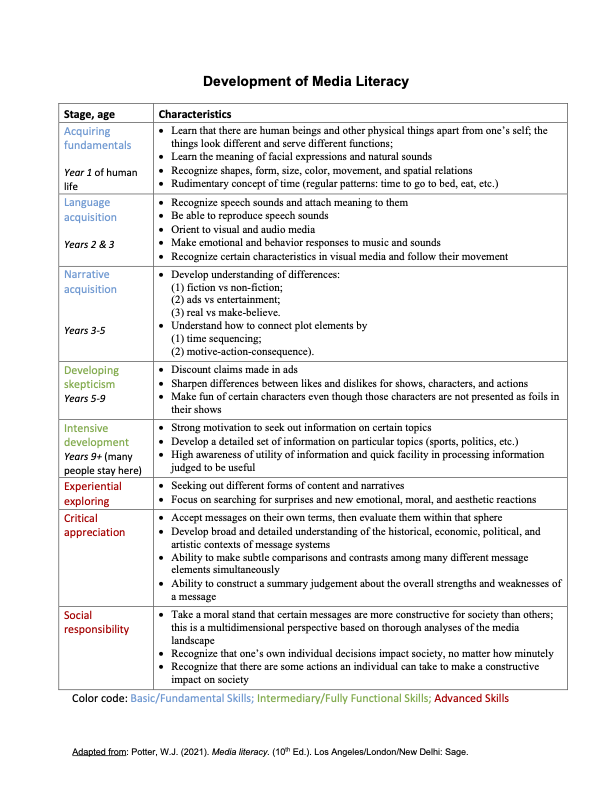
The truth, however, is that most people stay at the intermediary (still fully functional) level and don't want to spend the energy and time to improve their media literacy skills. This is why many people take the fake and misleading information on the Internet at its face value, especially when it is in line with their ideological and worldview positions.
To take them out of that passive consumption of media information mode, we need to encourage people to improve their media literacy. The work needs to be done in four areas as they are mapped out in the cover image above:
improving critical skills (the seven skills listed in the Skills box on the map);
motivating people to spend mental and physical energy on improving their media literacy by understanding their own media consumption patterns and resetting them to meet their goals and needs rather than those of the media;
expanding their knowledge structures about media and the world they operate in by realizing how media work, their history, technology, economics, and social impact;
and lastly, something I try to do here on Vocal by publishing my movie and TV shows reviews from the media literacy perspective - understanding how media products affect us at cognitive, emotional, aesthetic, and moral dimensions.
Once we are advanced enough in our media literacy skills, we can help others improve them, starting with our children, relatives and friends, and ending with our social media circles. Our entire world will be better for it.
About the Creator
Lana V Lynx
Avid reader and occasional writer of satire and short fiction. For my own sanity and security, I write under a pen name. My books: Moscow Calling - 2017 and President & Psychiatrist
@lanalynx.bsky.social
Enjoyed the story? Support the Creator.
Subscribe for free to receive all their stories in your feed. You could also become a paid subscriber, letting them know you appreciate their work.
Comments
There are no comments for this story
Be the first to respond and start the conversation.