
Tao Called AI Math “Toxic Waste.” The Fight Is Over Who Cleans Up.
OpenAI dropped 722 proofs into public view. Tao’s line was about benchmarks, verification, and responsibility, not whether AI can do mathematics.
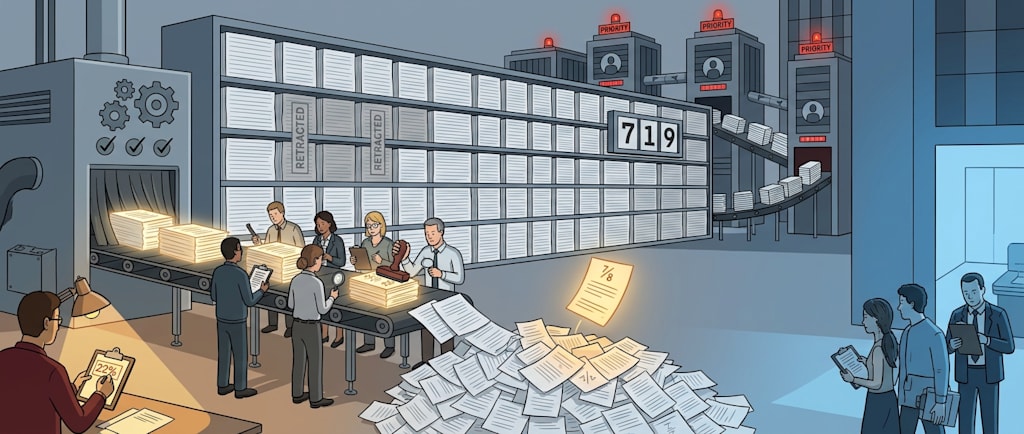
n October 2026, OpenAI’s mathematics manuscript repository showed 722 rows. The next day, three rows turned gray. Retracted. Then came 14 revisions, 13 citation updates, and a total of 719. Around then, Terence Tao said “toxic waste” on the SAIR podcast. Headlines cut the phrase out and used it as proof that Tao had rejected AI mathematics outright. Put the sentence back into the audio. The clauses around it are still there. He was describing proofs driven by benchmarks, dumped in bulk, and left for no one in particular to digest. His target was the mode of production and the allocation of responsibility.
What “waste” referred to
In an Observer interview, Tao laid out the chain more directly than he did on the podcast. AI companies are “racing to build the strongest model.” They need training. They need benchmarks. They need to give the model large numbers of problems to see whether its capabilities are improving. Mathematics problems are “almost the only trainable material left.” So “all the prizes and goals in our field suddenly became their benchmarks.” The result: “As a byproduct, they are generating these bad proofs. The results are great, but they don’t care whether the solution is elegant, who will understand it, or what happens next.”
Each clause limits what “waste” means. “Byproduct” names the process. Solving problems is not happening to advance mathematical understanding. It is something thrown off while the model climbs. “They don’t care whether the solution is elegant, who will understand it, or what happens next” names a vacuum of responsibility. The producer does not bear the obligation to digest. “Toxic” lands on “untreated, unclaimed, but consuming the receiver’s resources.” The phrase describes a batch of intermediate products dumped into the public domain. It does not settle the truth value of the whole pile.
If “toxic waste” were a universal negation, another evaluation from the same conversation could not stand. Tao said ten or so of the problems were ones he cared about. Manuscript No. 003, related to the quasi-Riemann hypothesis, pushed the zero-free region of the zeta function to 7/8. He called it “the biggest advance on the problem in fifty years.” He said that this proof, assembled from three or four existing ideas, was one “no living mathematician could have put together alone.” A person does not call a result “the biggest advance in fifty years” and also hold that it belongs to a set that is all waste. One reading works. He was rejecting the mode of production and the later allocation of responsibility. He was not rejecting the epistemic value of the results.
Processing costs had a concrete shape
When Tao said “or we have to deal with it,” he described a labor transfer already under way. Early counts of the repository’s formalization directory put about 22% of the 722 manuscripts through formal verification in Lean or similar systems. Among the 143 added between October 3 and October 6, none had been formally verified in Lean. Lean verification covers the formalized statement. It does not guarantee that the statement matches the original problem. Most manuscripts had not cleared even the minimum line of machine-checkable defense. The later record followed the same line: 3 retractions, 14 revisions, 13 citation updates, total 719.
Yi Ni of Caltech offered an analogy. Suppose a superintelligence claims it can build a bridge in three hours, builds 722 bridges at once, and three collapse the next day. “Would you still dare to use the rest?” The analogy targets the missing guarantee of passability. The builder left inspection and repair to passersby. The mathematical community caught that externalized cost. Waste here does not mean the conclusions are worthless. It means untreated intermediate products were dumped in bulk, and the processing was pushed onto people who had no part in the production decision.
The target was benchmark logic
On September 11, 2026, Tao and 24 other Fields Medalists co-signed an open letter, “The Serious Misalignment of AI in Mathematics.” The title draws the coordinates. The misalignment sits between the goals of AI companies and the goals of the mathematical community, not inside AI’s capabilities. The letter charges that AI companies “produce ‘true/false’ statements at an ever-increasing pace and at scale.” Mathematics grows through methods, explanations, knowledge transmission, and traceable chains of citation. It does not grow through throughput of true/false statements.
The Observer interview adds the competitive dynamics. When OpenAI heard that researchers at Anthropic were close to solving a Millennium Prize problem, the matter “became a code-red-level top priority.” Tens of millions of dollars were committed. Ten thousand AI agents were organized to attack these problems. In that framework, a mathematical problem functions as a test case to clear in a model arms race, not as an object to understand. Once cleared, the problem moves from “frontier of knowledge” to “processed data point.” The aesthetics of the proof, its interpretability, and its further developability stay outside the objective function.
Tao’s institutional response in the same conversation fits this. If AI-produced results give only answers, without understanding, explanation, and traceable citation, they should not enter the formal academic literature. That sets an entry threshold. It does not settle whether a proof is true. It calls for changing incentives. It does not call for stopping AI from doing mathematics.
The results’ height made the criticism stronger
The advance on the quasi-Riemann hypothesis matters because it exposes the tension inside the “waste” metaphor. Under a benchmark-driven mode of production, good mathematics can still appear as a byproduct. The way it appears makes its goodness hard to recognize and take up. Tao said that proof was one “no living mathematician could have put together alone.” That acknowledges a knowledge situation. AI can rearrange ideas humans already have, without “understanding,” in ways no individual human could reproduce. It can produce results humans can verify but struggle to construct independently.
Yu Deng’s “two boundaries” makes the situation clearer. For several centuries, “problems with a proof” and “problems whose proof humans can understand” largely coincided. Solving a problem usually meant understanding it, being able to explain it, extend it, teach it. AI makes the second boundary appear on its own. There is an intermediate zone: there is a proof, but humans do not yet understand it. Deng’s attitude is positive. AI proofs are “astonishing,” and they contain very good new ideas. This is “the co-evolution of humans and AI.” He and Tao share a premise. A proof must enter the range of what humans can understand, trace, and continue to develop before it has completed its life in the mathematical community. Deng emphasizes AI’s capacity to expand the boundary. Tao asks who will catch what comes over it.
Reading “toxic waste” as a blanket rejection of AI mathematical results misses the harder judgment. Tao did not say this mathematics is false, worthless, or should be discarded. He said proofs produced in this way, by these agents, without explanation or provenance, have their processing costs pushed onto people who did not participate in production. He also acknowledged that the pile pushed over contained ten or so problems he cared about and the biggest advance on that topic in fifty years. A critic who thought the whole pile was waste would not give that assessment in the same conversation.
“Toxic waste” describes a mode of production. It does not describe the truth value of the products. Tao and Deng ask for a change in incentives. Let mathematicians participate ex ante in setting tools and goals. Make explanation, provenance, and knowledge accumulation built-in requirements of AI mathematical output. Stop treating them as a process the community donates after the fact. The harsh metaphor works as a diagnostic report on the allocation of responsibility. It is not a verdict on AI’s mathematical ability. People who misread it let go of the most important part. Waste is “toxic” not because nothing inside has value. It is toxic because the people dumping it do not intend to take responsibility, and the people catching it have no obligation to take responsibility on their behalf.
The repository page now shows 719 rows. Three retractions, fourteen revisions, thirteen citation updates. On the podcast audio, the phrase “toxic waste” is still there. The clauses before and after it are still there too.
About the Creator
Jin
Writer of reamstories
https://reamstories.com/jin
Enjoyed the story? Support the Creator.
Subscribe for free to receive all their stories in your feed. You could also become a paid subscriber, letting them know you appreciate their work.
Comments
There are no comments for this story
Be the first to respond and start the conversation.