student
From balancing your course load to forging relationships with classmates to extracurricular involvement, these are the tried and true methods to nail your career as a student.
How to Make Money Writing Online with Textbroker (No Eperience Needed)
Start Earning as a Writer on Textbroker – No Experience Needed If you want to make money online by writing, Textbroker is a great place to start. You don’t need to be a professional writer or have years of experience. As long as you understand basic English grammar and can write clearly, you can begin earning on this platform.
By Kamran Khanabout a year ago in Education
The Short Video Gold Rush: Can AI Tools Like ShortBeast Really Help You Cash In?
Let's face it: our feeds are dominated by short videos. TikTok, Instagram Reels, YouTube Shorts – these bite-sized, scroll-stopping clips are consuming hours of our daily attention and driving massive engagement. It’s no wonder that everyone, from individual creators to big brands, is scrambling for a piece of the viral pie. The promise is alluring: explosive traffic, passive income streams, and brand authority, sometimes seemingly overnight.
By Epic Vibesabout a year ago in Education
Acting on Prosperity!
Your prosperity starts with your mindset. You must act like what you say. If you believe you’re blessed, your actions must show it. When God tells you to give, do it boldly. A prosperous person gives like one who knows he will never lack.
By Rabi Panimabout a year ago in Education
Career Favor Reaches Out to Rural India with Authentic Career Exploration Sources
Career Favor, a leading career focused platform, is transforming the way students and professionals navigate their career paths by providing accessible, expert-led resources tailored to their unique ambitions. With a mission to bridge the gap between reliable career guidance and rural Indian cities, Career Favor offers an extensive collection of insightful blogs and articles to help individuals make informed decisions about their future.
By Career Favorabout a year ago in Education
The Doctor Who Never Sleeps. AI-Generated.
In the silent hours of the night, when most hospital corridors grow still and human doctors finally get a moment to rest, there is one physician who never closes their eyes. They do not tire, they do not yawn, and they do not forget. This is the doctor who never sleeps — and it’s not a person at all. It’s artificial intelligence. A New Kind of Medical Partner Healthcare has always relied on two things: human skill and human endurance. But even the most dedicated doctors are bound by the limits of the body — fatigue, the need for rest, and the sheer impossibility of knowing everything at once. AI changes that equation. Today’s medical AI systems can scan thousands of patient records in seconds, cross-reference symptoms with decades of medical data, and suggest diagnoses that might take a human doctor hours — or even days — to uncover. They don’t replace the physician’s judgment; they enhance it. Imagine a doctor with a second brain, one that has read every medical journal ever published and can recall each detail instantly. That’s the reality AI is bringing to modern medicine. Catching Illnesses Before They Strike One of AI’s most promising abilities is early detection. In radiology, AI algorithms are now spotting cancer in X-rays and mammograms months before human eyes can see the warning signs. In cardiology, they’re predicting heart attacks by analyzing subtle changes in blood pressure, cholesterol levels, and even patterns in patient speech. It’s not magic — it’s pattern recognition at a scale no human could manage. Where a doctor might see one patient at a time, AI sees millions, finding the invisible threads that connect symptoms to outcomes. This means a patient can start treatment earlier, long before a condition becomes critical. The Tireless Night Shift For doctors and nurses, the night shift is grueling. Fatigue sets in, decision-making slows, and mistakes — rare but possible — can happen. AI, however, doesn’t experience exhaustion. In some hospitals, AI-powered monitoring systems now keep a constant watch on patients’ vital signs. If something changes — a dip in oxygen, a spike in heart rate — the system alerts medical staff instantly, sometimes before the patient even feels symptoms. In this way, AI becomes the vigilant guardian of the ward, catching emergencies in their earliest moments and giving human doctors precious extra minutes to act. Personalized Medicine — Tailored for You No two patients are exactly alike, yet traditional treatment often follows a one-size-fits-most model. AI is helping to change that. By analyzing genetic data, lifestyle habits, and personal health history, AI can suggest treatment plans designed for an individual’s unique biology. For cancer patients, this can mean selecting the drug that their specific tumor is most likely to respond to — avoiding the painful trial-and-error approach. It’s medicine at its most human — made possible by machines. The Emotional Side of a Digital Doctor Skeptics worry that AI will make healthcare cold and impersonal, replacing the warmth of a human touch with a sterile screen. But in practice, AI can actually give doctors more time for compassion. When AI handles the hours of data entry, report generation, and background research, doctors are freed to focus on the part of medicine only humans can deliver: listening, comforting, and connecting. Patients don’t want a robot’s hand on their shoulder — they want a human one. AI just makes it easier for that to happen. Not Without Challenges Of course, the doctor who never sleeps isn’t perfect. AI systems are only as good as the data they’re trained on. If the data reflects biases — in who gets treatment, in which symptoms are taken seriously — the AI may unintentionally carry those biases forward. There are also questions of trust. Who’s responsible if an AI makes the wrong call? The human doctor? The programmer? The hospital? These are ethical challenges the medical field is still wrestling with. And then there’s the human side — patients must feel comfortable knowing that a machine is part of their care. That trust will take time to build. A Future Where Humans and Machines Heal Together AI will not replace human doctors. But doctors who use AI may well replace those who don’t. The goal is not to create a machine that takes over medicine, but to build a partner that works tirelessly alongside humans. Imagine rural clinics with no resident doctor, but with AI-powered systems that can analyze scans, consult with remote specialists, and guide nurses in real-time. Imagine home health devices that monitor chronic conditions 24/7, alerting a doctor at the first sign of trouble. The doctor who never sleeps won’t be the hero of the hospital — but they will be the silent force that keeps more heroes alive. As the sun rises over tomorrow’s healthcare, the picture becomes clear: the future of medicine isn’t man or machine. It’s man and machine, working side by side. And in that future, the doctor who never sleeps will be watching over us all.
By Amin Turabiabout a year ago in Education
The Warrior Who Broke 9 Swords in One Day — And Changed the World"
The Sword of God: The Astonishing Life of Khalid ibn al-Walid Throughout human history, there have been figures so powerful, so legendary, that they transcend borders, religions, and ideologies. Their courage, intelligence, and leadership become universal lessons — and one such man was Khalid ibn al-Walid. Known by the title “The Sword of God”, Khalid was a military genius who never lost a single battle in over 100 engagements. But his story is far more than just blood and glory — it's a tale of transformation, humility, and greatness that continues to inspire even today. --- From Warrior of the Quraysh to Defender of Islam Khalid was born into the noble Quraysh tribe in 6th-century Arabia — the same tribe as the Prophet Muhammad (peace be upon him). He was raised among warriors, trained in swordsmanship and tactics from a young age. When Islam first emerged in Mecca, Khalid stood among its fiercest opponents. In fact, he played a decisive role in the Battle of Uhud, where the early Muslim army suffered heavy losses — many due to Khalid’s masterful cavalry maneuver. But then, something changed. Khalid watched the rise of Islam — not just as a religion, but as a force for justice, unity, and transformation. He saw men he once fought beside now living with purpose, discipline, and compassion. His heart began to shift. One day, Khalid rode into Medina, entered the Prophet Muhammad’s mosque, and declared his faith in Islam. The Prophet smiled and said: > “Praise be to God who guided you, O Khalid. I always saw greatness in you.” And from that day, Khalid’s sword no longer served tribal pride — it served a greater cause. --- The Turning Point: The Battle of Mu’tah Soon after his conversion, Khalid joined a Muslim army sent to confront the Roman Empire at Mu’tah (in present-day Jordan). The original commanders — Zayd ibn Harithah, Ja’far ibn Abi Talib, and Abdullah ibn Rawahah — were all killed in battle. The Muslim army was vastly outnumbered — 3,000 against more than 100,000 Roman troops. At this critical moment, Khalid took command. Using unmatched tactical brilliance, he reorganized the troops, executed feint retreats and flanking maneuvers, and managed to save the Muslim army from total annihilation. He broke nine swords in that one battle. When news reached the Prophet, he said: > “Khalid is a sword among the swords of Allah, unleashed upon the enemies of truth.” From that moment, he was known as “Sayf Allah” — The Sword of God. --- The Battle of Yarmouk: When Legends Are Born Khalid’s most legendary victory came in 636 AD at the Battle of Yarmouk, where a Muslim force of just 40,000 faced a Roman army of over 200,000. Any military analyst would call that suicide — but not when Khalid ibn al-Walid was in charge. He executed a masterclass in mobile warfare, leading cavalry charges, breaking Roman supply lines, and inspiring morale among the Muslims. He moved his troops with lightning speed, creating the illusion of greater numbers, and attacking the enemy from unexpected directions. The Roman Empire suffered a catastrophic defeat. Their dream of reclaiming the Levant was shattered forever. A Western historian once wrote: > “Had Khalid served the Romans, Europe might have spoken Arabic today.” --- A Leader Without Ego One of the most remarkable moments in Khalid’s life came not on the battlefield, but in an unexpected order. Caliph Umar ibn al-Khattab, fearing that people might start placing too much trust in Khalid rather than in divine help, removed him from command — in the middle of his victories. And Khalid’s response? No rebellion. No bitterness. He simply said: > “I fight for God, not for a position.” He continued to serve as a regular soldier under the new commander — the very essence of humility and discipline. --- The Most Shocking Part: How He Died Here’s the most surprising twist of all. Khalid ibn al-Walid — a man who fought over 100 battles, who was wounded head to toe, whose sword shaped the fate of empires — did not die in battle. He died in his bed. In his final moments, he is said to have wept and said: > “I’ve fought in so many battles, and there is no spot on my body without a scar from a sword or an arrow — yet here I die, like a camel in bed. May cowards never sleep in peace.” For a man who lived and breathed valor, dying a natural death was almost a heartbreak. --- Why Khalid ibn al-Walid’s Life Still Matters You don’t need to be Muslim to admire Khalid ibn al-Walid. He was a man who changed his beliefs when he saw the truth — something very few can do. He fought not for personal glory, but for justice, purpose, and unity. He respected discipline, leadership, and morality even when it meant sacrificing his ego. He wasn’t just a warrior. He was a man of principles. --- Final Thoughts: Lessons from the Sword of God Redemption is real — Even the fiercest of opponents can become the noblest of allies. Leadership is about service, not ego. True greatness lies in character, not just conquest. Khalid ibn al-Walid’s story isn’t just a chapter in Islamic history — it’s a timeless human tale of transformation, resilience, and glory. Whether you're a student of history, a leader, a soldier, or just someone seeking inspiration — his life offers lessons you won’t find in textbooks.
By MUSLIM Talk about a year ago in Education
Class Groups vs. Solo Study: What You’re Missing by Not Collaborating
In the world of online learning, students often grapple with a fundamental choice: to tackle their coursework alone, or to embrace the power of collaboration. While solo study undeniably has its place in building foundational knowledge, relying solely on it means missing out on a wealth of advantages that class groups offer. At Explain Learning, we continually emphasize the transformative potential of working with peers, especially in the context of preparing for exams and deepening understanding.
By Explain Learningabout a year ago in Education
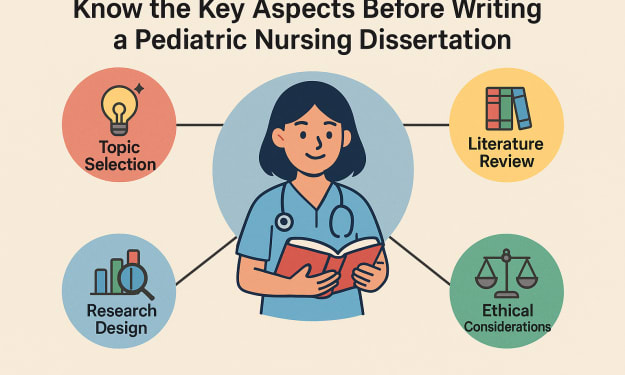
Know the Key Aspects Before Writing a Pediatric Nursing Dissertation
Students pursuing nursing to gain knowledge on pediatric care. It is a comprehensive research project that explores a specific issue or gap in pediatric healthcare. It requires in-depth analysis and original research on pediatric care when you write a dissertation. The pediatric nurses require specialised knowledge of child development and the ability to adapt care to meet the unique needs of each child.
By Mary Taylorabout a year ago in Education