student
From balancing your course load to forging relationships with classmates to extracurricular involvement, these are the tried and true methods to nail your career as a student.
What’s the Smartest Way to Do My Finance Exam Successfully?
Introduction: The Pressure of Online Finance Exams Finance is a crucial subject, especially for students pursuing business, accounting, economics, and professional certifications. Online finance exams can be demanding because they require analytical skills, numerical accuracy, time management, and theoretical knowledge—all under the pressure of a timed and sometimes proctored environment.
By Lucas Lednerabout a year ago in Education
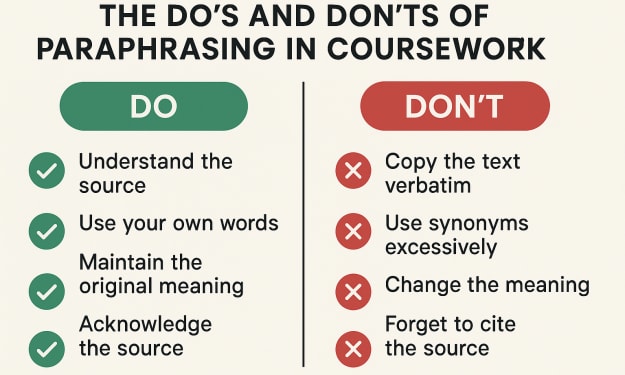
What Are the Do’s and Don’ts of Paraphrasing in Coursework?
When you analyse deeply, you’ll see that paraphrasing is more than a writing technique. It is a process where you duplicate someone else's work in your own words. However, people think paraphrasing is just about changing words with their tough synonyms to make a fresh written work, but it is not true. The correct way of paraphrasing includes your ideas and a restructuring format.
By Mary Taylorabout a year ago in Education
Breathing the Unseen Enemy: Smog’s Worldwide Impact
Smog Around the World: A Global Crisis We Can’t Ignore Step outside on what should be a bright sunny day, and instead of being greeted by blue skies, there’s a thick, grayish haze hanging low in the air. You squint, cough, and maybe even check your phone to see if it's safe to breathe. This isn’t an isolated scene from a dystopian movie—it’s a daily reality for millions of people around the world dealing with smog.
By Aamir Rehmanabout a year ago in Education
How Verbatim Transcription Enhances Qualitative Data Analysis
In the world of qualitative research, interviews serve as one of the most powerful tools for gathering in-depth insights. Whether you're studying human behavior, social dynamics, or personal experiences, interviews allow participants to share their perspectives in their own words. But the real challenge lies in how this rich, complex data is analyzed, and it all begins with transcription. Among the different types of transcription, verbatim transcription is often considered the gold standard for qualitative research. Unlike clean or summarized versions, verbatim transcription captures every spoken word and sound, including filler words like "uh," "um," pauses, stutters, repetitions, false starts, and even nonverbal cues like sighs or laughter. This may sound excessive at first, but in qualitative analysis, every detail counts. Here's how verbatim transcription plays a pivotal role in helping researchers make sense of interview data in a more authentic, nuanced, and rigorous way. Preserving Authenticity and Context At the core of qualitative research is the desire to understand people and their experiences authentically. Verbatim transcription helps preserve that authenticity by recording not only what participants say, but also how they say it. For instance, a pause before answering a sensitive question or a repeated phrase might hint at hesitation, uncertainty, or emphasis. These non-verbal elements can convey emotional undertones that are crucial to interpretation. Omitting such cues risks stripping the narrative of its emotional depth and context, which, in turn, weakens the analysis. Authenticity in data is not just about truthfulness; it's about preserving context, cultural, emotional, and psychological, which can be vital in fields like psychology, education, anthropology, or social work. Minimizing Researcher Bias One of the biggest challenges in qualitative research is the subjectivity of interpretation. Human memory is fallible, and researchers, often unconsciously, may interpret or remember responses in a way that fits their assumptions or expectations. Verbatim transcription acts as a corrective lens by providing a complete, objective record of the interview. Rather than relying on handwritten notes or partial recollections, researchers can refer to the transcript to ensure their interpretations are grounded in actual data. This reduces the risk of selectively quoting or paraphrasing based on personal bias, helping maintain the integrity and neutrality of the analysis. It also allows for participant validation or member checking, where participants can review the transcript for accuracy and clarify their intended meanings. Enabling Richer and Deeper Analysis In qualitative analysis, it's not just what participants say, it's how they say it. Verbatim transcription provides the level of detail needed to engage in deeper analytical techniques, such as: Discourse analysis (studying language patterns, power dynamics, and identity construction) Narrative analysis (focusing on the structure, tone, and flow of personal stories) Thematic analysis (identifying patterns and recurring themes across interviews) Grounded theory (generating theory from line-by-line data coding) These methods demand a text that reflects the organic, unfiltered nature of speech. Clean or edited transcripts often strip out the subtle linguistic elements that reveal contradictions, emotional states, or social cues, all of which are critical in qualitative work. Supporting Transparency and Rigor in Research Transparency is a key pillar of credible research. Verbatim transcripts provide a clear trail from raw data to interpretation, which enhances the auditability of a study. Reviewers, peers, or collaborators can trace how conclusions were drawn, how themes emerged, and how quotes were selected. This traceability is especially valuable when publishing qualitative studies in academic journals, where reviewers may request to see the original data or coding structure. Being able to demonstrate a precise, consistent method of analysis backed by verbatim data improves the trustworthiness of the findings. Moreover, quotes from participants, often used in the findings section, carry more weight when they are transcribed verbatim. It shows that the researcher hasn't paraphrased or sanitized the data, but rather respected the voice and perspective of the participant. Enabling Consistent Collaboration and Inter-Rater Reliability In studies involving more than one researcher, consistency in data analysis is vital. Verbatim transcription ensures that all team members work from the same dataset, reducing misunderstandings or discrepancies in interpretation. This uniformity supports inter-rater reliability, the degree to which different analysts or coders agree on the themes, codes, or interpretations. Without a detailed transcript, coders may rely on inconsistent memories or impressions, which can weaken the credibility of the analysis. By grounding the team in the same raw material, verbatim transcription supports both collaborative efficiency and methodological rigor. Improving Accessibility and Inclusivity Verbatim transcription also supports inclusive research practices. In diverse studies, participants may speak in dialects, accents, or culturally specific expressions. A skilled transcriptionist, especially a human one, ensures that all voices are accurately captured and understood, without standardizing or erasing linguistic uniqueness. This is especially important in cross-cultural or multilingual studies, where nuance in language can carry significant meaning. By maintaining the participant's original voice, researchers uphold cultural sensitivity and inclusivity in their work. Allowing for Re-analysis and Long-Term Use Finally, verbatim transcripts are valuable not just for current projects, but for future analysis. Researchers may return to transcripts for secondary analysis, comparative studies, or follow-up research years later. Having the full record ensures that nothing is lost, even if the original audio is no longer available. Moreover, if new questions or coding frameworks arise, a verbatim transcript provides the flexibility to explore fresh insights without needing to re-interview participants. Conclusion Verbatim transcription may require more time and effort than cleaner alternatives, but in qualitative research, it's a worthy investment. It safeguards the authenticity, richness, and depth of the data while supporting a more objective, transparent, and rigorous analysis process. From reducing bias to enhancing thematic exploration and improving collaboration, verbatim transcription services form the foundation of practical qualitative interview analysis. For researchers committed to uncovering real human insights, it's not just a helpful tool; it's an essential one. Partnering with a reliable, human-powered transcription service like GMR Transcription ensures that every voice is captured with the accuracy and nuance your analysis deserves.
By Beth Worthyabout a year ago in Education
Unlocking Potential: The Power of Education
Education is more than just books and classrooms. It’s the bridge between dreams and reality, the spark that ignites curiosity, and the tool that empowers individuals to shape their future. Around the world, access to quality education has proven to be one of the most powerful forces for positive change—not only for individuals but for entire communities. Take the story of Amina, a young girl from a small rural village. For years, education in her community was seen as a luxury, especially for girls. Most families prioritized early marriage and household responsibilities over schooling. But Amina had a different vision for her life. She dreamed of becoming a doctor to help the sick in her village who often lacked access to healthcare. Thanks to a community education initiative, Amina was given the opportunity to attend school. The road wasn’t easy—she walked several kilometers each day and often studied by candlelight—but her determination never faded. Years later, Amina graduated from medical school and returned to her village, where she opened a small clinic. Today, she not only provides healthcare but also mentors young girls, encouraging them to pursue their own dreams through education. Amina’s story is just one example of how education changes lives. Education Opens Doors Across the globe, research consistently shows that higher levels of education are linked with better job opportunities, higher incomes, and improved health. But the benefits go far beyond personal gain. When people are educated, they are more likely to engage in their communities, vote, start businesses, and help others rise with them. Education fosters critical thinking, empathy, and innovation—qualities that every thriving society needs. For children, the early years of education build the foundation for lifelong learning. As they progress through school, they gain not just knowledge but also confidence and communication skills. For adults, continuing education opens doors to new careers, better financial security, and personal growth. The Ripple Effect Education doesn’t just affect the learner—it creates a ripple effect. Studies show that when women are educated, their children are more likely to survive infancy, attend school themselves, and grow up healthier. Educated parents are better equipped to support their children's learning, manage their family’s health, and contribute to their local economies. In communities where education levels rise, poverty often decreases. Local businesses grow, crime rates fall, and innovation flourishes. Education is like planting a seed—it takes time to grow, but when nurtured, it transforms entire landscapes. Barriers Still Remain Despite the progress made globally, millions of people still lack access to quality education due to poverty, conflict, gender inequality, and lack of resources. For many, even basic education remains out of reach. In some parts of the world, children walk miles to reach the nearest school. In others, they face overcrowded classrooms, untrained teachers, or outdated materials. Girls, in particular, face additional challenges such as early marriage, cultural bias, or safety concerns that prevent them from completing their studies. However, positive change is possible—and happening every day. Governments, non-profits, and community leaders are working together to break down barriers, build schools, train teachers, and provide scholarships to those who need them most. Technology as a Gateway In recent years, technology has become a powerful tool in expanding access to education. Online classes, mobile learning apps, and virtual classrooms have brought learning to remote villages, refugee camps, and busy city neighborhoods. Even during times of crisis—like the COVID-19 pandemic—technology enabled millions to continue learning from home. With the right investment and planning, digital education can bridge the gap for students who would otherwise be left behind. Investing in the Future Education is not just an expense—it’s an investment. For every dollar spent on education, societies see multiple dollars returned in the form of economic growth, public health, and civic engagement. By ensuring that every child, teen, and adult has the opportunity to learn, we build stronger economies and more peaceful societies. We unlock the potential of inventors, teachers, artists, entrepreneurs, and leaders who will shape the future. A Call to Action As Amina’s story shows, the impact of education goes far beyond the classroom. It’s about empowerment, opportunity, and transformation. It’s about planting seeds today that will bloom into a better tomorrow. Whether you’re a student, parent, teacher, or policymaker, there’s a role to play in supporting education. Advocate for equal access, donate to educational programs, mentor a young learner, or simply encourage those around you to keep learning. In a world facing so many challenges, education is one of our most hopeful solutions. It equips us to solve problems, understand each other better, and dream bigger. Let’s invest in learning. Let’s unlock potential. Let’s build a brighter future—one educated mind at a time.
By Muhammad Saad about a year ago in Education
Maryland Students Choose PerfectEssayWriter.ai as #1 AI Essay Writer in 2025
Recent Google Trends data shows that the search term “AI Essay Writer Maryland” reached 100% interest this year, highlighting a sharp spike in demand. From large universities like the University of Maryland to local colleges and high schools, students are choosing PerfectEssayWriter.ai for its speed, accuracy, and academic tone.
By Jason Markusabout a year ago in Education
Latest Trends in School ERP Software You Should Know . AI-Generated.
In today's rapidly evolving educational landscape, staying competitive goes beyond academic excellence. School owners must focus on streamlining operations, improving communication, and making data-driven decisions. One of the most powerful tools available is School ERP (Enterprise Resource Planning) software. However, simply having an ERP system isn’t enough. The key is adopting ERP solutions that leverage the latest technology trends. This article explores the most important ERP developments school owners should be aware of in 2025, and how these trends can enhance school operations, reduce costs, and improve outcomes for students and staff alike.
By baileyemmaabout a year ago in Education
University of Exeter Foundation Year for International Students
Studying at a university ranked in the global top 200 is a real advantage. The University of Exeter gives international students, especially from Bangladesh, a clear way to begin their academic journey in the UK.
By MIE Pathwaysabout a year ago in Education
The Best Education for Children
Story: The Best Education for Children “What’s the best education for children?” It’s a question that parents across cultures, countries, and generations have asked—whispered in playgrounds, typed into search engines late at night, or worried silently while watching their child struggle with homework.
By waseem khanabout a year ago in Education