stem
The four major disciplines propelling our students and our society forward; all about education in science, technology, engineering, and mathematics.
How AI Is Making It Harder for College Graduates to Get Jobs in Software Engineering
Artificial intelligence is changing software engineering quickly. While AI tools improve productivity for companies and seasoned developers, they are also altering the job market. This shift makes it harder for new college graduates to find entry-level positions. The traditional route of earning a computer science degree, applying for junior developer jobs, and learning on the job is fading fast. AI is not completely removing software engineering jobs, but it is changing who gets hired, what skills are necessary, and how much output junior engineers are expected to provide right from the start.
By Rajiv Menon10 months ago in Education
Humans No Longer Make Decisions without AI
Artificial intelligence has quietly moved from a helpful tool to something far more influential. What started as software that corrected spelling, recommended movies, or answered trivia questions has evolved into systems people now consult for real-life decisions — from career choices and medical questions to relationships, finances, and even moral dilemmas.
By AnthonyBTV10 months ago in Education
Easy-to-understand explanations of current technology news
Easy-to-understand explanations of current technology news It can be difficult to keep up with the latest news because technology changes so quickly. New gadgets, apps, updates, and inventions appear on a daily basis. Virtual reality, artificial intelligence, and blockchain are all common terms, but not everyone knows what they really mean. In order for anyone to keep up with what's going on in the tech world, this article provides an explanation of the most significant technology trends of the present in language that is straightforward and simple to comprehend.
By Farida Kabir10 months ago in Education
The Story of Andrew J. Beard
The Story of Andrew J. Beard: The Man Who Made Railroads Safer Andrew Jackson Beard entered the world in 1849 under the brutal weight of slavery, born into a system designed to crush ambition and erase potential. Yet from the beginning, Beard possessed something stronger than circumstance: a mind that could see solutions where others only saw problems.
By TREYTON SCOTT10 months ago in Education
⭐ The Brave Life of James Forten —
James Forten was born in Philadelphia in 1766. He grew up near busy ships, tall sails, and people working hard every day. Even as a young boy, James was smart, kind, and always eager to help his family. He dreamed of doing something important with his life.
By TREYTON SCOTT10 months ago in Education
What Happens When You Press Play on Blooket — A Full Walkthrough
Most Blooket guides tell you where to click. This one tells you what is actually happening behind each click — why the platform is designed the way it is, what each screen is doing, and how understanding the full flow makes you a better host and a smarter player.
By Backlinks Cart10 months ago in Education
SEO Handbook. AI-Generated.
Most people run into SEO the same way: you build a site, you publish something you’re genuinely proud of, and you expect reasonably that the internet will do its thing. You wait a day or two. Maybe a week. You refresh your stats like you’re checking a pulse.
By Sayed Zewayed10 months ago in Education
Hepatitis C: The Silent Virus That Affects Millions Worldwide. AI-Generated.
What if you were carrying a dangerous virus for years without knowing it? Millions of people around the world are living with Hepatitis C without showing any clear symptoms. This silent virus slowly attacks the liver and can remain undetected for decades, causing serious health problems if left untreated. Despite its severity, Hepatitis C is now considered one of the most curable viral diseases thanks to modern medical advancements.
By Antonuos Zarey10 months ago in Education
THE STORY OF LIGHT: A TRIBUTE TO DR. SHIRLEY ANN JACKSON AND THE AGE OF FIBER
Before the world could whisper through glass, before light itself carried our voices across continents, before fiber‑optic lines spread across the nation like glowing nerves of a digital body— there was a girl in Washington, D.C.
By TREYTON SCOTT10 months ago in Education
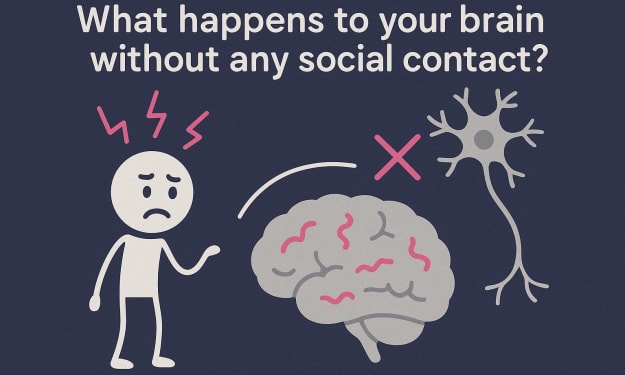
What happens to your brain without any social contract?
Everyone needs time to themselves, and peaceful solitude has stress-relieving benefits. But being alone takes on an entirely different dimension when it creeps up or is forced upon you. When that's the case, the effects can be surprisingly extensive. And though different people experience distinct effects at different times, symptoms tend to become more severe and persistent the longer one's isolated. When someone is involuntarily confined to one space indefinitely— for days, weeks, months, or even years— alone and without productive tasks, their body will likely undergo numerous changes. Let's take a look at what may happen and why. Early on, stress hormones may spike, and as time passes, that stress can become chronic. Social interactions and meaningful activities are essential for emotional stability. This may be because they provide us with what researchers call “social reality testing”— a sort of sounding board where we can gauge how rational our perceptions are. So, when someone’s deprived of those kinds of communication and tasks, their sense of identity and reality becomes threatened. Their thoughts spiral and their impulses take the reins, setting the stage for depression, obsessions, suicidal ideation, and, for some, delusions and hallucinations. Over time, this prolonged agitation can cause the brain's limbic system, which regulates fear and stress, to become especially responsive and hyperactive. Meanwhile, the prefrontal cortex, the brain’s hub for reasoning and moral judgment, may shrink, impairing one's focus, memory, and cognition. Overall, the balance shifts from rational thinking towards emotionality. And as someone remains in this state, the imbalance becomes ingrained, making them more prone to bouts of anxiety, rage, and irrational actions. Isolation will also affect other parts of the person's health. They may lose sense of time and have difficulties sleeping. They're more likely to experience heart palpitations, headaches, dizziness, and hypersensitivity. And they may also lose weight because of stress-induced digestive issues and poor appetite. One can attempt to cope by establishing the healthiest routine possible under the extreme circumstances, including robust exercise, reading, and writing. But that can only do so much. The United Nations, many human rights organizations, and experts classify this kind of forced, prolonged isolation as torture. And yet, it’s something imprisoned people in many countries endure. Also called “solitary confinement” or “restrictive housing,” the practice is most common in the United States. In 2019, more than 120,000 US prisoners lived in solitary confinement, spending 22 to 24 hours a day in mostly windowless cells spanning roughly six by nine feet. Quaker groups introduced solitary confinement to US prisons in the late 1700s, as an alternative to corporal punishment, believing it could bring about reflection and penitence— hence “penitentiary.” But the practice quickly faced criticism, from public figures all the way to the Supreme Court. Charles Dickens, for one, condemned solitary confinement as “worse than any torture of the body.” Its use dwindled, but then, in the 1980s, alongside more punitive, tough-on-crime laws, US prison populations skyrocketed. As prisons grew crowded, incidences of protests, rebellions, and violence grew, and prison authorities increasingly used solitary confinement to maintain control. Many people have been placed in solitary confinement for minor, nonviolent infractions, like talking back to prison guards. And solitary confinement is harmful to everyone, but many who’ve experienced it have pre-existing mental health disorders, which it only exacerbates. Solitary confinement also seems to have lasting effects that make readjusting to life outside of a cell difficult. People who have gone through solitary confinement are three times more likely to show signs of post-traumatic stress disorder. And they commonly report experiencing shifts in their personalities, increased anxiety and paranoia in otherwise ordinary situations, and difficulty concentrating and connecting with others. Some states have restricted the use of solitary confinement in cases involving serious mental illness, children, or pregnancy, and some have adopted 15 or 20 day limits for everyone. But laws that regulate solitary confinement aren’t always enforced— and prison authorities have created loopholes. Yet solitary confinement does immense damage that is contrary to rehabilitation, while failing to reduce prison violence. Meanwhile, other countries have centered more humane approaches. Norway, for example, imprisons far fewer people per capita than the US while spending five times more per prisoner on accommodations, classes, and work-release programs. Norway also sees far fewer people return to prison after release, with one of the world’s lowest rates of recidivism, indicating we tend to get better together.
By Munesh Yadav 10 months ago in Education