movie review
Movie reviews for the lifelong learner; films about inspiring educators, the college experience, high school woes, education rights worldwide and more.
Offline Skills That Still Matter in a Digital World
Introduction: In a world where screens dominate and algorithms influence nearly every decision, it's easy to assume that traditional skills have become outdated. From cloud storage to chatbots, the digital era has redefined how we work, learn, and connect. But despite all this progress, certain offline skills remain not only relevant—they’re essential.
By Natik Ahsanabout a year ago in Education
Oprah Winfrey: From Poverty to Power
Start writing...The Beginning Wasn’t Easy Oprah Winfrey was born in 1954 in a small town in Mississippi, USA. Her early life was full of struggle and pain. She lived with her grandmother in a tiny house that didn’t even have running water. They were so poor that little Oprah had to wear potato sacks as clothes because they couldn’t afford to buy real ones. Life was very hard for Oprah. By the age of nine, she had already faced abuse and many personal challenges. Most people would feel hopeless in such a situation, but not Oprah. Even as a young girl, she had a dream. She believed that her life could be better one day. Deep inside, she told herself, “This is not the end of my story.” A Love for Learning Despite her hard childhood, Oprah found comfort in books. She loved reading and learning. Her grandmother taught her to read at a very young age, and that became a turning point in her life. She was smart and spoke well, and this helped her do well in school. Later, Oprah won a scholarship to Tennessee State University, where she studied communication. She had a strong voice and a special way of speaking that made people want to listen to her. While still in college, she got a job at a local radio station. That was the beginning of her media journey. Climbing the Ladder After working in radio, Oprah got a job as a television news anchor. But things didn’t go smoothly at first. In fact, she was fired from one of her TV jobs because the producers thought she was "too emotional." They didn’t like that she showed feelings while reporting stories. But Oprah didn’t let that stop her. She believed in herself and didn’t give up. Instead of trying to hide her emotions, she used them to connect with people. She got a new job hosting a daytime talk show in Chicago — and that changed everything. The Oprah Winfrey Show In 1986, Oprah launched The Oprah Winfrey Show. It wasn’t just another TV program — it was something special. Oprah talked to everyday people, as well as famous guests. She covered serious topics like health, family problems, and life struggles, but also had fun, joyful episodes. People loved her honesty and kindness. The show ran for 25 years and was watched by millions around the world. Oprah didn’t just entertain people — she inspired them. She made her viewers feel heard, seen, and understood. More Than a Talk Show Host As Oprah’s fame and success grew, she began building her own business empire. She started her own company, Harpo Productions (which is “Oprah” spelled backward), and later created her own television network called OWN (Oprah Winfrey Network). She didn’t stop there. Oprah became a powerful voice in books, movies, and education. She supported many causes, including girls' education and health care. She built a school for girls in South Africa and has given millions of dollars to help people in need. A True Billionaire with a Big Heart Today, Oprah Winfrey is one of the richest and most respected women in the world. She is a billionaire, but more importantly, she is a role model. Her life story is not just about money and fame. It’s about never giving up, no matter how hard life gets. Oprah’s journey from a poor child in Mississippi to a global media queen shows what’s possible when you believe in yourself. She didn’t let her past define her future. She worked hard, stayed kind, and used her voice to help others. The Lesson We Can Learn Oprah’s story teaches us that where you start doesn’t matter as much as where you’re going. Even if you face pain, poverty, or failure, you can still succeed if you stay strong, believe in yourself, and keep going. She once said, “Turn your wounds into wisdom.” That’s exactly what she did — and that’s what we can all try to do, no matter our background. --- Final Thought: Oprah Winfrey’s life is proof that dreams can come true. She is living evidence that anyone — even a little girl in a potato sack — can grow up to change the world. All it takes is belief, hard work, and the courage to keep moving forward.
By Qaseem Ahmadzaiabout a year ago in Education
The Boy Who Shared His Lunch
On the first day of school, Sam wasn’t nervous—he was protective. Not of his books or his backpack. But of his lunch. It was packed with his favorites: a crustless peanut butter and jelly sandwich, apple slices, a cookie wrapped in foil, and a juice box cold enough to fog up the lid. To Sam, this wasn’t just lunch. It was comfort. It was his.
By Ahmad Malikabout a year ago in Education
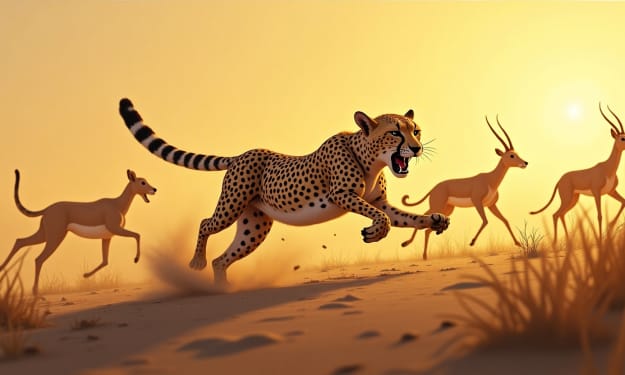
The Impatient Cheetah
In the vast grasslands of the African savanna, there lived a young cheetah named Kito. Kito was the fastest of his siblings, with sleek golden fur covered in black spots and legs that could carry him like the wind. But despite his incredible speed, Kito had one great flaw—he was impatient.
By Shahzad Khanabout a year ago in Education
The Human Being: A Fragile Body with an Infinite Soul
What is a human? Is he merely a walking collection of cells, nerves, and bones? Or is there something deeper—something invisible yet eternal—that gives him meaning and value? This question has been asked for centuries, from ancient prophets to modern philosophers, and yet the mystery remains as captivating as ever. From the dust of the earth, man was created. Soft, fragile, and helpless. And yet, within this frame of dust lives a soul that reflects divine breath. This paradox is the essence of being human—a balance between weakness and strength, limitation and potential, death and immortality. Born Weak, Destined for Greatness A human child is born unable to walk, talk, or feed itself. But within just a few years, he begins to question the universe. He builds homes, writes poetry, creates art, splits atoms, and even dares to fly. From a cradle to the cosmos, his journey is filled with wonders. This journey is not just physical. It is deeply spiritual. For every invention he makes, there is a hunger for peace. For every mountain he climbs, there is an abyss inside him he still doesn't understand. Man lives in two worlds: one outside him, and one within. The Heart That Feels, The Mind That Thinks What makes a human more than an animal is not just intelligence. It is emotion. A man cries not because he is weak, but because he can feel. He loves, he fears, he hopes. A mother sacrifices her sleep for her child. A stranger donates blood for someone he may never meet. These are not instincts; they are choices of the soul. Likewise, man is capable of destruction. Wars, cruelty, lies, betrayal—these too are uniquely human. The same mind that heals can also hurt. The same heart that loves can also hate. This duality is what makes mankind both beautiful and dangerous. The Mirror of Morality Every human has a mirror inside—called conscience. It whispers when we do wrong, and it sings when we do right. Unlike animals, humans have the power to choose. We are not driven only by hunger or fear. We are driven by meaning. Even in the darkest prison, a man may shine like a star if he holds on to truth. And even in a palace, a man may rot in misery if he sells his soul. True richness is not gold; it is goodness. True success is not fame; it is faith. Man's Search for Purpose From ancient times, man has looked to the stars, asking: “Why am I here?” This question has driven religion, science, art, and even war. Some find their answer in worship, others in work, some in love, and some in silence. But one truth is clear: man was not made to merely eat, sleep, and die. He was made to rise, fall, learn, and rise again. He was made to connect—to his Creator, to others, and to himself. A human is not complete when he fills his stomach, but when he fills his heart. He is not alive when he breathes, but when he believes. The True Strength of a Human It is not in the muscles or money, but in mercy. The strongest man is he who forgives when he can destroy. The bravest is he who speaks the truth when it is dangerous. The most successful is he who lifts others when he himself is broken. We live in a world that often forgets the soul. We polish our shoes more than our hearts. But the human being, at his core, is a spiritual traveler. His body will die, but his deeds will echo. His soul will return to the One who created him. Conclusion: A Reminder to Remember You are a human—not just a name or a number. You are a reflection of divine mercy, walking on earth. You carry within you the power to heal or hurt, to build or break, to love or destroy. But above all, you carry the responsibility to be more than what the world expects. So be kind, be wise, be humble. You are temporary, but your choices are eternal. The stars are not far—they are within you.
By Noman Afridiabout a year ago in Education
Unlocking the Power Within: How to Sharpen Your Mind and Awaken Mental Brilliance
In a world where speed, precision, and creativity are more valuable than ever, a sharp mind is your greatest weapon. Whether you’re a student trying to excel in exams, a professional aiming for success, or simply someone striving for a more focused and productive life—an agile, alert brain can change everything. But how does one sharpen the mind? Is it only a matter of genetics, or can anyone train their brain to think faster and clearer? The truth is, your brain is like a muscle. The more you train it, the sharper it becomes. Just like physical fitness, mental fitness requires regular effort, smart habits, and conscious choices. Let’s explore how you can awaken the hidden brilliance of your brain and keep it razor-sharp throughout your life. --- 1. Nourish Your Brain with the Right Fuel You are what you eat—and so is your brain. A nutrient-rich diet is the foundation of a sharp mind. Omega-3 fatty acids (found in fish, walnuts, and flaxseeds), antioxidants (found in berries, green tea, and dark chocolate), and vitamins like B12, D, and E are essential for brain health. Avoid excessive sugar and processed foods, as they can dull your thinking and lead to mental fatigue. Hydration is equally crucial; your brain is 75% water, and even mild dehydration can impair concentration and memory. --- 2. Exercise: Move Your Body, Empower Your Mind Physical exercise doesn't just tone your body—it transforms your mind. Regular aerobic activity increases blood flow to the brain, promotes the growth of new neurons, and boosts memory and mood. Even a 30-minute walk daily can improve cognitive function. Yoga and stretching also reduce stress and increase oxygen supply to the brain, enhancing focus and emotional clarity. --- 3. Mental Workouts: Challenge Your Brain Just like your muscles need resistance training, your brain needs challenges to grow stronger. Engage in puzzles, logic games, riddles, or brain-training apps. Learn a new language, take up a musical instrument, or dive into unfamiliar subjects. Reading books outside your usual interests stretches your thinking and introduces new mental patterns. The more you challenge your brain, the more powerful it becomes. --- 4. Master the Art of Focus and Mindfulness In the age of constant distractions, attention is a rare treasure. Multitasking might seem productive, but it actually reduces efficiency and increases mental clutter. Train yourself to focus on one task at a time. Mindfulness meditation is a powerful tool to declutter the mind, reduce anxiety, and increase awareness. Just 10 minutes of daily mindfulness can improve decision-making, creativity, and emotional intelligence. --- 5. Get Proper Sleep: The Silent Brain Booster Sleep is not a luxury—it’s a necessity. During sleep, your brain consolidates memories, processes information, and removes toxins. Chronic sleep deprivation impairs judgment, memory, and attention. Aim for 7–9 hours of quality sleep per night. Avoid screens before bedtime and create a calm, dark, and cool sleep environment to enhance rest. --- 6. Limit Digital Overload Constant scrolling, notifications, and screen time can fragment your attention and drain your mental energy. Set boundaries with technology. Use focus timers, turn off non-essential notifications, and allow yourself screen-free zones during the day. Digital detox, even for a few hours daily, can restore mental clarity and spark original thinking. --- 7. Cultivate Positive Thinking and Emotional Resilience Negativity shrinks the brain's capacity to function at its best. Train your mind to focus on solutions rather than problems. Gratitude journaling, positive affirmations, and surrounding yourself with uplifting people can dramatically impact your mental sharpness. Resilience—the ability to bounce back from setbacks—keeps your brain strong even in times of stress. --- 8. Stay Curious and Never Stop Learning The most brilliant minds in history shared one trait: relentless curiosity. Ask questions. Seek answers. Stay fascinated. Whether you're 16 or 60, a curious mind is a young mind. Attend workshops, watch documentaries, explore new cultures—learning fuels growth and keeps the brain agile. --- Conclusion: Your Mind, Your Masterpiece Sharpening your mind is not a one-time effort—it’s a lifestyle. Every decision you make, every habit you build, either strengthens or dulls your mind. Begin today. Choose nourishing foods, embrace daily movement, challenge your brain, and protect your focus. Be kind to your mind and train it with purpose. Over time, you’ll not only think better—you’ll live better. Because a sharp mind doesn’t just change the way you think. It changes everything.
By Noman Afridiabout a year ago in Education
A Nation that eats its own flesh
Does any civilization consume its own meat? Cannibalism—the act of consuming human flesh—has existed in various cultures across the world throughout history. In most modern societies, it is considered taboo to eat "one's own meat," or members of the same community or species. However, there were civilizations where cannibalism had ritual, spiritual, or survival significance. We can appreciate the complexity of human behavior, belief systems, and survival instincts across time and culture by comprehending these practices. It is essential to approach this issue with respect and objectivity. In many cases, cannibalism has been misunderstood, misrepresented, or exaggerated, especially during colonial periods when Western explorers and missionaries often demonized indigenous practices. Nonetheless, there are well-documented cases of cannibalism in history that serve as anthropological insights into how diverse societies viewed life, death, power, and the human body.
By Dr Sazidul about a year ago in Education
The Science Behind Wrinkled Fingers: Why Do They Prune in Water?
For decades, people assumed that fingers wrinkle in water simply because the skin absorbs moisture and swells. However, scientific research has revealed a far more fascinating explanation—one that involves the nervous system, evolutionary biology, and even potential survival advantages.
By Niranjon Chandra Royabout a year ago in Education