degree
Degrees defined: PhD, Master, Bachelor, Associate–all about that expensive piece of paper called your degree.
From Stress to Success: How Thesis Help Services Can Transform Your Research Journey
If you’re a university or college student staring down the daunting task of writing your thesis, you’re not alone. For many, the thesis journey feels like climbing a steep mountain with no visible summit. Sleepless nights, overloaded schedules, scattered research papers, and creeping self-doubt often become unwelcome companions. But here’s the good news—you don’t have to go it alone. With the right support, your academic struggle can be transformed into a rewarding and enriching journey. That’s where seeking Help For My Thesis comes into play.
By Robert Smithabout a year ago in Education
10 Things To Be Patient With When You Study In Canada!
Studying abroad is thrilling, but it also has new challenges. Most students wish to study in Canada due to its best colleges and stunning cities. However, when you travel to a foreign country, things do not move quickly. You will have to wait, adapt, and learn as you go. Your best friend now is patience. Here, we will discuss various places where students have to be patient while residing and studying in Canada. It will make you better prepared for your adventure and deal with changes easily.
By Khush Agrwalabout a year ago in Education
Trump’s University Restrictions Create Global Shift in Student Choices
Trump’s Restrictions on Universities Open Doors for Other Countries After Trump's actions, competition among several countries has intensified, as China has already announced it will welcome students who are unable to gain admission to the United States. Last year, at the National Schools Regatta — a rowing competition for young people — the longest queue was outside the stalls of American universities. This event takes place on the waters of Dorney Lake at Eton College and primarily includes students from private schools. It also draws large crowds of parents, grandparents, relatives, and friends. Striped blazers and school logos are visible everywhere. The boat races are intense and exciting, but many in the audience seem more eager to get their children admitted to a top American university — whether through sports or some other avenue. As Oxford and Cambridge have recently limited their intake from private schools, the attention of such families has shifted across the Atlantic towards the United States. Nowadays, nearly every private school has at least one expert who knows which American university is best and how to navigate the admission process. Exhibitions are also held where universities promote themselves, with representatives always available to impress parents. This is why Donald Trump’s recent attack on American universities — even if only temporary — has left many surprised. Earlier this week, the U.S. Department of Homeland Security moved to revoke Harvard University’s ability to admit foreign students — essentially halting their visa applications. Ostensibly, the goal is to purge universities of so-called “liberal” ideologies. Trump also announced plans to further cut federal contracts with Harvard — the same university that recently witnessed major protests in support of Palestine. At the very least, the President has signaled that chaos and uncertainty will likely dominate the future. At a time when affluent British families had found an alternative to Oxford and Cambridge in American universities, that path is now uncertain as well. However, Trump’s crackdown also presents a golden opportunity for British higher education to fill the gap. Due to the elitism of Britain’s private and a few select state schools, only a handful of universities — such as Durham, St Andrews, Edinburgh, and some in London — are considered worthy after Oxford and Cambridge. After that, parents, teachers, and unfortunately even students and employers give little attention to other universities. Russell Group universities, which consider themselves second only to Oxford and Cambridge, are seen by many as merely second-tier. The rest of the universities may barely be acknowledged at all. In 2023–24, the U.S. admitted 1.1 million international students, 10,000 of whom were from the UK. These students contributed $43.8 billion to the U.S. economy in tuition, accommodation, and other expenses. This isn’t just a financial loss for Britain — it’s also a loss of talent and intelligence that often never returns home. For American universities, this has become a business — and a profitable one at that. This is Britain’s chance to make its education system appealing again, especially as foreign student numbers and their fee contributions decline. Competition is now fierce, as China has already announced it will welcome students unable to gain admission to the U.S. It’s also true that British universities themselves are partly to blame for this decline. In recent decades, they’ve expanded rapidly, and some institutions and courses don’t meet quality standards. However, we must not forget the bias that works against these institutions as well. In this context, the UK government's move to impose funding cuts on universities is also damaging. The education sector is already under immense pressure, weakening morale and discouraging progress. If it is to seize the opportunity suddenly created by the U.S. president’s aggressive measures, the government must provide it with confidence and financial support. This should be a joint effort — one that serves Britain's interests and encourages students to stay in the country for their education, as this would also benefit the economy. It would be in the national interest for students to remain, complete their education, and begin their careers locally. While some may mourn and shed tears over this situation, the reality is: by closing one door, Trump has opened another.
By Ikram Ullahabout a year ago in Education
What is a Master's in Library and Information Studies?
Often, I am asked what my degree actually is. It has become a common occurrence that I will get blank looks and glazed eyes from folks who have never heard about the degree. Which is perfectly fine, as there usually is a quick explanation I give “it's to be a librarian” but it is just as often that I'll get a response of “you need a Master's for that?” Which leads to more convoluted and not particularly easy to explain reason behind that. So, to set the record straight, what is an MLIS degree?
By Minte Staraabout a year ago in Education
10 Reasons to Choose MATS University – The Best Private University in Raipur
In the realm of higher education, selecting the right university is a monumental decision that can shape the trajectory of a student’s life. For students in Chhattisgarh and beyond, MATS University stands as a beacon of academic excellence, innovation, and holistic development. Located in the heart of Raipur, MATS University has steadily earned the reputation of being the best private university in Raipur.
By Best Private University In Raipurabout a year ago in Education
Things You Must Know About Student Accommodation in Reading
Reading is the best city in the center of England, where many students from around the world come. It is the best place to pursue your studies, whether UG or PG degrees. However, it is because of a thriving student group, the best colleges, and a lively culture. Before starting your learning journey, you must know some crucial things about student accommodation in Reading, UK. This guide will give you all the details you need to learn to make the best decision. It is to pick the ideal Reading student accommodation place to know the fees and services. Let's check these things!
By vishabhrahejaabout a year ago in Education
"Deforestation and the Future of the Amazon: A Wake-Up Call for Humanity"
Introduction The Amazon rainforest, sprawling across over 6.7 million square kilometers in nine South American countries, is the world’s largest tropical forest and a vital component of Earth’s ecological system. Often called the "lungs of the Earth," this vast forest produces about 20% of the planet’s oxygen and absorbs enormous amounts of carbon dioxide, helping regulate the global climate. Home to an estimated 10% of all known species and over 400 indigenous communities, the Amazon is a hotspot of biodiversity and cultural heritage. However, ongoing deforestation in the Amazon threatens to unravel this delicate balance, risking devastating consequences for local ecosystems and global climate alike.
By Shamshair Khan Hasan Zaiabout a year ago in Education
Leadership Skills Development
Are you ready to reach your career goals? In today's fast world, leadership is key to career success. The top leaders work hard to get better. They aren't born with special skills. Instead, they focus on developing important qualities for growth.
By LaMarion Zieglerabout a year ago in Education
The Great scientist Nikola Tesla
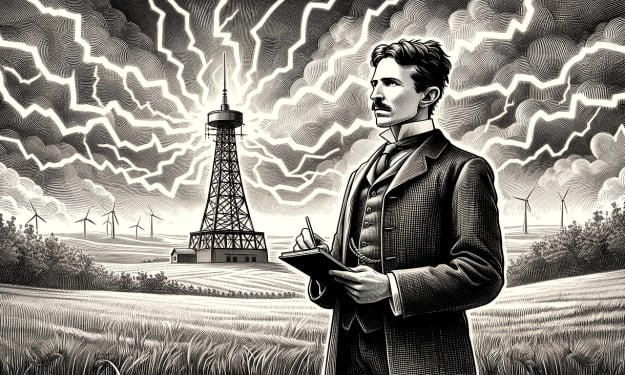
The Life and Times of Nikola Tesla in The Lightning Dreamer In 1856, Nikola Tesla was born in a small Croatian village called Smiljan during a lightning storm. Legend has it that the midwife whispered that it was a bad sign when lightning and thunder struck the night sky. However, Tesla's mother promptly responded, "No, this child will be a child of light." She was correct in many ways. Tesla was not like the other children from a young age. He had extraordinary abilities: his memory was like a picture, his imagination was vivid, and his curiosity was never-ending. Tesla experimented, built models, and studied the forces of nature while his friends were out playing games or chasing animals. He was able to design machines in his mind down to the tiniest details, frequently without ever writing anything down. Tesla was drawn to science and engineering, particularly electricity, which was still a mystery to the majority of people at the time, even though his father wanted him to become a priest like him. Tesla made a personal promise to himself that he would dedicate his life to invention after overcoming a serious illness in his teens. With nothing more than a suitcase, a few coins, and a head full of revolutionary ideas, this determination led him from Austria to Prague and then to the United States in 1884. Tesla started working for the well-known inventor and businessman Thomas Edison as soon as he arrived in New York City. Tesla initially admired him. However, the conflict between the two began quickly. Tesla had come up with the idea for alternating current (AC), which is a better way to send electricity over long distances. On the other hand, Edison was not planning to alter his entire business model because he was so invested in direct current (DC). Tesla asserted that Edison even offered him a substantial bonus for improving his DC generators, but Edison later backtracked and said, "You don't understand our American humor." Tesla left Edison's company and began digging ditches to survive, feeling betrayed. However, he did not give up. George Westinghouse, a businessman who recognized the genius in Tesla's air conditioning system, eventually provided him with support. In what came to be known as the War of the Currents, a fierce and well-publicized battle over the future of electricity, they challenged Edison's DC empire together. Even publicly electrocuting animals, Edison went so far as to fund demonstrations demonstrating the alleged dangers of AC. It was calculated and brutal. However, Tesla's concepts prevailed. The World's Columbian Exposition in Chicago in 1893 marked a turning point when Tesla and Westinghouse used AC power to illuminate the entire fairground. For many, this was their first encounter with electric light. The entire world noticed how stunning it was.Following that, Tesla became somewhat of a household name. He gave dramatic demonstrations of his inventions, including wirelessly lighting lamps, sending electricity through his body, and creating lightning with his Tesla coil. However, he was not simply putting on a show. He was anticipating the future by attempting radio, wireless communication, and even remotely controlled machines. Radio, radar, and wireless transmission are just a few of the modern technologies that can be traced back to Tesla's original concepts. However, his ultimate goal was to provide the entire world with free energy. He started building a huge tower he called Wardenclyffe in New York with support from financier J.P. because he believed he could send power through the atmosphere of the Earth. Morgan. However, Morgan withdrew the funding when he realized that Tesla's plan could not be monetized because there was no way to meter free energy. The tower was never completed. Tesla's fortunes began to decline in the years that followed. He was given credit for his pioneering work by other inventors. He was exhausted by legal battles and lawsuits. He disappeared from the public eye, living by himself in hotels in New York, frequently feeding pigeons, and drifting into bizarre routines. He once claimed to have fallen in love with a white pigeon, claiming that she provided him with light during his darkest hours. In 1943, Tesla passed away by himself in the New Yorker Hotel's Room 3327. He was without friends, family, or money. He appeared to be forgotten by history for a while. However, not forever. Today, Nikola Tesla is hailed as one of history's greatest minds. He is remembered not only for his inventions but also for his vision—his belief in a world where power and knowledge are freely shared and invisible forces connect it all. His name can still be found in museums, books, documentaries, and even electric cars. "The present is theirs; the future, for which I really worked, is mine," Tesla once said. He was correct. Our present is his future.
By Itachi Jhonabout a year ago in Education
How to Naturally Protect Yourself from Flies and Mosquitoes – Day and Night
As the warm breeze of summer flows in, it brings longer days, fresh fruit, and time spent outdoors. But it also invites some of the most annoying — and sometimes dangerous — visitors into our lives: flies and mosquitoes.
By Haroon Bahramzaiabout a year ago in Education