courses
Tackle that seemingly endless selection of course offerings; a roundup of helpful resources and sound advice for selecting the best courses and acing them.
Empowering Children with Mental Health Challenges: Teaching Strategies for Success
Supporting Children with Mental Health Challenges in Private Lessons: Effective Teaching Strategies By Klara Nolan As educators, we often encounter students with unique needs that require more than the typical classroom approach. Children dealing with social anxiety, depression, post-traumatic stress disorder (PTSD), or navigating issues related to their gender identity, such as being transgender, face challenges that can make traditional schooling environments overwhelming. In these cases, private lessons can provide a lifeline, offering personalized instruction in a supportive, flexible setting that caters to their emotional and mental health needs.
By Klara Nolan2 years ago in Education
The Transformative Power of Education: Essential for Societal and Personal Development
Long considered as one of the most effective instruments for both personal and social revolution is education. From prehistoric times to the digital era, education has molded society, enabled individuals, and propelled economic development. In the fast changing environment of today, education is more important than ever since it not only provides knowledge and skills but also develops critical thinking, creativity, and adaptability—qualities necessary for surviving in a world growingly complicated and linked.
By Sudip Chowdhury2 years ago in Education
The Development and Worth of Education and Training in the Contemporary Society
Education and training have been fundamental foundations of human development and society's progress for millennia. From the Greek old academies to contemporary digital classrooms, the evolution of these establishments reflects the evolving needs and values of societies. Not only for personal growth but also for economic stability and societal advancement; hence, education and training become even more crucial in modern society.
By Sudip Chowdhury2 years ago in Education
Affiliate Marketing: A Beginner's Guide to Making Money
how to make money with affiliate marketing as a beginner affiliate marketing has emerged as a powerful way for individuals to generate income online. This business model allows people to earn commissions by promoting products or services from other companies, creating a win-win situation for both marketers and businesses. With its low barrier to entry and potential for significant earnings, affiliate marketing has become an attractive option for those looking to start a side hustle or build a full-time online career.
By carlos martinez garcia2 years ago in Education
BTech colleges in Delhi University
Delhi University (DU), one of India’s premier educational institutions, is renowned for its academic excellence and rich heritage. While traditionally known for its arts, commerce, and science programs, DU also offers top-notch engineering education through its constituent colleges. This comprehensive guide will cover everything you need to know about B.Tech colleges in Delhi University, including eligibility criteria, fee structure, specializations offered, accreditations, campus life, admission process, entrance exams, placements, return on investment (ROI), and course demand.
By Divya Bisht2 years ago in Education
Building Trust and Confidence in ESL Classrooms: The Power of Safe Learning Spaces
As an ESL teacher and a teacher trainer with years of experience, I’ve come to realize that language learning is much more than just vocabulary, grammar, or pronunciation. It’s a vulnerable process—students are often self-conscious, afraid to make mistakes, or worried about feeling embarrassed in front of their peers. That’s why creating a safe, supportive space in the classroom is so important. When students feel safe and valued, they’re willing to take risks with language and grow faster. In this article, I’ll share some insights I’ve gained about building strong teacher-student relationships and how to personalize the learning process for each student.
By Klara Nolan2 years ago in Education
Addressing Climate Change: Comprehending Origins, Consequences, and Contemporary Mitigation Techniques"
Introduction Climate change refers to long-term changes in the Earth's climate patterns, specifically an increase in average world temperatures. This phenomena has become one of the most important concerns of the twenty-first century, with far-reaching implications for ecosystems, human civilisations, and economy. Understanding its causes, recognising its consequences, and implementing effective mitigation efforts are critical to ensuring a sustainable future.
By Labib siddique 2 years ago in Education
Knowing the Functions of the C Language
In C, a function is a section of code that carries out a certain purpose. They are used to divide code into more manageable, smaller pieces that can then be called upon by other parts of the program to carry out their specific function. A function in the C programming language can accept zero, one, or more arguments and return either a value or nothing.
By himaja nareshit2 years ago in Education
Social attitude
** ATTITUDE / MINDSET ** The mindset is described as an evaluation from various perspectives around the world. The human mind holds immeasurable thoughts within it. Each individual has differing thoughts. These thoughts change according to time, place, and the way the mind functions. It is in this context that one can understand the mindset of individuals by assessing how they identify themselves. Their mindsets encompass both internal and external relationships. Mindsets are always formed in relation to certain people, groups, objects, or institutions. Therefore, mindsets are not internal factors unrelated to external influences. Instead, they arise from certain aspects of the environment. A person is not born with a mindset but develops or learns it as they grow within society. Some mindsets are acquired directly from personal experience, while many others are acquired indirectly through learning, listening, or observing. A mindset is a pre-determined attitude towards an object, place, living being, or relationship, in either an agreeable or opposing manner. In other words, it refers to the mental preparedness that prompts someone to think and act in a particular way towards something. Many have noted that mindsets are generally either positive or negative. Positive mindsets foster connections and relationships, while negative mindsets can lead to a lack of connection or the breaking of relationships. Since mindsets are a state of mental readiness, they can be introduced through a person’s speech and behavior. Mindsets define not only what a person desires, chooses, expects, or limits but also what they dislike and avoid in unnecessary situations. Thus, a person’s actions, whether in collaboration with or opposition to another person, society, or institutions, are influenced by their mindset. A mindset consists of three components: 1. **Affective Component**: This component evaluates whether the emotions people experience towards an object are positive or negative. 2. **Behavioral Component**: This component indicates the intention behind the expression of a mindset through behavior. 3. **Cognitive Component**: This component represents what people know about the world, every object in it, and life, and how they understand them. Although these three components are not necessarily interconnected, they are still considered distinct elements. **Psychological Theories** Psychologists discuss the formation and theories of attitudes. They cover a variety of aspects, including changes in attitudes. 1. **Learning Theory** 2. **Cognitive Dissonance Theory** 3. **Perception Theory** 4. **Expectancy-Value Theory** 5. **Cognitive Activation Theory** Shelly suggests that learning is a skill found in humans. Attitudes are learned through three methods: imitation, conditioning, and reinforcement. Attitude change occurs through learning information or emotional shifts. Perception can create or change certain attitudes. Every person adopts only those attitudes that are useful and valuable. When a person understands a thought and begins to be motivated, attitude change happens. Attitudes play a role in both individual psychological processes and social behavior. Therefore, in this world, attitude change leads to addressing issues like war, peace, and human rights, among others. Attitudes have been identified from various perspectives: individual level, relational level, and social level. These attitudes, including direct attitudes, showcase how they manifest in humans. **Individual Level and Direct Attitude** Life is about struggles, finding joy in replacements, and being content with what one has. Every human possesses beliefs, successes, encouragements, efforts, expectations, detachment, and courage. Life events are imprinted in their psyche, revealing these attitudes. When one fails to achieve something, disappointment, frustration, and sorrow push the mind to try something else. This behavior is known as "compensation" by psychologists. Every individual adopts this approach in life. Therefore, a person must cultivate an attitude that motivates their thoughts and efforts. Through this, one can achieve a stable mental maturity and conduct. **Social and Cultural Contexts and Direct Attitude** Social attitude refers to how a person should behave in the society they belong to and how society views individual actions. Every individual emerges through social connections. Without humans, there is no society. Similarly, there is no isolated individual without society. Humans are capable and have an innate need to participate in social life. Society is not imposed on human nature but is an integral part of it. No one can live in isolation because they need others to fulfill their desires and needs. As Pascal Gilbert stated, "When like-minded individuals unite and strive for common goals, society emerges." An individual in society creates or learns common attitudes. Culture plays a significant role in forming these attitudes. Culture can be seen as the external manifestation of the mental attitude that forms the foundation for a better life. Edward Burnett says, "Culture is the totality that includes knowledge, beliefs, arts, morals, laws, and other capabilities and habits acquired by a person as a member of society." When a person interacts with others and engages with cultural outcomes, social attitudes are formed. Social attitudes manifest as feelings of justice, hard work, unity, duty, rights, pride, enthusiasm, and struggle. Human needs and consumption are intertwined. As needs increase over time, natural desires and mental states change accordingly. In today’s scenario, as human needs increase, one must develop the mental maturity to face them. In today’s urban life, people have lost the joy of experiencing nature. In a life filled with sorrow and distress, a person lives mechanically, but sometimes changes occur within. Through social relationships, a person gains some bitter experiences. The development of science has led to a civilized lifestyle where people have even forgotten to appreciate nature, instead witnessing its destruction. Psychological analysts approach life’s practical problems with a focus on fundamental principles. They note that the root causes of human suffering lie in the environment in which the mind develops, and the social relationships that emerge within this environment present obstacles, opportunities, and variations. Therefore, it is through material changes that these can be removed, enabling attitude changes, as noted by psychologists.riting...
By Mohamed sha2 years ago in Education
Software Quality Metrics. AI-Generated.
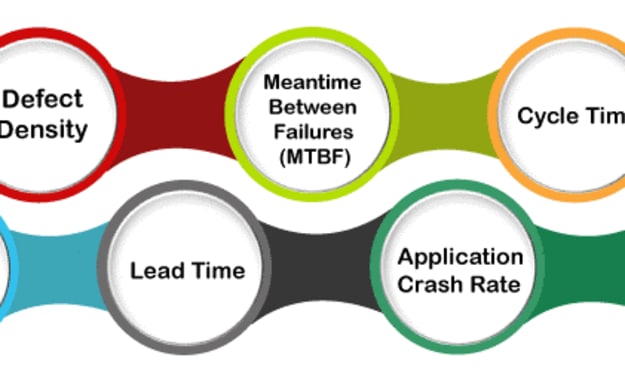
In software development, the assurance of high-quality products is essential for success. Quality metrics are significantly important, offering measurable standards to evaluate different facets of software performance and dependability. These metrics assist teams in pinpointing problems, making knowledgeable choices, and enhancing the software they deliver. This article delves into the crucial software quality metrics, their significance, and their impact on software development and upkeep.
By Pushpendra Sharma2 years ago in Education