bullying
The Unscripted Trap: Why Reality TV Feels So Irresistibly Addictive
Reality television, despite frequent criticism, remains a dominant force in global entertainment. From talent competitions and dating shows to survival sagas and docu-soaps, its grip on audiences seems unshakeable. Viewers often find themselves saying, "Just one more episode," only to binge hours later. This begs the question: Why does reality TV feel so incredibly addictive? The answer lies in a potent cocktail of psychological triggers, clever production techniques, and fundamental human desires.
By Jacky Kapadiaabout a year ago in Education
Putting on the Armor of God for Permanent Victory
**Part 2: Putting on the Armor of God for Permanent Victory** In Part 1, we saw that spiritual battles are not against flesh and blood but against principalities and powers that influence territories and lives. We also learned that without the armor of God, no believer can stand. Now, let us consider how to put on this armor and use it effectively to walk in permanent victory.
By Rabi Panimabout a year ago in Education
The Blessings of Humility and How to Grow in It.
The Blessings of Humility and How to Grow in It. In Part 1, we learned that pride is a dangerous enemy that leads to destruction. But the good news is this: **humility is the pathway to promotion, protection, and divine favor.** While pride closes doors, humility opens them. While pride pushes God away, humility draws Him closer.
By Rabi Panimabout a year ago in Education
Vocal.Media: A Creative Platform for Writers and Storytellers
Vocal.Media is an online publishing platform designed to give writers, bloggers, and storytellers a place to share their voices with the world. Launched in 2016, it has grown into a space where creators can publish articles, short stories, poems, reviews, and essays while connecting with an engaged audience. Unlike traditional blogging platforms, Vocal provides writers with built-in readership opportunities, monetization options, and themed communities called “Vocal Communities,” which allow creators to target specific audiences.
By Muhammad Ibrahimabout a year ago in Education
Predicting the Future, Cartoon-Style: The Simpsons’ Hits and Misses
If someone had told you back in the 1990s that a yellow cartoon family could “predict” the future, you probably would’ve laughed. Yet here we are, decades later, still talking about The Simpsons and how often their fictional jokes seem to line up with reality. Created by Matt Groening in 1989, this show wasn’t made to be a crystal ball — it was meant to make people laugh. But somehow, between all the slapstick humor, satirical jabs, and life in the quirky town of Springfield, the writers have dropped hints about events that actually came true. And of course, not every prediction hit the mark — some were way off, and that’s part of the fun.
By Vocal Member about a year ago in Education
She Sells Seashells by the Seashore – An Essay
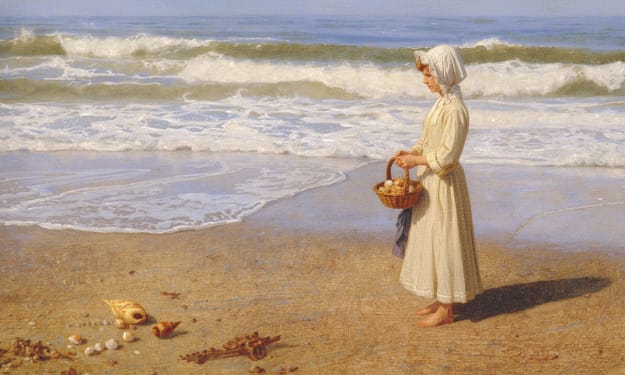
There are some phrases in the English language that seem almost timeless. They roll off the tongue in a playful way, yet they hide more depth than most people expect. “She sells seashells by the seashore” is one of those phrases. At first glance, it’s just a tongue twister, the kind you might hear in a classroom or around a campfire when someone challenges you to say it three times fast. But behind those eight little words is a fascinating mix of history, clever language, and even a story of determination that reaches back to the early 1800s. Where It All Began The exact origin of this famous tongue twister isn’t crystal clear, but many historians link it to the life of Mary Anning (1799–1847). Mary was not just any seaside vendor; she was a self-taught fossil collector and paleontologist from the town of Lyme Regis on the southern coast of England. As a child, she began scouring the cliffs and beaches for fossils — not as a hobby, but as a means to help support her family after her father’s death. It’s worth noting that Mary didn’t technically sell ordinary seashells. She sold fossilized shells and prehistoric remains — things that fascinated scientists and wealthy tourists of the time. Still, her work almost certainly inspired the popular line. In 1908, songwriters Terry Sullivan and Harry Gifford wrote a song titled “She Sells Seashells”, and it is widely believed that Mary’s remarkable life was their inspiration. Over time, that song’s chorus broke free from the sheet music and became the tongue twister we know today. Why It’s Tricky If you’ve ever tried to say “She sells seashells by the seashore” quickly, you know it’s not as easy as it looks. That’s because the phrase is packed with alliteration (repeating the same first sound in multiple words) and consonance (repeating similar consonant sounds in close proximity). The challenge here lies in switching between the “s” sound and the “sh” sound. These are produced in similar ways but require slightly different positions of the tongue and airflow. Your mouth has to adjust very quickly, and when you rush, the sounds tend to blur together. That’s why tongue twisters like this are often used by actors, singers, and public speakers to warm up their voices and sharpen their pronunciation. More Than Just a Game While most people meet this phrase as a playful challenge, it’s also a kind of miniature story about work, place, and persistence. In just eight words, you can picture a woman standing on a sunny shore, selling the treasures she’s gathered from the sea. There’s a rhythm to it, almost like the gentle lap of waves, and it’s easy to imagine the sound of shells clinking together in a basket. For Mary Anning, this wasn’t just a poetic image — it was her life. She faced storms, landslides, and the constant danger of working on unstable cliffs, yet she kept going. Her discoveries helped shape early paleontology, but because she was a woman in the early 19th century, she received little formal recognition in her lifetime. Today, though, her name is remembered alongside the tongue twister that may have been inspired by her. Educational Value Teachers often use this phrase to help students with pronunciation, especially those learning English as a second language. It’s short enough to memorize, but complex enough to require real concentration. By practicing it slowly and then speeding up, learners gain better control over their speech. It’s also a tool for developing listening skills. When students hear others attempt the phrase, they start to notice the subtle differences between “s” and “sh,” which sharpens their ear for detail. In a way, this little line is like a gym workout for the tongue and brain. A Symbol of Resourcefulness Beyond the classroom, “She sells seashells by the seashore” can be read as a tiny lesson in business and self-reliance. The “she” in the sentence is independent. She gathers her own products (seashells), chooses her marketplace (the seashore), and makes a living through her own effort. That’s entrepreneurship in its simplest form. It’s no wonder this phrase has sometimes been used in marketing or motivational contexts. It reminds us that success can come from starting with what’s right in front of us — even something as simple as shells washed up by the tide. Why It Stays With Us Many tongue twisters fade into obscurity, but this one has stayed alive for over a century. There are a few reasons for that: It’s easy to remember — only eight words. It paints a clear picture — anyone can imagine a seashore and shells. It’s playful — people of all ages enjoy trying to say it fast. It has a real story behind it — the connection to Mary Anning gives it depth. In a world where so much of our communication is typed rather than spoken, the fact that this old-fashioned phrase still pops up in classrooms, acting studios, and even social media trends says something about its enduring charm. Conclusion “She sells seashells by the seashore” may seem like a simple children’s rhyme, but it carries history, challenge, and meaning within its short structure. It’s a playful exercise in language, a nod to a remarkable woman’s determination, and a reminder of the creativity hidden in everyday life. Whether you use it to warm up before a performance, practice your English, or simply have a laugh with friends, it connects you to over a century of voices that have stumbled, laughed, and tried again. And maybe that’s the real beauty of it — just like the woman in the phrase, we keep going, one shell at a time.
By Vocal Member about a year ago in Education
Master Your Mind: The Power of Effective Study Methods
Master Your Mind: The Power of Effective Study Methods Unlock Your Academic Potential with Proven Techniques for Focus, Retention, and Success When Maya entered her first year of university, she was excited—but also overwhelmed. High school had been manageable, but now, with lectures, reading assignments, projects, and exams all piling up, she began to question whether she was really cut out for it. After her first round of exams didn’t go well, Maya didn’t blame anyone else. “I know I’m smart,” she thought. “But maybe I’m just not studying the right way.” So, she started researching different study techniques. That’s when she discovered the Pomodoro Technique—a simple but powerful time management method developed in the 1980s. It sounded almost too easy: study for 25 minutes, take a 5-minute break, and repeat. After four cycles, take a longer break. Maya was skeptical. “Only 25 minutes? That’s not enough time to get into a flow,” she thought. But she decided to try it anyway. She set a timer, cleared her desk, turned off notifications, and opened her psychology textbook. To her surprise, the first 25 minutes flew by. And when the timer rang, she stood up, stretched, and made some tea. When she sat down again, she didn’t feel tired or distracted—she felt refreshed. By the end of two hours, she had completed more work than she usually did in twice the time. The structured bursts of focus were exactly what she needed. No more endless, unproductive cramming sessions. No more drifting off or scrolling through social media. The Pomodoro Technique helped her mind stay sharp, and the frequent breaks kept her energy steady. But Maya didn’t stop there. Encouraged by the success of this time method, she started layering on other strategies: 1. Active Recall Instead of just rereading notes, Maya began testing herself. She’d close her book and write down everything she could remember. Then, she’d check for gaps. This method, known as active recall, helped move information into her long-term memory. 2. Spaced Repetition She also started using a flashcard app that spaced out questions over days and weeks. It repeated tough questions more often and easy ones less, helping her brain strengthen connections over time. 3. Study Environment Maya made her study space inviting—bright lighting, a comfortable chair, and motivational quotes pinned on the wall. She even had a little plant on her desk to bring in some life. By keeping this area clean and tech-free, she associated it with focus and progress. 4. Goal Setting Each day, she wrote down 3 specific tasks. Not “study biology,” but “review 2 chapters and answer 10 practice questions.” Clear goals helped her stay focused and gave her a sense of accomplishment when she checked them off. --- Over time, Maya’s grades improved—but more importantly, her confidence grew. She no longer dreaded exams. She felt in control of her learning and actually enjoyed it. One day, her classmate Jordan asked, “How do you stay so on top of things? I’m drowning over here.” Maya smiled. “It’s all about the method. I don’t study more than anyone else—I just study better.” She showed him the Pomodoro timer on her phone and explained how she combined it with recall and spaced repetition. Jordan gave it a shot, and within a few weeks, he too saw a difference. Their little group grew. Soon, Maya and Jordan were meeting weekly with a few other students, sharing tips and encouraging one another. They called themselves the Mind Masters. What started as a simple experiment with a timer turned into a movement of motivated learners. --- By the end of the year, Maya was thriving. Not just academically, but mentally and emotionally too. She had developed a healthy rhythm and proven to herself that success wasn’t about cramming—it was about working smarter. Now in her final year, Maya often mentors new students. She tells them the same thing: “The secret isn’t magic. It’s method.” And whenever she says it, she thinks back to that first day she tried something new—to that one small decision that changed everything. --- The Takeaway: Study success isn’t about raw hours—it’s about strategy. Whether it’s the Pomodoro Technique, active recall, or setting clear goals, the right method can turn stress into structure and confusion into clarity. Like Maya, any student can master their mind—it just starts with a single step in the right direction.
By Muhammad Saad about a year ago in Education
Mastering the Art of Easy Essay Writing
Emma Reynolds had always dreaded essay assignments. The blinking cursor on a blank page filled her with anxiety, not inspiration. While her classmates seemed to churn out structured, compelling essays overnight, Emma felt paralyzed at the starting line, overwhelmed by introductions, body paragraphs, and conclusions that never quite clicked. That all changed in her final year of high school, thanks to a surprising encounter—and a few simple steps that transformed her writing forever. It began in the most unlikely place: detention. Emma had been caught texting in class. It wasn’t typical for her, but she’d had a rough morning. Her English teacher, Mr. Caldwell, assigned her a one-hour detention after school—and told her to bring her most recent essay draft. When she arrived at his classroom that afternoon, she found him seated at his desk, calmly sipping tea. He gestured to a chair and said, “Let’s fix that essay of yours.” Emma sighed. “It’s hopeless. I’m just not a writer.” “Nonsense,” he replied. “Writing is like cooking. You just need the right ingredients—and to stop overcomplicating the recipe.” He handed her a printed copy of her essay, marked with comments, and then a clean sheet of paper. “Let’s start from scratch. I’ll walk you through five steps. If you can follow these, I promise essay writing will feel easy.” She raised an eyebrow. “Five steps?” “Five. That’s all you need.” --- Step 1: Understand the Prompt “Most students rush to write,” Mr. Caldwell said, “without fully understanding what the question is asking.” He had Emma read the essay prompt again. It was a simple question about whether social media does more harm than good. “So,” he asked, “what’s your opinion?” Emma shrugged. “I guess it depends…” He cut her off gently. “No ‘depends’. Take a stance. Just pick a side, and we’ll build from there.” After a moment of thinking, she said, “Okay. I think it does more harm.” “Good. That’s your thesis. That’s your purpose.” --- Step 2: Plan Before You Write Next, he drew a simple chart with three columns on the board labeled: Main Idea, Evidence, and Explanation. “Think of three reasons why social media causes harm,” he instructed. Emma filled in the chart with ideas: addiction and distraction, misinformation, and mental health issues. For each point, she added a piece of evidence from her research and a quick explanation in her own words. “Now,” Mr. Caldwell said, smiling, “you have the skeleton of your essay.” --- Step 3: Write a Clear Introduction Mr. Caldwell showed her a basic formula: hook, context, thesis. “You don’t need to sound fancy,” he said. “Start with a strong statement, give a bit of background, and then say what you believe.” Emma tried: "In today’s digital world, social media is everywhere. While it connects people, it also creates major problems. This essay argues that social media does more harm than good due to its addictive nature, spread of misinformation, and negative impact on mental health." “Clear and confident,” he nodded. “Perfect.” --- Step 4: Build Strong Body Paragraphs “Each body paragraph,” he explained, “should be like a mini-essay. Start with a topic sentence, give evidence, explain it, then link back to your thesis.” Together, they wrote one paragraph based on her first point: addiction and distraction. It came together smoothly, her ideas flowing now that she had a clear structure. “Don’t overthink your words,” he said as she typed. “Clarity beats complexity every time.” --- Step 5: End with Purpose Finally, he guided her through a conclusion: restate the thesis in different words, summarize the key points, and end with a final thought. Emma wrote: "Although social media offers connection, its drawbacks outweigh its benefits. Its addictive nature, role in spreading false information, and harm to mental health show that it causes more harm than good. To protect ourselves, we must use it more mindfully—or risk being controlled by the very tools meant to connect us." She looked up. “That… didn’t feel hard.” Mr. Caldwell grinned. “That’s the idea.” --- From that day on, Emma no longer feared the blank page. She had mastered something more important than advanced vocabulary or complex structures—she had learned to write with confidence, clarity, and purpose. By graduation, not only had she improved her grades, but she also helped friends with their writing, sharing the same five steps that changed everything for her. She even started a blog titled Easy Essay Emma, where she broke down essay tips for other students who felt stuck like she once did. Because sometimes, all it takes to become a writer—is realizing it’s not about talent, but having the right tools.
By Muhammad Saad about a year ago in Education
Empowering Minds: The Transformative Power of Education
Empowering Minds: The Transformative Power of Education How Learning Shapes Brighter Futures and Builds Stronger Communities In a small village nestled between rolling hills and golden fields, lived a curious 10-year-old girl named Amina. Her eyes sparkled with questions about the world — why the stars twinkled, how birds knew where to fly, and what lay beyond the horizon. But for a long time, her questions had no place to land. Her family, like many others in the village, struggled to make ends meet, and school was a distant dream. That changed when a local non-profit partnered with government educators to open a school in the village. It wasn’t grand — just a few classrooms, wooden benches, and a chalkboard — but for Amina and dozens of other children, it was a gateway to a new world. From the moment she stepped into the classroom, Amina’s life began to change. She learned to read, write, and count. She discovered the stories of faraway lands, the mysteries of science, and the beauty of her own culture’s history. Most importantly, she discovered her own voice. Education gave Amina something she had never felt before: hope. It gave her the confidence to dream beyond her circumstances and the tools to one day make those dreams real. --- Amina’s story is just one of millions around the globe — a testament to the power of education. Beyond just reading and writing, education builds critical thinking, empathy, confidence, and a sense of belonging. It’s one of the most powerful tools we have to fight poverty, inequality, and injustice. Why is education so important? Education doesn’t only shape individuals — it strengthens families and transforms communities. When children go to school, they grow up to make better choices, access better job opportunities, and contribute positively to society. Educated individuals are more likely to support democratic values, care for their environment, and raise healthier children. According to UNESCO, each additional year of schooling can increase a person’s income by up to 10%. Girls who complete secondary education are far less likely to marry early and more likely to become leaders and entrepreneurs. In fact, when you educate a girl, you educate an entire generation. In communities where education is prioritized, there are lower crime rates, better health outcomes, and stronger economies. Simply put, education plants the seeds for long-term, sustainable growth. --- But despite the proven benefits, millions of children worldwide still lack access to quality education due to poverty, conflict, discrimination, or lack of resources. For many, the nearest school is hours away, the teachers are undertrained, or families can't afford the supplies. That’s why organizations, governments, and individuals around the world are working together to break these barriers — by building schools in rural areas, training passionate educators, providing scholarships, and advocating for policies that protect every child’s right to learn. In one rural region of South America, for example, a mobile classroom project brings education to children who live in remote mountain communities. Teachers travel by donkey or boat, carrying books and supplies to ensure no child is left behind. In cities, mentorship programs help young students from low-income families stay in school and believe in their potential. These are more than just feel-good stories — they are real-life examples of how education changes lives. --- Back in Amina’s village, years have passed. She is now a confident teenager, teaching her younger siblings how to read and write under the same tree where she once asked about the stars. Her school helped her gain a scholarship to attend secondary school in the nearby town. She dreams of becoming a doctor, not just to treat people but to teach others how to care for their health. Her journey is a reminder that the gift of education is never just for one person — it spreads. When we educate one child, we invest in a ripple effect of growth, change, and possibility. --- Conclusion: Education is more than just learning facts — it's about unlocking potential. It gives people the tools to build a better life, to understand the world, and to shape the future. Amina’s story, like many others, shows us that when we invest in education, we are building a brighter, more just world for all. It reminds us that no matter where a child is born — whether in a big city or a quiet village — every mind deserves the chance to shine. Because when we empower minds, we empower humanity.
By Muhammad Saad about a year ago in Education
Empowering Minds, Changing the World
In the quiet hills of northern Kenya, the sun was just beginning to rise over the village of Laretu. A soft, golden light filtered through the acacia trees, warming the red earth and stirring life into a place that, for generations, had been forgotten by progress. But something was changing. Twelve-year-old Amina sat under a tree, her well-worn notebook balanced on her knees. Her eyes scanned the pages with a mixture of determination and wonder. Only a few years earlier, books were foreign objects in her home—luxuries reserved for cities and for boys. But now, every morning before tending to her family’s goats, Amina read. And every night before sleep, she dreamed—not of marriage or chores, but of chemistry labs, stethoscopes, and faraway universities. What had happened in Laretu was not magic. It was education. A small, solar-powered school had been built just three years ago, through a collaboration between a global nonprofit and local leaders. At first, only a few families were willing to send their children—especially girls. But over time, change began to ripple. Amina's older brother, once resistant to her learning, watched her explain the water cycle better than any adult in the village. Her father, who had never learned to read himself, began to ask her to read letters for him. The village began to see knowledge not as a threat to tradition, but as a bridge to a better life. Across the globe, similar ripples were forming. In a refugee camp in Jordan, Syrian children who had lost their homes and families were rebuilding their identities through classrooms filled with stories, science, and hope. In the favelas of Brazil, coding programs were turning at-risk youth into software developers, some of whom would go on to launch startups tackling real-world problems in healthcare and finance. In rural Bangladesh, mobile classrooms on boats were reaching flood-prone communities, ensuring that even climate change could not interrupt a child’s right to learn. Education was proving to be the great equalizer—not instantly, and not perfectly—but undeniably. What made education so powerful was not just the transfer of knowledge, but the transformation of the self. When people learned, they began to question. They asked why things were the way they were, and whether they had to remain that way. Amina began to ask why her village lacked clean water, and what she could do to fix it. Others asked why women weren’t allowed to own land, or why corruption was accepted as normal. Education planted the seeds of critical thinking, and critical thinking sparked action. By the time Amina was sixteen, she had started a girls’ science club. By nineteen, she had received a scholarship to study environmental engineering abroad. And by twenty-five, she returned—not to escape her past, but to rebuild it. With help from university contacts and local government grants, Amina led a project to design and install a low-cost water purification system in Laretu, using solar distillation methods adapted from her studies. Illnesses dropped, children missed fewer school days, and mothers had more time for community enterprises. But perhaps the most transformative part was what she inspired. Younger girls began to follow in her footsteps. Boys, too, started to see education not as a threat to their identity, but as an expansion of it. The idea that power came through violence or wealth began to shift—now, the most respected people in the village were teachers, scientists, and community organizers. On a global scale, stories like Amina’s were multiplying. Educated populations were driving democratic reforms, innovating climate solutions, and demanding accountability from their leaders. Education wasn’t merely preparing people for jobs—it was preparing them to reshape the world. The United Nations’ reports confirmed what many already believed: no other single factor had as wide-reaching an impact on global well-being as education. It reduced poverty, improved health outcomes, promoted gender equality, and strengthened economies. In every corner of the world, empowered minds were rewriting futures. Standing on a small hill overlooking her village, Amina once said to a group of visiting students, “We used to think change had to come from outside—from governments, from donors, from heroes. But real change starts when one person learns something new, and decides not to keep it to themselves.” In a world facing crises of inequality, climate, and conflict, it was not weapons, wealth, or even technology that promised the greatest hope. It was education—humble, patient, and persistent—that lit the way forward. Empowering minds, changing the world. The transformation had already begun.
By Muhammad Saad about a year ago in Education