
SwiftUI vs UIKit: Choosing the Right Framework for iOS App Development?
What is SwiftUI? Key Features and Benefits What is UIKit? Overview and Strengths SwiftUI vs UIKit: Key Differences SwiftUI and UIKit in 2025: Which is the Future? Choosing the Right Framework for Your iOS App Development

When it comes to iOS app development, choosing the right framework is crucial for creating efficient and user-friendly apps. Two of the most popular frameworks are SwiftUI and UIKit, each with its unique strengths.
SwiftUI is a modern framework that simplifies the development process, while UIKit has been the go-to choice for many years, offering more control over app design.
In this blog, we’ll compare SwiftUI and UIKit, highlighting their key differences and helping you decide which one is the best fit for your next iOS app development project.
What is SwiftUI? Key Features and Benefits
SwiftUI is a modern framework from Apple for building user interfaces across iOS, macOS, watchOS, and tvOS. It uses a declarative syntax, meaning you describe your UI and SwiftUI automatically updates it when data changes, making development quicker and easier.
Key Features:
- Declarative Syntax: Simple and clean code that updates automatically.
- Live Previews: See real-time changes in your design.
- Cross-Platform Compatibility: Write once, run on all Apple devices.
- Automatic Dark Mode & Accessibility: Built-in support for dark mode and accessibility.
Benefits:
- Faster Development: Less code, faster results.
- Consistency: Ensures a consistent experience across platforms.
- Future-Proof: SwiftUI is the future of iOS app development.
SwiftUI is an excellent choice for modern iOS app development, providing a smooth, efficient, and future-ready framework.
What is UIKit? Overview and Strengths
UIKit is Apple’s long-standing framework for building user interfaces in iOS apps. It’s been the backbone of iOS development for many years and offers developers full control over the design and behavior of app elements. Unlike SwiftUI, UIKit uses an imperative programming style, where developers define exactly how the interface should behave.
Key Strengths of UIKit:
- Flexibility and Control: UIKit provides granular control over every aspect of your app’s user interface, from animations to complex custom views.
- Mature and Well-Documented: As a tried-and-true framework, UIKit has an extensive set of resources, documentation, and community support, making it reliable for experienced developers.
- Compatibility: UIKit is the go-to choice for apps that need to support older versions of iOS, ensuring broad device compatibility.
UIKit continues to be a powerful tool for building highly customized, feature-rich apps. It’s especially useful when you need complete control over your app’s interface or are working with legacy code.
SwiftUI vs UIKit: Key Differences
When deciding between SwiftUI and UIKit for iOS app development, it's important to understand the core differences between the two. Both frameworks are powerful but serve different purposes depending on your app’s needs. Here’s a breakdown of the key differences to help you make the right choice for your next project.
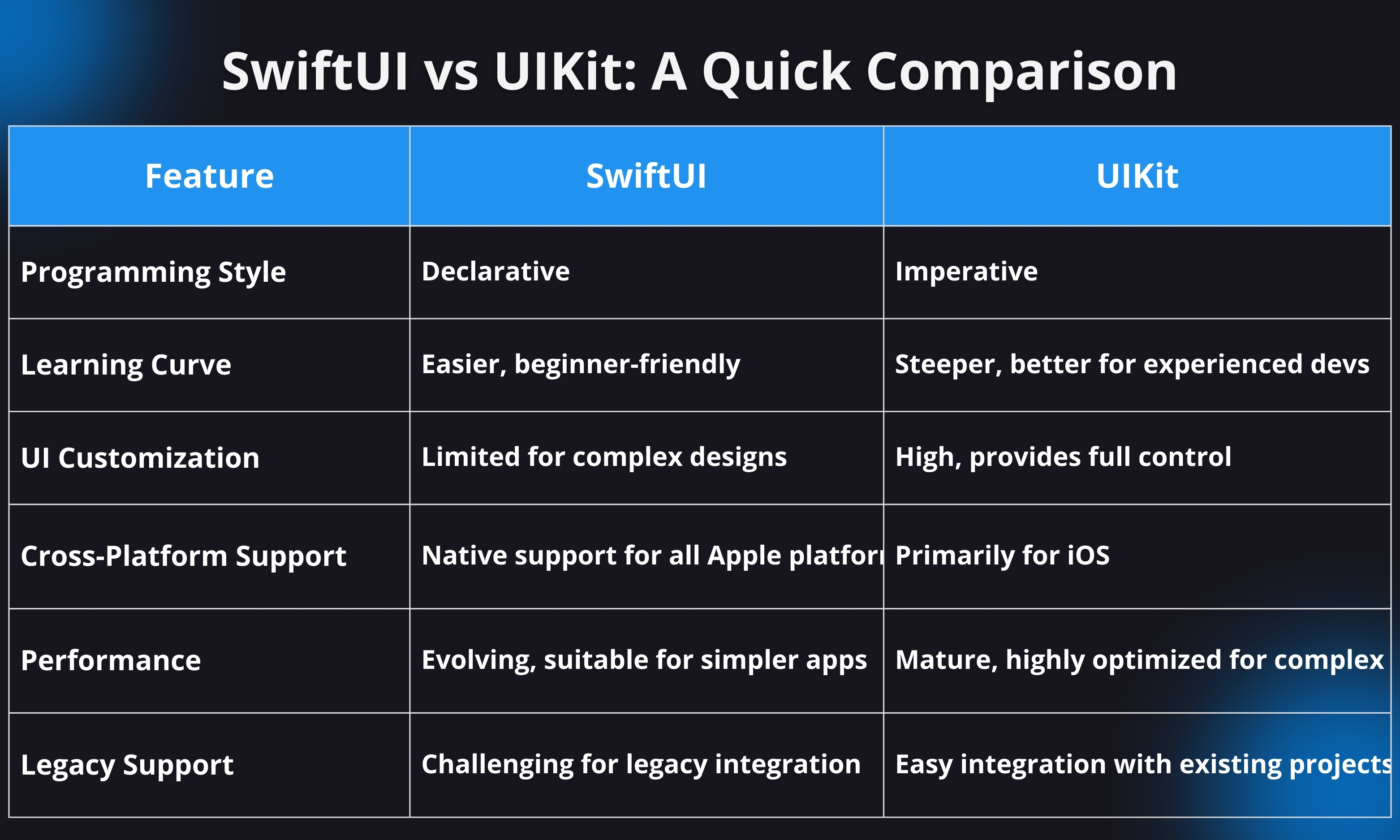
1. Development Style
SwiftUI: Uses a declarative syntax, meaning you declare what the interface should look like and it updates automatically when data changes.
UIKit: Uses an imperative programming style where you define each UI element and its behavior step-by-step.
2. Learning Curve
SwiftUI: Easier for beginners, especially for developers familiar with Swift. The declarative approach simplifies UI building.
UIKit: Steeper learning curve due to its detailed control over UI elements, making it better suited for experienced developers who need more customization.
3. UI Customization
SwiftUI: Provides built-in UI components that are flexible, but customization can be limited compared to UIKit for more complex layouts.
UIKit: Offers greater flexibility and control, allowing for deep customization of each UI component, making it ideal for complex designs.
4. Cross-Platform Support
SwiftUI: Native support for all Apple platforms (iOS, macOS, watchOS, tvOS) with a single codebase.
UIKit: Primarily focused on iOS, though it can be used on other platforms with additional setup.
5. Performance
SwiftUI: Still evolving and improving, but may not be as optimized as UIKit for very complex apps with heavy customization.
UIKit: Mature and highly optimized, making it suitable for apps with complex interactions and heavy graphical demands.
6. Integration with Existing Code
SwiftUI: Works well for new apps but may require additional effort to integrate with UIKit-based projects.
UIKit: Easier to integrate into existing projects, especially for legacy apps.
SwiftUI vs UIKit: A Quick Comparison
SwiftUI and UIKit in 2025: Which is the Future?
As we look ahead to 2025, SwiftUI and UIKit will continue to shape the future of iOS app development. Here’s a closer look at how both frameworks are evolving and which one is best suited for different types of projects.
SwiftUI’s Rise:
SwiftUI is Apple’s newer framework that simplifies iOS development with a declarative style.
It’s easy to learn, fast to implement, and works across all Apple platforms (iOS, macOS, watchOS, tvOS).
By 2025, SwiftUI is expected to be the go-to framework for new apps, making development smoother and faster.
UIKit’s Continued Relevance:
UIKit has been around for over a decade and is known for giving developers fine control over UI elements.
It’s still the best choice for complex apps that require heavy customization and intricate design.
UIKit will continue to be essential for maintaining and updating older apps or those with specific performance needs.
The Hybrid Approach:
In 2025, developers will likely use both frameworks together. SwiftUI will handle simple, modern interfaces, while UIKit can be used for complex, customized elements.
This balance allows developers to leverage the strengths of both frameworks for a more flexible, efficient development process.
In short, SwiftUI is the future for new apps, while UIKit remains vital for complex or legacy projects. Both frameworks will coexist and complement each other in the iOS development world.
Choosing the Right Framework for Your iOS App Development

Choosing the right framework for your iOS app development is crucial to your app’s success. SwiftUI offers speed and simplicity, perfect for modern apps, while UIKit gives you more control for complex designs. The right choice can fast-track your development and ensure top-notch performance. Ready to build an app that stands out? Partner with VT Netzwelt, an expert iOS app development company in the USA, and let’s make it happen!
About the Creator
VT Netzwelt
VT Netzwelt is a leading software development company in India, the US, and Germany that has completed over 700 projects. 🏆 We delivered high-quality web and mobile software on time, ensuring 100% customer satisfaction.
Enjoyed the story? Support the Creator.
Subscribe for free to receive all their stories in your feed.
Comments
There are no comments for this story
Be the first to respond and start the conversation.