
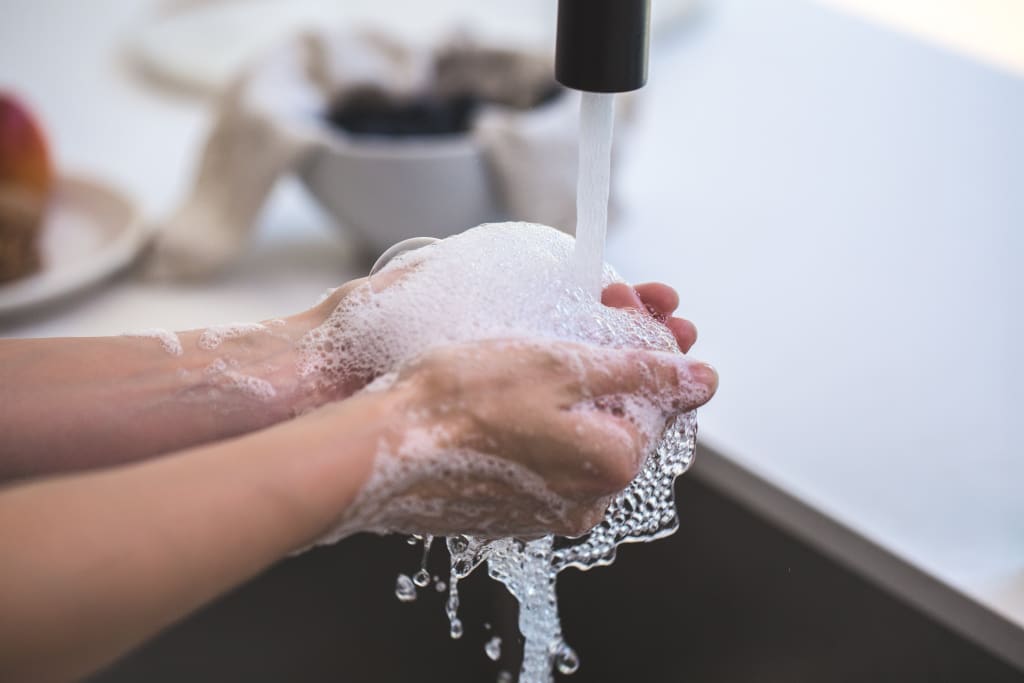
Your hands, up close, are anything but smooth. With peaks and valleys, folds and rifts, there are plenty of hiding places for a virus to stick. If you then touch your face, the virus can infect you. There are two extraordinarily simple ways you can keep that from happening: soap and water, and hand sanitizer. So which is better?
The coronavirus that causes COVID-19 is one of many viruses whose protective outer surface is made of a lipid bilayer. These lipids are pin-shaped molecules whose heads are attracted to water, and tails are repulsed by it. So in water-rich environments, lipids naturally form a shell with the heads outside and the tails inside. This shared reaction, called the hydrophobic effect, makes the lipids stick loosely together. This outer structure helps the molecular machinery of the virus break through cellular membranes and hijack our cells.
Still, it does have weak points where the right molecules could pry it apart. And this is where the soap comes in. A single drop of any brand of soap contains quadrillions of molecules called amphiphiles, which resemble biological lipids. Their tails, which are similarly repulsed by water, compete for space with the lipids that make up the virus’s shell. They’re just different enough to break up the regularity of the virus’s membrane, making the whole thing come crashing down. Those amphiphiles then form bubbles of their own around particles including the virus’s RNA and proteins. Apply water, and you’ll wash that whole bubble away.
Hand sanitizers, on the other hand, work less like a crowbar and more like an earthquake. When you surround a coronavirus with water, the hydrophobic effect gives the bonds within the membrane their strength. That same effect also holds the big proteins that form coronavirus’s spikes in place and in the shape that enables them to infect your cells. If you dry the virus out in the air, it keeps its stability. Now surround it with a high concentration of an alcohol, like ethanol or isopropanol (found in most hand-sanitizers). This makes the hydrophobic effect disappear, and gives the molecules room to move around. The overall effect is like removing all of the nails and mortar from a house and then hitting it with an earthquake. The cell’s membrane collapses and those spike proteins crumble.
In either method, the actual process of destroying the virus happens in just a second or two. But doctors recommend at least 20 seconds of hand-washing because of the intricate landscape that is your hand. Soap and sanitizer need to get everywhere, including your palms, fingertips, the outsides of your hands, and between your fingers, to protect you properly. And when it comes to a coronavirus outbreak, doctors recommend washing your hands with soap and water whenever possible.
Even though both approaches are similarly effective at killing the virus, soap and water has two additional benefits: first it washes away any dirt which could otherwise hide virus particles, but more importantly, it’s simply easier to fully cover your hands with soap and water for 20 seconds. Of course, hand sanitizer is more convenient to use on the go. In the absence of a sink, use the sanitizer as thoroughly as possible and rub your hands together until they’re dry.
So wherever possible, soap and water are recommended for a coronavirus, but does that mean it's best for every viral outbreak? Not necessarily. Many common colds are caused by rhinoviruses that have a geometric protein structure called a capsid instead of a lipid membrane. The capsid doesn't have nearly as many weak points where soap amphiphiles can pry it apart, so it takes longer for soap to be effective. However some of its surface proteins are still vulnerable to the destabilizing effect of hand sanitizer. In this and similar cases, hand sanitizer may be more effective, especially if you then wash your hands to remove residual particles. The best way to know which to use for any given outbreak is to do what's best for all things illness-related: follow the advice of accredited medical professionals.
About the Creator
Enjoyed the story? Support the Creator.
Subscribe for free to receive all their stories in your feed.
Comments
There are no comments for this story
Be the first to respond and start the conversation.