
Smart Home, Vulnerable Home: How Your Habits Could Be Inviting Cyber Intruders - By: Maha Ghunaim
In an era where convenience meets connectivity, smart homes promise effortless living—but at what cost? Groundbreaking research by Maha Ghunaim

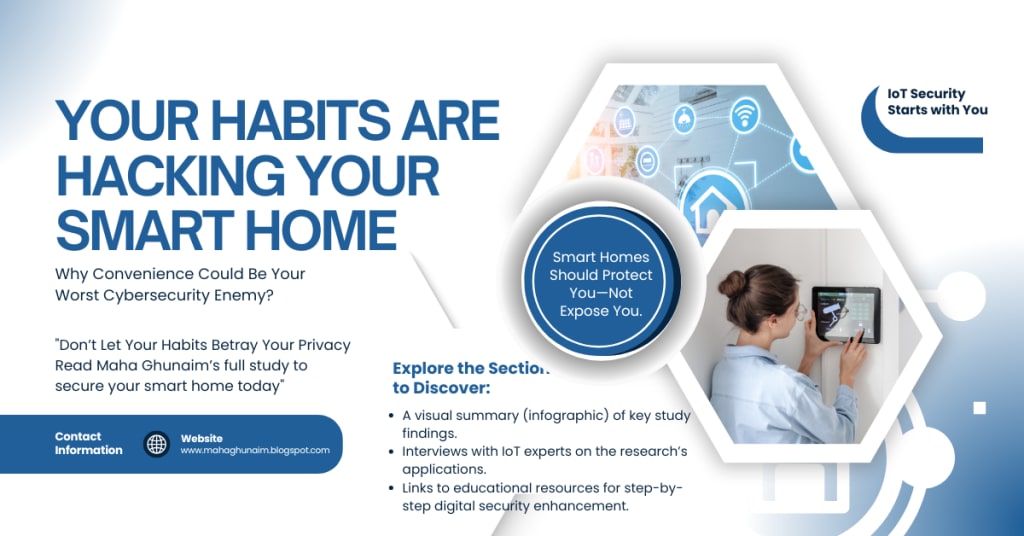
Why Convenience Could Be Your Worst Cybersecurity Enemy?
Imagine this: You’re sipping coffee in your living room, adjusting your smart thermostat, asking Alexa to play your favorite playlist, and double-checking your doorbell camera—all from your phone. Convenient, right? But lurking beneath this seamless tech utopia is a silent threat: your own behavior.
A groundbreaking study by Maha Ghunaim, “Investigating the Impact of User Behavior in the Security of Smart Home IoT Devices,” reveals a startling truth: the weakest link in smart home security isn’t the devices—it’s us. Let’s dive into why your daily habits might be leaving your digital front door wide open.
The Invisible Elephant in the Room: You
Smart homes promise convenience, but human oversight often undermines their security. Ghunaim’s research highlights how seemingly harmless actions—or inactions—create loopholes for hackers:
- “Set it and forget it” syndrome: Failing to update firmware or change default passwords.
- Password laziness: Using “admin123” or recycling the same password across devices.
- Over-sharing on apps: Granting unnecessary permissions to IoT apps (like letting your smart fridge access your contacts).
- Ignoring encryption: Connecting devices to unsecured Wi-Fi networks in public spaces.
Hackers’ Playground: Real-World Consequences
The study uncovers chilling examples of how lax habits lead to breaches:
- A hacked baby monitor broadcasting private moments online.
- Smart locks disengaged remotely due to weak authentication.
- Botnets hijacking thousands of IoT devices to launch large-scale DDoS attacks.
These aren’t hypotheticals—they’re the cost of complacency.
Breaking the Cycle: From Risk to Resilience
Ghunaim’s work isn’t just a wake-up call—it’s a roadmap to safer smart homes. Here’s how to flip the script:
- Embrace “Security First” Rituals:
- Change default credentials immediately.
- Enable multi-factor authentication (MFA) for all devices.
- Update Like Your Privacy Depends On It (Because It Does):
- Automate firmware updates.
- Ditch unsupported devices that no longer receive patches.
- Segment Your Network:
- Isolate IoT devices on a separate Wi-Fi network to limit breach fallout.
- Audit App Permissions:
- Ask: Does my smart lamp really need access to my location?
The Future of Smart Living: A Shared Responsibility
While manufacturers must prioritize built-in security (encryption, regular updates), Ghunaim stresses that users hold equal power. Imagine a world where “smart” doesn’t just mean connected—it means secure by default.
As AI and IoT merge further, the stakes will only rise. Will we evolve from being the problem to becoming the firewall?!
Final Thought
Your smart home is only as strong as your least secure habit. Let’s stop treating cybersecurity as an afterthought and start making it as routine as charging our phones. After all, a hacked thermostat isn’t just about temperature—it’s about trust.
"Don’t Let Your Habits Betray Your Privacy Read Maha Ghunaim’s full study to secure your smart home today"
Inspired by Maha Ghunaim’s research, this article reimagines the conversation around IoT security. Dive deeper into her findings here: Link to Study.
Smart Homes Should Protect You—Not Expose You.
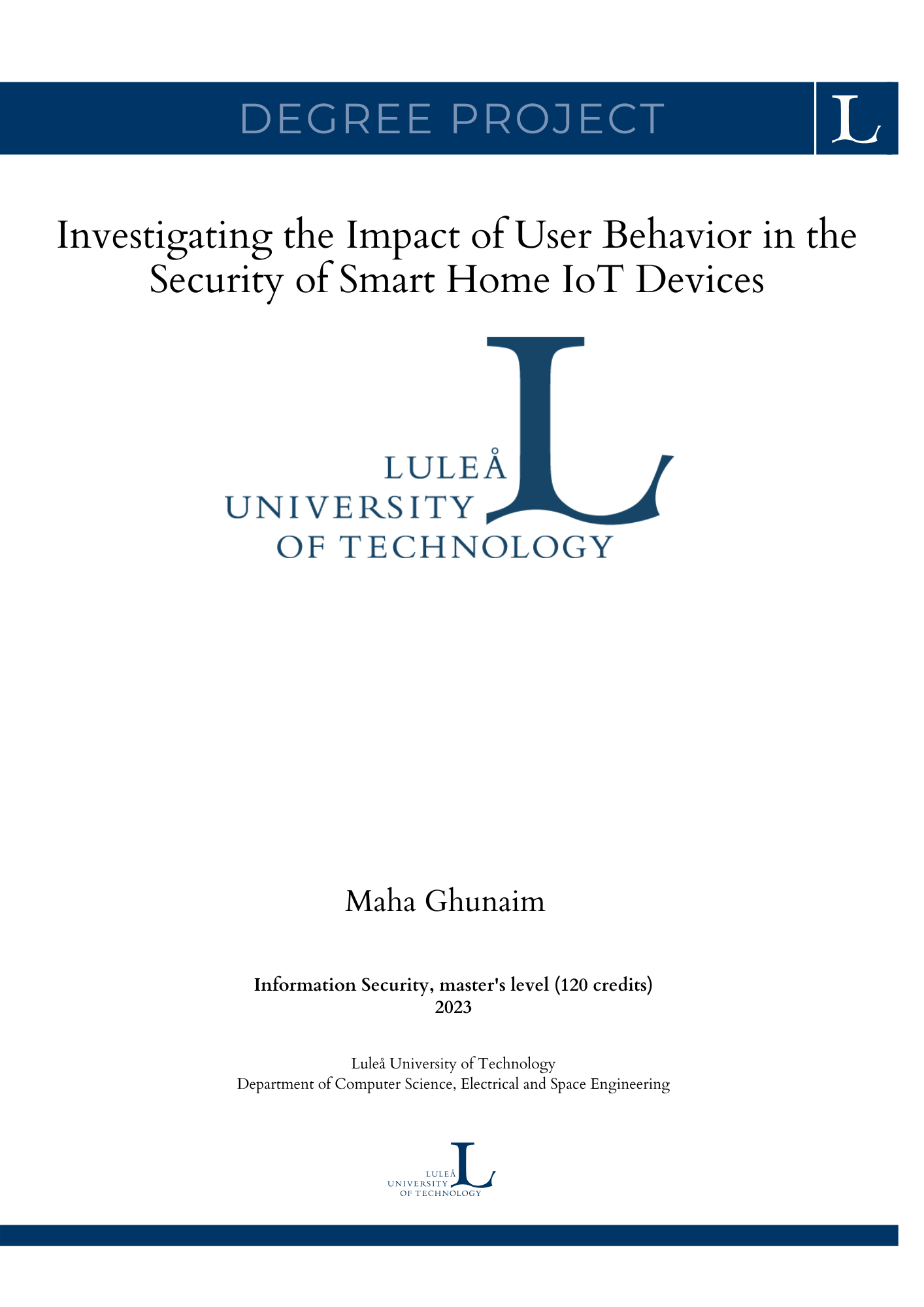
Investigating the Impact of User Behavior in the Security of Smart Home IoT Devices
Luleå University of Technology Department of Computer Science, Electrical and Space Engineering
As technology is growing at a fast pace, IoT-based smart home services are increasingly adopted by people. IoT-based smart homes offer numerous unimaginable benefits, including efficiency, safety, effectiveness, scalability of services, devices, and data, among many others. However, there is another side to this technology: security threats.
As IoT-based technology is distributed in nature, implementing security measures and policies to protect the infrastructure becomes very difficult. The infrastructure faces threats such as information theft, eavesdropping, distortion, and more.
Ensuring the security of smart home IoT devices is a critical concern, and user behavior plays a major role in achieving it. Furthermore, Theory of Planned Behavior (TPB) was utilized throughout the study.
This study employed a qualitative research methodology and content analysis technique to investigate the impact of user behavior on the security of smart home IoT devices. The findings revealed several themes, such as the significance of comprehending and resolving security issues, the implementation of security measures, and the impact of user education and awareness. The study offered fresh perspectives on IoT device security and will aid in developing security best practices.
N.B.
This section ( IoT Security Starts with You ) embodies Maha Ghunaim’s commitment to bridging the gap between scientific research and practical application, empowering individuals to adopt smart technology with confidence and security.
Section Description:
In a world where technology is advancing at breakneck speed, researcher Maha Ghunaim offers a profound insight into the relationship between humans and technology through her master’s thesis: "Investigating the Impact of User Behavior on the Security of Smart Home IoT Devices."
What You’ll Find in This Section:
The Dark Side of Technological Convenience: While smart devices grant us unparalleled control over home management, the study warns of hidden security vulnerabilities stemming from daily habits—like neglecting system updates or using weak passwords.
Theory of Planned Behavior (TPB): How does this theory explain users’ decisions regarding cybersecurity? Discover the unique link between social sciences and security engineering.
Qualitative Analysis of User Awareness: Surprising results reveal the role of security education in reducing breaches and the importance of proactive measures like network segmentation and data encryption.
Proposed Security Practices: Practical recommendations to transform smart homes from "easy targets" into digital fortresses, based on the study’s field data.
Why This Thesis Matters:
The findings aren’t limited to academics or cybersecurity experts—they’re a guide for every smart homeowner striving to protect their privacy. Here, you’ll learn:
- How simple habits (like regular updates) make a radical difference in device security.
- Why security awareness is an integral part of the future user experience.
- How companies and users can collaborate to build secure smart ecosystems—from design to daily use.
Explore the Section to Discover:
- A visual summary (infographic) of key study findings.
- Interviews with IoT experts on the research’s applications.
- Links to educational resources for step-by-step digital security enhancement.
“Security isn’t just technology—it’s a mindset we live daily.”— Maha Ghunaim
About the Creator
Maha Ghunaim - مها غنيم
Unlock the Power of Resilience & Reinvention: Dive into Maha Ghunaim’s Extraordinary Journey
Enjoyed the story? Support the Creator.
Subscribe for free to receive all their stories in your feed.
Comments
There are no comments for this story
Be the first to respond and start the conversation.