
Shakespeare's "Missing" London House: A 400-Year Mystery Solved
The layout that unravelled a 400-year mystery

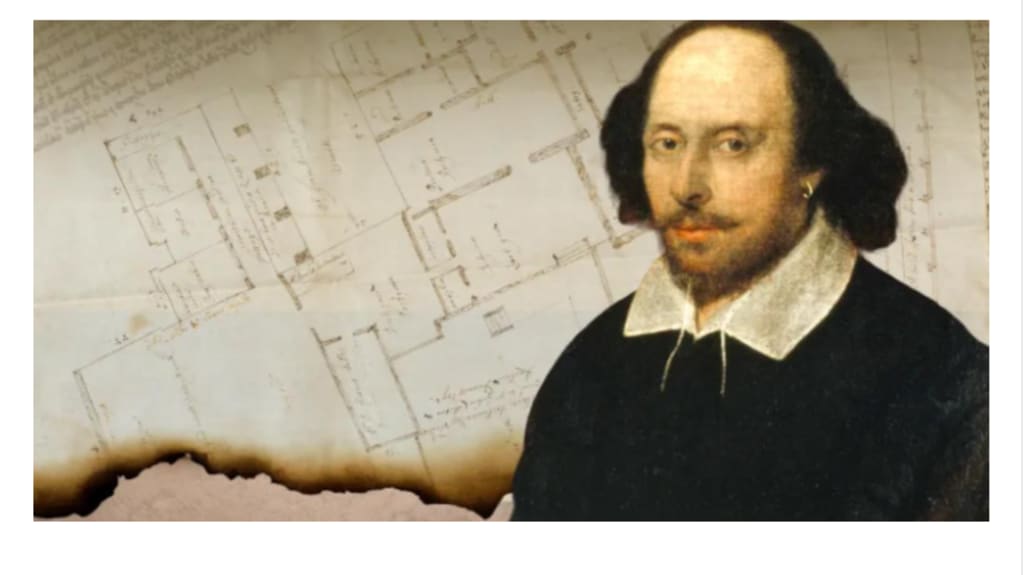
One of the most intriguing unresolved mysteries in literary history for centuries has been the precise location of William Shakespeare's only known London house.
A King's College London researcher has now identified the exact site of the property the Bard bought in the Blackfriars neighbourhood in 1613, potentially changing the story of his last years. In addition to confirming the precise address, the discovery—which was made possible by a hitherto unidentified 17th-century floorplan—also provides the first insight into the size and layout of the property.
Professor Lucy Munro, who teaches Shakespeare and Early Modern Literature at King's College London, uncovered the find while looking through the archives for a larger project. Shakespeare's ownership of property in the Blackfriars precinct, which formerly housed a significant Dominican friary in the thirteenth century, has long been recognised. But its precise location has remained obstinately unclear.
Shakespeare "purchased lodgings in the Blackfriars Gatehouse located near this site," according to a 2013 dark-blue City of London plaque at 5 St Andrew's Hill. The term "near this site" itself is a witness to four centuries of historical ambiguity.
All of it has been altered by Professor Munro's research. She has been able to precisely map the property thanks to the discovery of three missed documents: two from The London Archives and one from The National Archives. Shakespeare's home's exact position and dimensions are confirmed by a comprehensive design of a portion of the Blackfriars precinct that was created in 1668, not long after the Great Fire of London.
The layout that unravelled a 400-year mystery
Shakespeare's home was located across from the eastern end of Ireland Yard, the foot of Burgon Street, and portions of the late nineteenth-century structures at 5 Burgon Street and 5 St Andrew's Hill, according to the 1668 plan that is kept at The London Archives (reference CLC/522/MS14570/001).
This indicates that the blue plaque that is currently in place is indeed on the exact location of Shakespeare's London home, not just "near" it. The remaining portion of the land extended roughly 45 feet from east to west and between 13 and 15 feet from north to south.
However, the portion that crossed the old friary's "Great Gate" is not shown on the post-fire map, probably because it lacked foundations. Because of its size, the structure was split into two distinct homes by 1645. Other converted friary buildings and probably a nearby bar known as the Sign of the Cock—a pub called The Cockpit still stands on the site today—were among its environs.
Professor Munro said in a news statement from King's College London, "This discovery throws into question the narrative that Shakespeare simply retired to Stratford and spent no more time in the city." "It has sometimes been thought that he bought his Blackfriars property merely as an investment, but we don't know that this is true, or that he never used it for himself."
Changing the Story of Shakespeare's Last Years
According to conventional wisdom, Shakespeare returned to his family home in Stratford-upon-Avon to live as a gentleman shortly after acquiring the Blackfriars residence in 1613. He may have spent a lot more time in London in his later years than previously thought, though, based on the size and location of the recently mapped home.
The Blackfriars theatre, where he worked, was conveniently near to the residence. Shakespeare continued to work in London following the acquisition, according to historical documents. He co-wrote the play Two Noble Kinsmen with John Fletcher later in 1613, and it is also noted that he visited London in November 1614.
"After all, he could have bought an investment property anywhere in London, but this house was close to his workplace at the Blackfriars theatre," Professor Munro said. "This new evidence that the Blackfriars house was quite substantial makes it not inconceivable that some of it may have been written in this very property." Shakespeare's Globe Director of Education Dr. Will Tosh enthusiastically applauded the finding, saying:
"Professor Munro's amazing discovery demonstrates that human graft cannot be replaced in the archive, and we are rewarded for her diligence with a brilliant new understanding of Shakespeare the London writer. She has made it easier for us to comprehend how important the city was to our greatest dramatist, both personally and professionally.
The Destiny of the Property: From Shakespeare to the Great Fire
Professor Munro's extra materials provide a detailed account of the property's subsequent history. Shakespeare's family kept it until 1665, when Elizabeth Hall Nash Barnard, his granddaughter and the daughter of Susanna, his oldest daughter, sold it. For the first time, the details of how and when the property left the family's possession, as well as the price at which it was sold, are revealed in the paperwork.
Sadly, the mansion and many other structures across the city perished in the Great Fire of London in 1666, which occurred barely a year after the sale. A printing enterprise, printing ink producers, carpet merchants and eventually residential buildings have all occupied the site during the past century.
"I was doing research as part of a wider project and couldn't believe what I was looking at — the floorplan of Shakespeare's Blackfriars house," Professor Munro said, clearly excited by the moment of discovery. Research on it has been idle for a long time because it was thought that there wasn't much more proof to acquire."
On April 17, 2026, the Times Literary Supplement published the complete details of Professor Munro's research. The discovery opens a fascinating new chapter in our knowledge of Shakespeare's life in London and presents the intriguing prospect that some of the best pieces in the canon of English literature may have been penned in a home on a peaceful Blackfriars street. After more than 400 years, it has finally been recognised.
About the Creator
Enjoyed the story? Support the Creator.
Subscribe for free to receive all their stories in your feed.
Comments
There are no comments for this story
Be the first to respond and start the conversation.