
Section Formula | Definition, Formulas, Proof, Examples
Learn the section formula with simple explanations, formulas for internal and external division, step-by-step proof, and solved examples for better understanding.

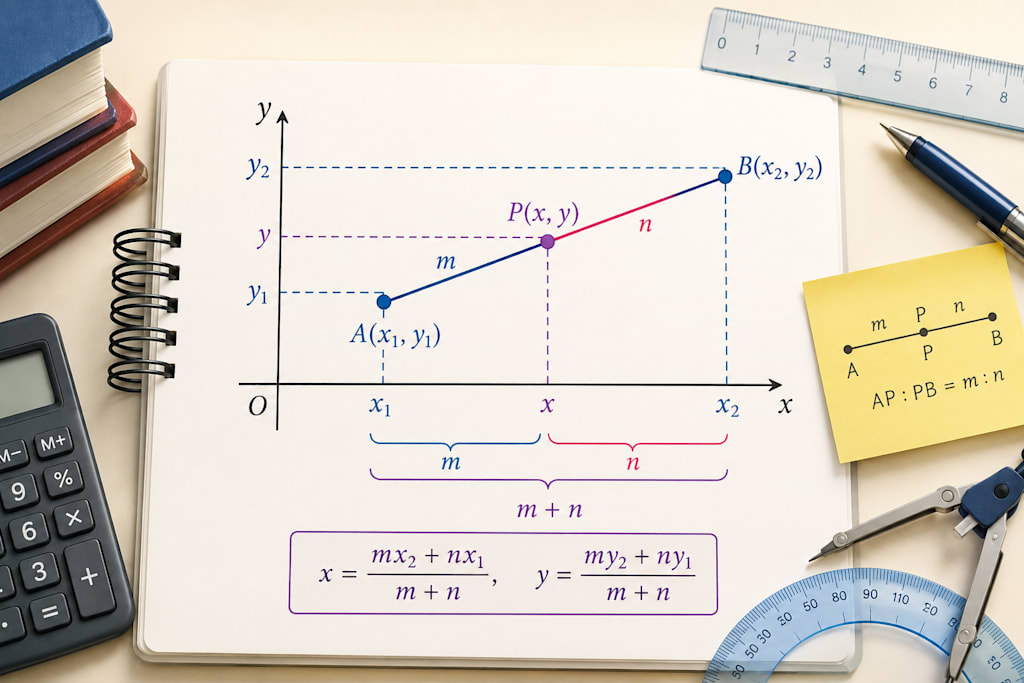
In coordinate geometry, one of the most useful tools for locating points between two known positions is the section formula. Whether you are dividing a line into equal parts or finding a point that lies in a specific ratio, this formula gives you a precise and reliable answer.
Instead of guessing or measuring visually, the section formula allows you to calculate exact coordinates using simple algebra. This makes it especially valuable in graphing, geometry problems, and real-world applications like mapping and design.
In this article, you will understand the section formula from the ground up, including its definition, formulas for internal and external division, detailed proof, and practical examples.
What Is the Section Formula?
The section formula is used to find the coordinates of a point that divides a line segment joining two given points in a specific ratio.
Suppose you have two points on a coordinate plane:
- Point A with coordinates (x₁, y₁)
- Point B with coordinates (x₂, y₂)
Now, if a point P divides the line segment AB in a ratio m:n, the section formula helps you find the exact coordinates of point P.
In simple words, it tells you:
"Where exactly is the point located between or outside two given points?"
Types of Section Formula
The section formula is divided into two main types based on how the point divides the line:
1. Internal Division
When the point lies between A and B, it is called internal division.
2. External Division
When the point lies outside the line segment AB, it is called external division.
Understanding the difference between these two is important because the formulas are slightly different.
Section Formula for Internal Division
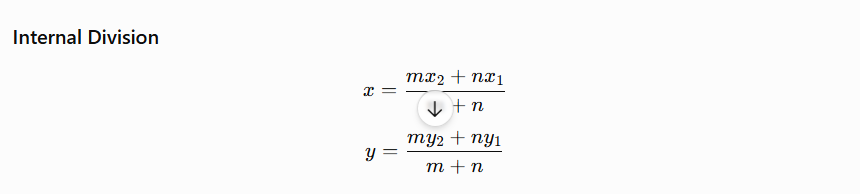
If point P divides the line segment AB internally in the ratio m:n, then the coordinates of P are:
How to Understand This
The formula is essentially a weighted average of the coordinates of A and B. The weights depend on the ratio in which the point divides the line.
The larger the value of m, the closer the point is to B. Similarly, a larger value of n brings the point closer to A.
Section Formula for External Division
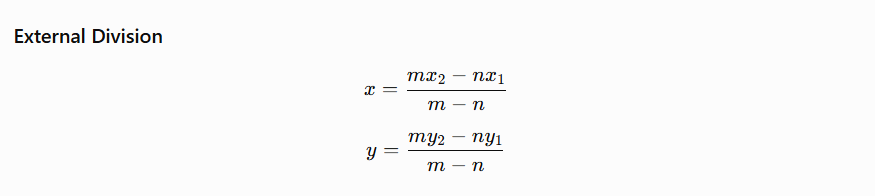
If point P divides the line segment externally in the ratio m:n, then the coordinates of P are:
Key Idea
In external division, subtraction is used instead of addition because the point lies outside the segment, not between the endpoints.
Proof of Section Formula (Internal Division)
Let us derive the internal division formula step by step.
Suppose:
- A(x₁, y₁)
- B(x₂, y₂)
- P(x, y) divides AB in the ratio m:n
This means:
AP / PB = m / n
Step 1: Use Distance Concept
From ratio definition:
AP / PB = m / n
Using coordinate differences along the x-axis:
(x − x₁) / (x₂ − x) = m / n
Step 2: Cross Multiply
n(x − x₁) = m(x₂ − x)
Expand both sides:
nx − nx₁ = mx₂ − mx
Bring like terms together:
nx + mx = mx₂ + nx₁
Factor x:
x(m + n) = m x₂ + n x₁
So,
x = (m x₂ + n x₁) / (m + n)
Step 3: Repeat for y-coordinate
Following the same process:
y = (m y₂ + n y₁) / (m + n)
Thus, we get the internal division section formula.
Examples of Section Formula
In this section, we'll cover various examples to understand the concepts better:
Example 1: Internal Division
Find the point that divides the line joining A(2, 4) and B(8, 10) in the ratio 1:2.
Using the formula:
x = (1×8 + 2×2) / (1+2) = (8 + 4)/3 = 12/3 = 4
y = (1×10 + 2×4) / (1+2) = (10 + 8)/3 = 18/3 = 6
So, the point is (4, 6).
Example 2: External Division
Find the point that divides A(3, 6) and B(9, 12) externally in the ratio 2:1.
Using the formula:
x = (2×9 − 1×3) / (2−1) = (18 − 3)/1 = 15
y = (2×12 − 1×6) / (2−1) = (24 − 6)/1 = 18
So, the point is (15, 18).
Example 3: Midpoint as a Special Case
When m = n, the section formula becomes the midpoint formula.
x = (x₁ + x₂) / 2
y = (y₁ + y₂) / 2
This shows that the midpoint is just a special case of the section formula.
Applications of Section Formula
The section formula is not just limited to textbook problems. It has practical uses in different areas:
- Dividing a line segment into equal or unequal parts
- Finding midpoints in geometry
- Graph plotting and coordinate analysis
- Computer graphics and animation
- Physics problems involving position and motion
It provides accuracy and eliminates the need for approximation.
Common Mistakes to Avoid
Many students make small mistakes while using the section formula. Here are a few things to watch out for:
- Mixing up m and n in the formula
- Using addition instead of subtraction in external division
- Forgetting to apply the formula separately to x and y coordinates
- Not simplifying the final answer
Being careful with these details can help you avoid errors.
Final Thoughts
The section formula is one of the most powerful tools in coordinate geometry. Once you understand how it works, you can easily locate points on a line with precision.
Instead of memorizing blindly, focus on the idea behind it. It is simply a way of balancing positions using ratios. When you see it this way, the formula becomes much easier to remember and apply.
With regular practice, you will be able to solve even complex problems confidently and accurately.
About the Creator
Saif
Exploring different parts of life.
Enjoyed the story? Support the Creator.
Subscribe for free to receive all their stories in your feed.
Comments
There are no comments for this story
Be the first to respond and start the conversation.