
Remote Tech Job Market Didn’t Die. It Moved.
The Remote Revolution Didn’t End
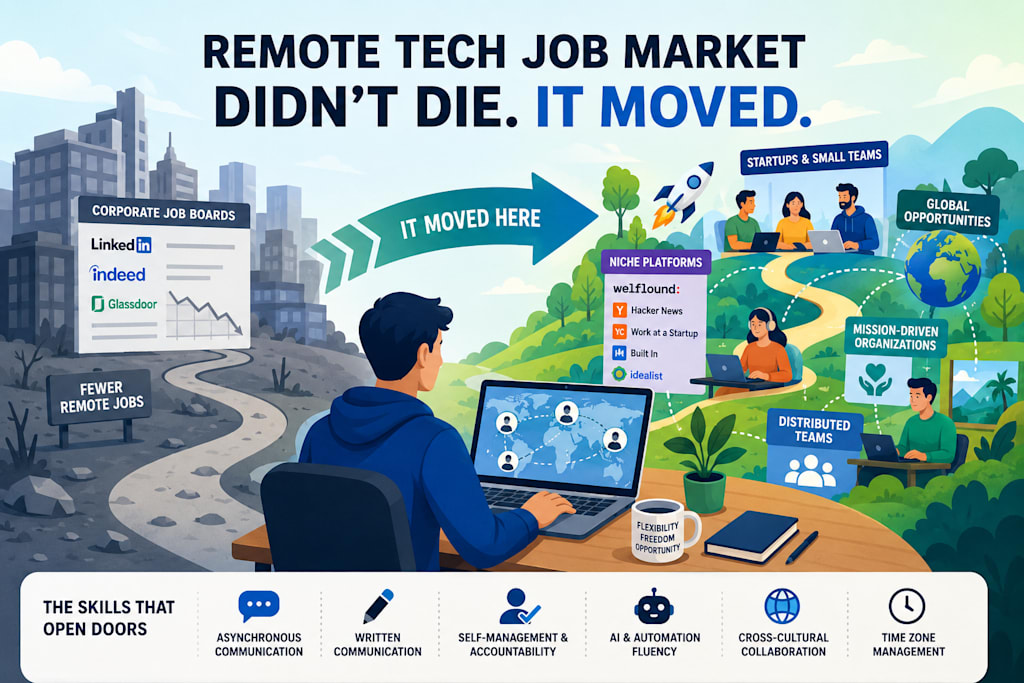
Remote tech work looked unstoppable just a few years ago. Developers were working from beach towns, designers were traveling full time, and companies bragged about ‘work from anywhere’ policies as a major perk. The future of work, it seemed, had finally arrived.
Things started to change then. The large tech companies began calling people back to offices. Hybrid schedules got tighter. Some companies quietly eliminated the fully remote option. And then something alarming started happening to people looking for remote tech jobs: the listings on big job boards were drying up. For many workers, remote work seemed to be a thing of the past.
But that’s not what happened. There are still remote tech jobs out there. They just moved to other parts of the internet and to other types of companies. The people who still say remote work is booming are generally looking in places where most applicants aren’t. That change is transforming the entire remote job landscape in 2026.
Why Are Remote Listings Harder to Find
Part of the confusion is where people look for jobs. For years, job seekers have turned to platforms like LinkedIn, Indeed, and traditional corporate career pages. During the remote work boom, those platforms were inundated with all-remote gigs. But today many big companies are cutting back on those opportunities.
As companies tighten return-to-office policies, many large employers are requiring workers to return to the office at least part-time. Some businesses are now mandating that workers be in the office three or four days a week. Some have abandoned remote hiring except for a few specialized roles. That shift has meant there are fewer remote jobs available on the big job boards.
If you’re on LinkedIn every day, you might legitimately think remote work is dying because there are fewer postings than there have been. “In fact, the market hasn’t disappeared, it’s become fragmented.
The hottest remote hiring is now happening in smaller communities, startup ecosystems, mission-driven organizations and niche platforms many have never explored.
Startups and Smaller Teams Are Shifting to Remote
The biggest change in the remote job market is the kind of company that’s hiring. Big companies have expensive office leases, rigid management structures and pressure from executives who want people to work together in person. Many are requiring staff to return to physical offices.
Startups, however, work differently. Because small companies care more about finding talented people than where those people are located, small companies tend to be more flexible. Distributed teams make financial sense, many startups can't afford offices in expensive cities anyway.
As a startup founder, hiring remotely means you have access to developers, designers, marketers, and engineers from all over the world. They are not trying to recruit local talent in San Francisco or New York, they can build teams in many countries and time zones. That flexibility has kept remote hiring alive in the startup world even as bigger employers retreat.
The best remote opportunities are in different locations
The best remote jobs today are more and more posted outside of the traditional job boards. Websites like Wellfound, the “Who’s Hiring” threads on Hacker News, Y Combinator’s Work at a Startup board, Built In, and Idealist have become key hubs for remote hiring.
These platforms will bring another type of employer. Many listings are from startups, nonprofit organizations, AI companies, software studios, and mission-driven businesses that still have a strong belief in distributed work, as opposed to giant corporations with thousands of employees.
For many of these organizations, remote work is not a temporary policy but a competitive advantage. Some companies hire remotely specifically to attract super talented workers for whom flexibility is more important than the perks of office life. Others are totally international by design, and were never meant to create centralized offices. The result is a quieter, yet highly active, remote hiring ecosystem.
The Shift Too Many Job Seekers Are Missing
Surprisingly, many job seekers are still doing what they did in 2021. They log onto LinkedIn, search for “remote,” and send out hundreds of applications, with thousands of other applicants. That approach is nowhere near as effective because the competition on the mainstream platforms is huge now.
At the same time, smaller, more niche hiring communities tend to be less competitive and have better opportunities. Remote job seekers today are generally doing something a little different. They’re joining startup communities, networking in niche online spaces, contributing to open-source projects or reaching out to smaller companies directly. In other words, remote hiring is becoming more about relationships.
This can be frustrating at first, but it can work to the advantage of well-qualified candidates. Smaller companies are often more interested in portfolios, practical skills, communication ability and adaptability than formal credentials alone. In a startup, you can get noticed a hell of a lot faster with good real world skills than in a huge corporate hiring system.
The Definition of a “Tech Job” Is Broadening, Too
Another reason people think remote tech jobs are disappearing is that the market is evolving. A few years ago, most people thought tech work = software engineering. But today, remote opportunities are available across a much wider range of roles.
Tech companies are hiring remotely for roles including product management, customer support, technical writing, operations, UX design, AI training, cybersecurity, marketing, recruiting and community management. And even organizations that are not traditional software companies often need tech-adjacent talent.
That is, someone who only searches for “remote software engineer” jobs may be missing out on a large portion of the modern remote job market. The opportunities are there, only they're more varied than they used to be.
Remote Work Has Gotten More Global
One of the biggest changes long-term is that remote work has gone global. Companies are not just looking to one geographic region when hiring. A European startup could have a developer in Sri Lanka, a designer in South Africa and a project manager in Canada all at once.
Global hiring is both a competition and an opportunity. Workers today compete with talent from all over the world, but they also have access to jobs that would have been impossible to reach in the past.
Remote work is no longer an escape from the office for many. It’s about harnessing a truly global economy. That’s a big change in how careers are being developed.
The remote job market is getting more intentional
The days when companies could offer remote work as a trendy perk may be ending. Companies that are committed to remote work, though, tend to be much more deliberate about it. They intentionally design systems, workflows, and cultures for distributed teams.
That tends to create healthier long-term remote environments than the rushed remote transitions that many businesses went through in years past. Strangely enough, the current shift may actually help remote work in the long term.
The companies that really appreciate remote collaboration are continuing to do it. Those who never truly bought into it are returning to office culture. Consequently, a growing number of remote workers are ending up in organizations where flexibility is part of the company identity, not an experiment.
Remote Tech Jobs Still Exist, Just Harder To Track Down
The biggest mistake people make in 2026 is thinking that fewer visible listings means fewer opportunities. Remote tech jobs are not dead. They’ve moved from massive corporate boards to startup ecosystems, niche platforms, distributed organizations and global hiring networks. The market just looks smaller because it is less centralized than it used to be.
The opportunities are still very real for those job seekers who are willing to change. It’s not just about landing a remote job anymore. The problem was where the remote world was going to next.
#RemoteWork #TechJobs #WorkFromHome #FutureOfWork #RemoteJobs #DigitalCareers #StartupJobs #OnlineWork #CareerGrowth #TechIndustry
About the Creator
Enjoyed the story? Support the Creator.
Subscribe for free to receive all their stories in your feed.
Comments