
Redundancy Consultation Meeting Survival Guide
What Questions to Ask — and What to Never Say
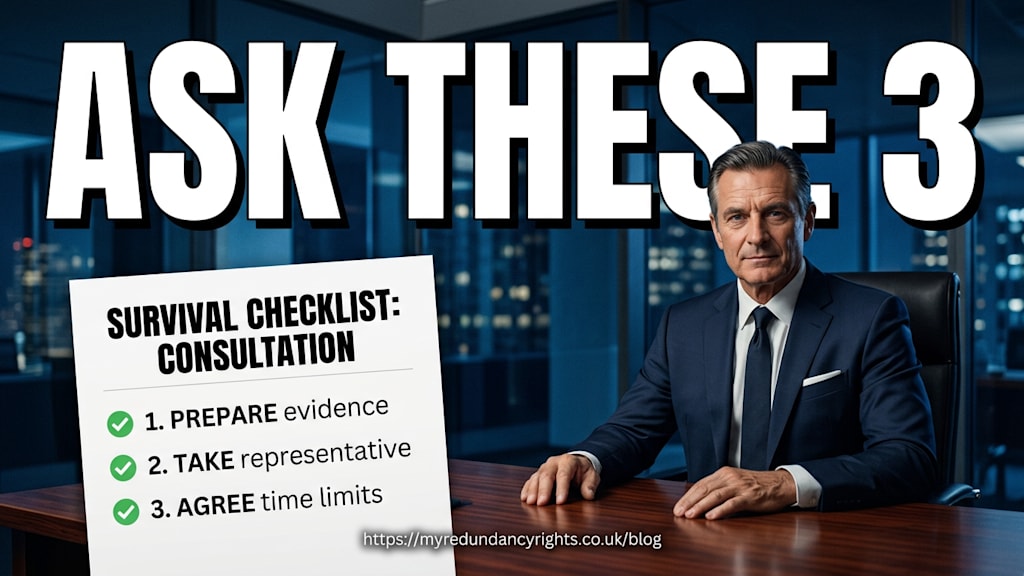
Walking into a redundancy consultation meeting unprepared is one of the most expensive mistakes an employee can make. Not because of what might happen in the room — but because of what you might say, agree to, or sign before you have had time to think. This guide gives you the exact framework to walk in prepared, protect your rights from the first minute, and leave with everything you need to secure the best possible outcome.
Shift Your Mindset Before You Walk In
The biggest mistake employees make before a consultation meeting is approaching it as a passive participant — someone things are being done to. You are not there to be told what is happening. You are there to ask questions, gather information, and protect your position.
Before the meeting:
Pull together your original contract of employment, any enhanced redundancy policy in your staff handbook, recent performance reviews, and any written communications about the restructure
Write down your questions in advance — you will not remember them in the room if you are anxious
Remind yourself: this is a process with rules. You have rights. The meeting is step one of that process, not the end of it
“I went into my first consultation meeting completely unprepared. I didn’t know I could ask for the selection criteria in writing. By the time I found out what my scores were, two weeks had passed and I’d already half-accepted the situation mentally. Don’t make that mistake.”
— Reader, logistics sector, 11 years’ service
The Questions You Must Ask
These questions are not aggressive. They are the standard, reasonable questions any employee in a consultation process is entitled to ask — and which your employer is required to answer.
On the selection process:
What criteria were used to identify roles at risk?
Can I see the scoring matrix that was applied to my position?
Who scored me, and were they aware of my full performance record?
Were any criteria applied that could be connected to a protected characteristic — such as part-time working, absence related to disability, or maternity leave?
On alternatives to redundancy:
What steps has the business taken to avoid redundancies?
Are there any suitable alternative roles currently available within the organisation?
Has redeployment into any other function, location, or working pattern been considered for my role?
On the package:
Can you confirm in writing how my statutory redundancy pay has been calculated?
Does the company operate an enhanced redundancy scheme, and does it apply to me?
What is the proposed notice period, and will it be worked or paid in lieu?
What accrued holiday will be included in my final settlement?
What are the proposed dates and timelines at each stage of this process?
On the process itself:
How many consultation meetings will there be, and what is the timetable?
Am I entitled to be accompanied to this meeting by a trade union representative or workplace colleague?
Will I receive written notes of this meeting?
What Not to Say or Do
Consultation meetings are formal processes. What you say can be used to close down your options later.
Do not accept any offer or agree to any terms in the meeting — take everything away in writing and review it independently before responding
Do not sign any document on the spot, including a settlement agreement or a variation to your contract
Do not make the discussion personal — questioning the motives of individual managers or raising comparisons with colleagues who were not selected weakens your position without strengthening it
Do not volunteer information about your financial situation, your plans, or how urgently you need the money — this hands leverage to the employer
Do not express immediate acceptance or relief — remain measured and professional regardless of the offer
After the Meeting: What to Do Within 24 Hours
The period immediately after a consultation meeting is the most important window. Act quickly.
Write down a detailed record of everything discussed — who said what, what figures were mentioned, what timelines were proposed. Date and time it. Store it somewhere safe
Request written notes of the meeting from your employer if they have not already been provided
The Consultation Process Has Rules — Use Them
Employers are legally required to carry out a genuine consultation process. That means consulting before a decision is made — not informing you of a decision that has already been taken. It means considering alternatives to redundancy. It means applying selection criteria fairly and consistently.
According to employment tribunal data, procedural failures in redundancy consultation are among the most common grounds for successful unfair dismissal claims. Most employees in consultation meetings do not know this. The ones who do are the ones who ask the right questions.
About the Creator
myredundancyrights
Free, plain-English UK employment law guidance — redundancy, unfair dismissal, gross misconduct, PIPs and more. Know your rights before it's too late.
Enjoyed the story? Support the Creator.
Subscribe for free to receive all their stories in your feed.
Comments
There are no comments for this story
Be the first to respond and start the conversation.